 UW CSE Ph.D. student Shulin (Lynn) Yang has won a “best paper” award for her paper “Skull Retrieval for Craniosynostosis Using Sparse Logistic Regression Models” (Shulin Yang, Linda Shapiro, Michael Cunningham, Matthew Speltz, Craig Birgfeld, Indriyati Atmosukarto, and Su-In Lee) at the MICCAI Workshop on Medical Content-Based Retrieval for Clinical Decision Support.
Lynn is advised by Linda Shapiro and Su-In Lee. The paper was presented (in Nice, France!) by co-author (and CSE/Shapiro Ph.D. alum) Indri Atmosukarto, who is now a research scientist at ADSC in Singapore. The other authors are doctors at Seattle Childrens.
Congratulations one and all! Read more →
 Trifacta, a San Francisco big data company co-founded by incoming University of Washington computer science professor Jeffrey Heer and University of California-Berkeley computer scientist Joe Hellerstein, emerged from stealth mode today with $4.3 million in funding from Accel Partners.
Read more here. Read more →
 Sift Science, a Bay Area startup involving UW CSE alums Brandon Ballinger, Jason Tan, and Grace Kim, is featured in GigaOm:
“The problem of online fraud, fake reviews and sock puppetry is only going to get worse, according to recent research. But there are ways to identify likely perpetrators and that’s what Sift Science aims to do.
“The 8-person San Francisco startup uses machine learning to analyze user interaction with web sites and create a digital profile of who will likely perpetrate online fraud, said company co-founder Brandon Ballinger, an ex-Google software engineer.”
Read more here. Read more →
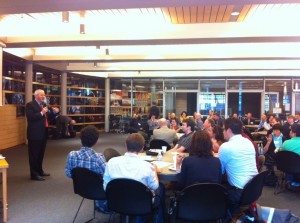
Seattle Mayor Mike McGinn recognizes Evergreen Apps Challenge winners
Announced in May, the Evergreen Apps Challenge encouraged geeks around Washington State to build apps that could benefit those living here by using government data from data.seattle.gov, data.wa.gov, and datakc.org.
This week, Seattle Mayor Mike McGinn, King County Executive Dow Constantine, and Washington Governor Chris Gregoire recognized the winners.
Taking the first-place was Living Voters Guide, a non-partisan resource developed by UW CSE students and faculty with a host of collaborators – that fosters civil discussion and provides descriptions of current ballot measures.
Read about it here and here. Check out Living Voters Guide here. Read more →
 The National Science Foundation (NSF), with support from the National Institutes of Health (NIH), today announced 8 awards totaling nearly $15 million in new Big Data fundamental research projects. These awards aim to develop new tools and methods to extract and use knowledge from collections of large data sets to accelerate progress in science and engineering research and innovation.
A UW CSE project led by Magda Balazinska, Bill Howe, and Dan Suciu was among the 8 awardees. In brief:
“The ability to analyze massive-scale datasets has become an important tool both in industry and in the sciences and many systems have recently emerged to support it. However, effective methods for deep data analytics are currently high-touch processes: they require a highly specialized expert who thoroughly understands the application domain and pertinent disparate data sources and who needs to perform repeatedly a series of data exploration, manipulation and transformation steps to prepare the data for querying, machine learning or data mining algorithms. This project explores the foundations of big data management with the ultimate goal of significantly improving the productivity in big data analytics by accelerating the bottleneck step of data exploration. The project integrates two thrusts: a theoretical study, which leads to new fundamental results regarding the complexity of various new (ad hoc) data transformations in modern massive-scale systems, and a systems study, which leads to a multi-platform software middleware for expressing and optimizing ad hoc data analytics techniques.”
Congratulations to Magda, Bill, and Dan! Learn about all 8 new Big Data awards here. Learn about the UW eScience Institute here. Read more →
 Companion GeekWire essays by UW CSE’s Ed Lazowska and Madrona Venture Group’s Matt McIlwain explore the choice faced in the 2012 Presidential election by voters from the innovation sector.
“I have three principles that I hope you share. First, I try to be fact-based. Second, I try to be consistent – to display intellectual integrity. Third, I recognize that my success is due not only to my own efforts, but also to various advantages of circumstance with which I was blessed. These principles make America’s 2012 choice clear …
“Even ignoring issues of fairness, the idea that growth is stimulated by lowering taxes on the affluent and on corporations has no basis in reality … The ‘small businesses’ affected by increased high-end tax rates aren’t startups or neighborhood drycleaners – they’re S-Corps and LLCs that can well afford it! …
“If trickle-down economics worked, we’d be drowning in jobs and prosperity, given how rich the rich have become and how profitable corporations are. The rich getting richer doesn’t animate growth – a rising median wage and economic inclusion do! …
“If you care about technology and you care about growth, the choice is clear …”
Read Lazowska’s essay here. (Read McIlwain’s … if you must … here.) Read more →
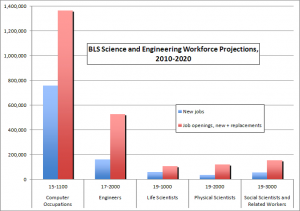 An article on the mismatch between computer science jobs and educational capacity includes various University of Washington examples, including comments by CSE’s Ed Lazowska:
“Until recently, the University of Washington was only able to accommodate 25% of computer science applicants, though it will be expanding somewhat this year due to a recent funding increase …
“At other schools, the numbers are even starker. Carnegie Mellon, for example, enrolled just 130 of the 4,200 applicants this fall to its computer science school. Harvey Mudd College in Claremont, Calif. accepted only 21% of computer science applicants last year.
“And that’s a shame, with so many computer-related jobs going unfilled. But it gets worse — much worse, when you look at the demand that’s coming.
“A US Bureau of Labor Statistics report projects huge increases in Science, Technology, Engineering, and Mathematics (STEM) jobs over the next decade, but not just any STEM jobs. The vast majority is in computer-related occupations …
“Of course, not every computer-related job requires a computer science degree, or any kind of college degree. Banking, insurance, and manufacturing all hire IT professionals who can do their jobs without one. But companies like Microsoft and Google that carve out new avenues in computing only hire degreed students from schools with strong programs, and they would rather leave a position vacant than fill it with someone they consider unqualified.”
Read more here. Read more →
 GeekWire describes UW CSE alum Greg Linden’s Code Monster programming site for kids:
“Greg Linden is a veteran software engineer and startup entrepreneur in Seattle who developed Amazon.com’s recommendation engine, started the personalized news website Findory.com and worked for Microsoft’s Live Labs, among other tech ventures and companies.
“He’s also a parent who wants to make sure his kids learn a little about computer programming languages.
“But when he initially looked around for something helpful online, all he could find ‘was either tutorials designed for adults that overwhelm younger learners with their boring syntax and complexity, or games that didn’t teach an actual, valuable programming language.’
“So he came up with a solution: Code Monster from Crunchzilla. It’s a free site, designed for kids ages 9-14, that blends elements of a game and tutorial to teach basic Javascript skills.”
Read more here. Read more →
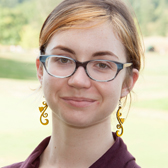 UW CSE Ph.D. student Tamara Denning, who works with professor Yoshi Kohno in UW’s Security and Privacy Research Lab, has been named on of 18 recipients of 2012 Intel Ph.D. Fellowships. Tamara was one of 3 of the 18 to win special recognition of her research at a technical poster session for all of the awardees.
Meet Tamara and the other 2012 Intel Ph.D. Fellowship winners here. Learn about Tamara’s work here.
Read more →
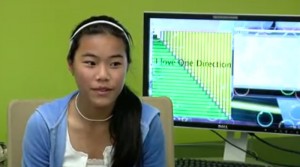 This summer, UW CSE hosted three week-long summer daycamps for secondary school students – two for middle schoolers and one for upper schoolers.
Here’s a terrific short video featuring one of the middle school daycamps.
Watch the video here. Learn about all of UW CSE’s K-12 outreach activities here. Read more →