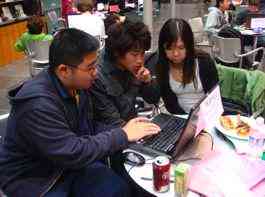
 A TechFlash post by UW CSE alumna Hélène Martin, who teaches computer science at Seattle’s Garfield High School.
“What does it take to inspire teenagers to consider computing careers? RSA encryption, a large supply of fruit snacks and a healthy competitive atmosphere may be part of the answer.
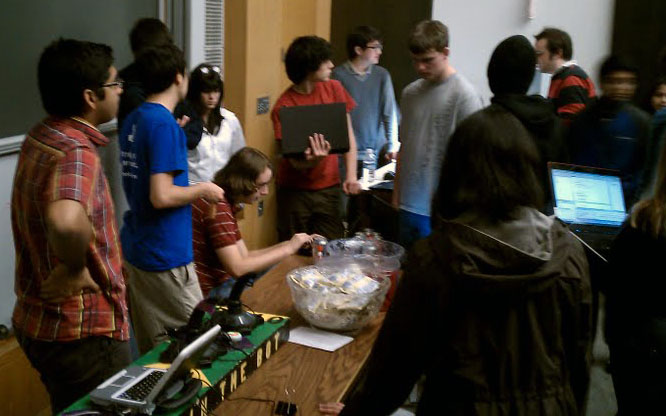
“Last Saturday, students from around the Puget Sound gathered at the University of Washington for a battle of the minds: the Puget Sound Computer Science Teachers Association’s biannual programming competition. Over 70 students ages 12 to 18 piled into an auditorium to hear UW Computer Science & Engineering lecturer Stuart Reges describe Fermat’s Little Theorem and its role in cryptography before a three-hour problem solving marathon.”
Read the full post here. Learn more about the day’s activities here. Read about Hélène’s Garfield Computer Science program here. Read more →
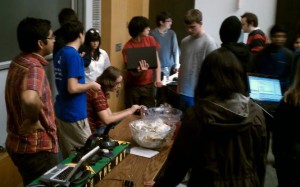
Peter Brook and students at the FRC workshop
On Saturday December 11, the Allen Center was hopping with high school students and teachers.
UW CSE undergraduate Peter Brook, a FIRST Robotics Competition stalwart in high school, worked with undergraduate Ashoat Tevosyan, alumnus Kevin Ross, and a number of CSE undergraduate volunteers to present a FIRST Robotics Competition programming workshop for about 70 team members from the region. A follow-on workshop, focused on autonomous mode, will take place on December 18.
UW CSE alum Hélène Martin, now the computer science teacher at Seattle’s Garfield high school, presented a Python programming workshop for high school teachers, under the auspices of the Puget Sound chapter of CSTA.
And UW CSE faculty member Stuart Reges hosted the annual Puget Sound CSTA programming contest, organized by Crystal Hess, a teacher at Tahoma High School. The competition gives students interested in programming an opportunity to meet each other and hone their skills. It also gives us an opportunity to expose students to UW CSE in the hopes that some will choose to pursue computer science in school and as a career.
Here’s a nice TechFlash article describing some of the goings-on. Read more →
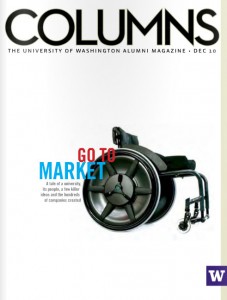 UW CSE professors Oren Etzioni and Shwetak Patel are featured in this article concerning University of Washington entrepreneurship in the latest issue of Columns, the UW alumni magazine.
The “best quote in the article” award goes to Oren – who has started multiple companies and holds the Washington Research Foundation Entrepreneurship Endowed Professorship in Computer Science & Engineering: “The obligation of venture capitalists is to make money. My professional obligation is to satisfy my curiosity. Curiosity-driven research – it’s a wonderful thing.”
Read the article here. Read more →
 Among the 41 distinguished computer scientists named ACM Fellows today:
Affiliate professor Doug Burger, Microsoft Research, “For contributions to distributed microprocessor architectures and memory systems”
Ph.D. alumna Anne Condon, University of British Columbia, “For contributions to complexity theory and leadership in advancing women in computing”
Ph.D. stepchild Mike Dahlin, University of Texas at Austin, “For contributions to the science and engineering of large-scale distributed computer systems” (Mike was a student of Tom Anderson’s when Tom was a faculty member at UC Berkeley)
Ph.D. alumna Carla Ellis, Duke University, “For contributions to techniques for energy management in mobile devices, and for service to the computing community”
Ph.D. alumnus Stefan Savage, University of California, San Diego, “For contributions to large scale systems and network security”
And, in the “all in the family” category, Frank Tompa, University of Waterloo, brother of UW CSE faculty member Martin Tompa, “For contributions to text-dominated and semi-structured data management”
ACM announcement here. Read more →
 US News has a new college ranking category this year: “Best Colleges for Shoppers.” We have only one thing to say: “Who Da Man?!?!”
(Actually, we have something else to say: The National Academies would have crapped this up.)
See here and here. Read more →

Siobhan Quinn

Kendal Sager
Dot Diva is a website built by WGBH Boston to expose high school women to the power of computer science to change the world.
Dot Diva has just rolled out fifteen great profiles of young women using their computer science education in interesting ways. Two of them are UW CSE alums: Siobhan Quinn and Kendal Sager.
Siobhan works at Foursquare in New York City, following several years at Google and Blogger.com. She says she didn’t think she’d be interested in computer science, but took our intro course as a requirement. “I was hooked after the first project, which had us build characters that walked across the screen. I wrote code to give my characters colorful clothes, which earned me extra credit.”
Kendal is a character technical director at DreamWorks. Kendal makes it possible for animated characters to have natural-looking moves and expressions. “I take a 3-D model of a character and put a ‘skeleton’ in it so that the animator can make it come to life.” Read more →
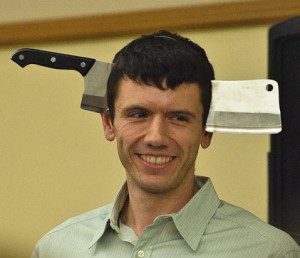 A good time was had by … even Pete. See Bruce Hemingway’s photographs here.
Twenty five years ago, the faculty skit was a lot funnier, mostly because it included things you wouldn’t attempt today. Read more →
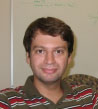
(this photo has been cropped)
No, we are not making this up. Just exaggerating a bit.
XBIZ newswire, “Adult entertainment industry news for the media” – a division of XBIZ.com, “The leading source for adult industry news” – reports on the paper “An Empirical Study of Privacy-Violating Information Flows in JavaScript Web Applications.”
We cannot in good conscience quote from the XBIZ article in this family-oriented blog, but you can read it here. We will note, however, that based upon extensive research, Sorin and his UCSD colleagues recommend Chrome and Safari for surfing porn.
(We thank Stefan Savage, our Southern California pornography correspondent, for this item.)
Update: A lawsuit has now been filed in response to this disclosure; see article here.
(We thank Stefan Savage, our Southern California legal correspondent, for this item.) Read more →
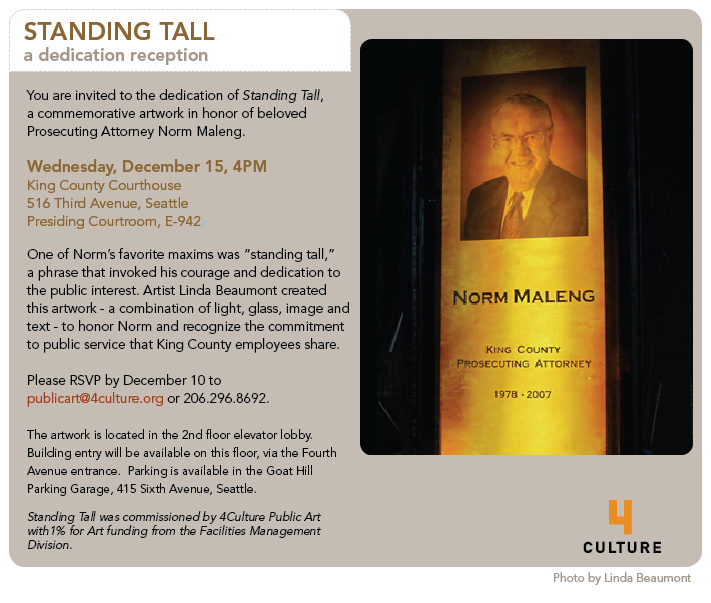
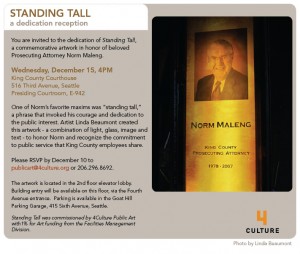 A new art installation at the King County Courthouse will honor Norm Maleng, King County Prosecuting Attorney from 1978-2007. Norm’s wife, Judy, is an early graduate program alumna of UW CSE; Judy continues to host wonderful events for early UW CSE faculty and alums, a tradition that she and Norm began many years ago. Read more →
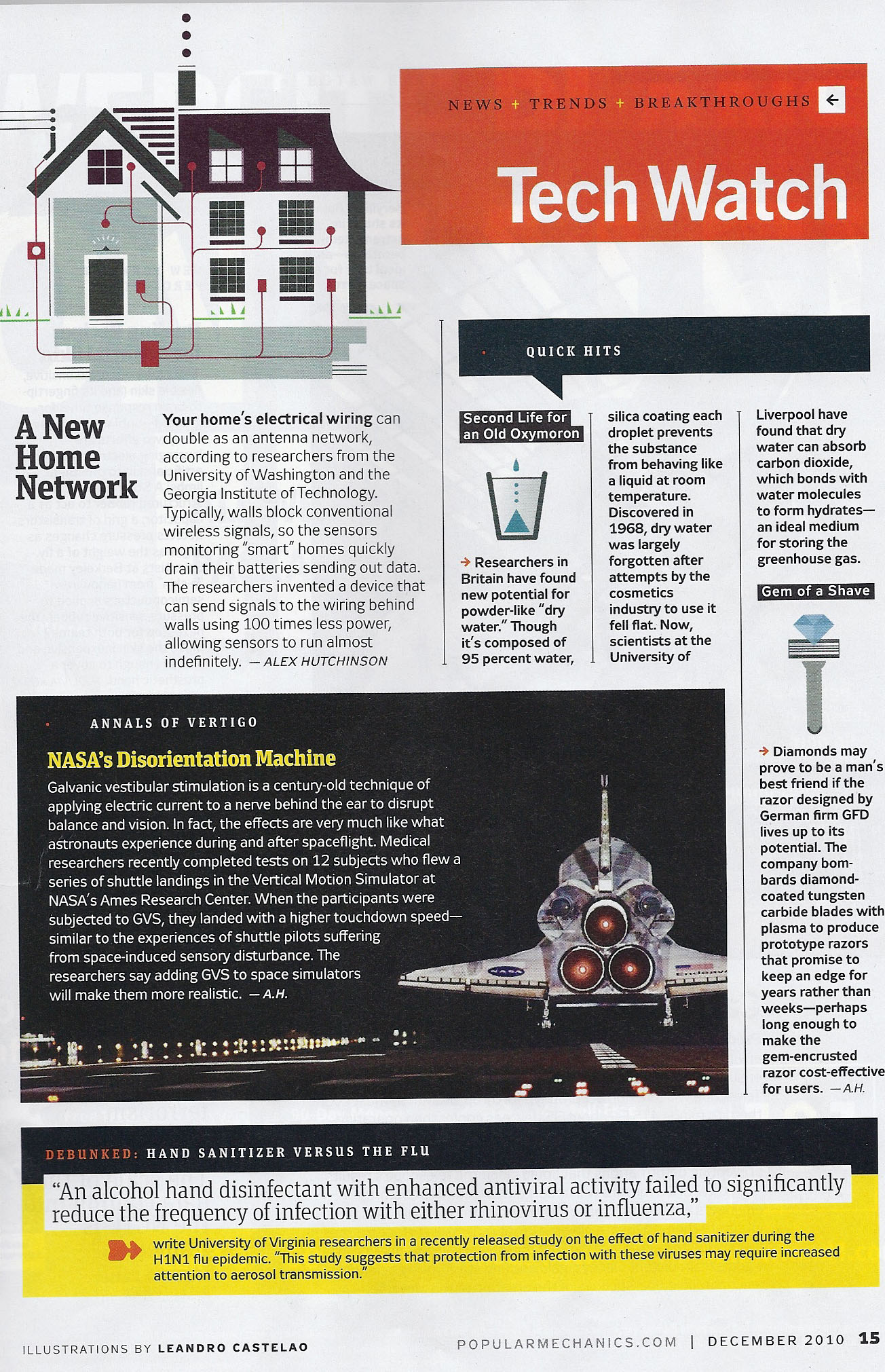
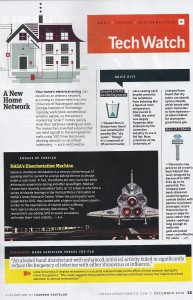 “Typically, walls block wireless signals, so the sensors monitoring ‘smart’ homes quickly drain their batteries … the researchers invented a device that can send signals to the wiring behind walls using 100 times less power, allowing sensors to run almost indefinitely.”
Learn more about SNUPI here. Read more →