Kids get hands-on with computer science at UW CSE’s DawgBytes summer camps

DawgBytes logoEvery summer, UW CSE welcomes students from around Washington state to campus for our DawgBytes day camps. This year, 125 middle school and high school students will enjoy the opportunity to get hands-on with computer science at one of six co-ed camp sessions devoted to robotics, web design, or programming computer games in Quorum.

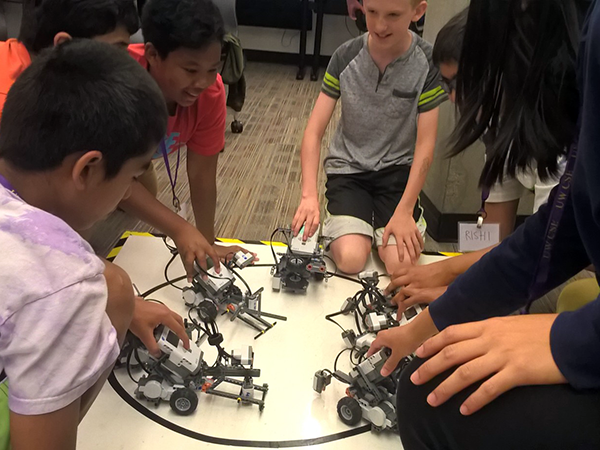
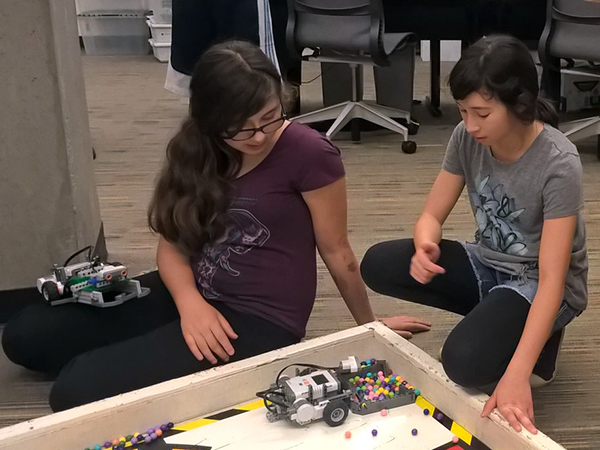
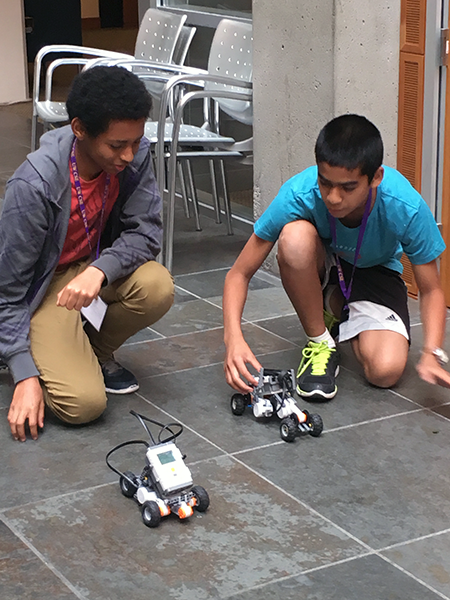
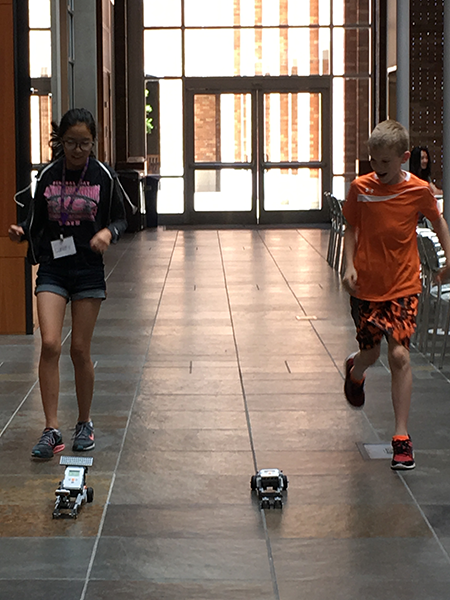
We kicked off the summer with the first of three sessions on robotics, in which campers work in teams to build and program robots using LEGO Mindstorms. At the end of the five-day session, participants showed off their creations while competing in some friendly robot games.

Check it out:

Group of campers playing robot games

Campers with their robots

Robot raceRobot race

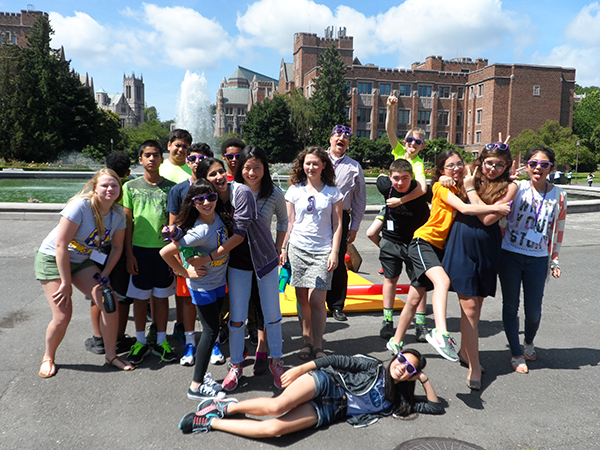
Group shot of DawgBytes campers

Looks like fun, doesn’t it?

Since 2012, over 600 K-12 students—more than half of them girls—have had the opportunity to explore the wonderful world of computer science at one of our day camps. Thanks to the generous support of our donors, scholarships are made available to eligible students to cover the bulk of their camp fees. Learn more about DawgBytes camps here, and visit the DawgBytes Facebook page here. Read more →

UW CSE’s Maaz Ahmad, Julie Newcomb earn accolades at SYNT 2016

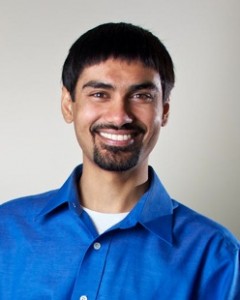
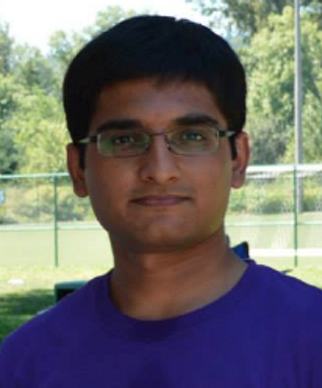
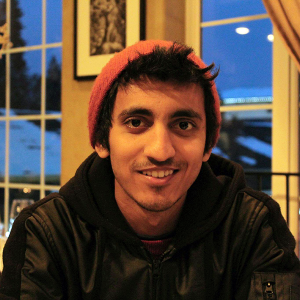
Maaz Ahmad

Maaz Ahmad

UW CSE Ph.D. student Maaz Bin Safeer Ahmad, who works with professor Alvin Cheung of UW CSE’s Programming Languages & Software Engineering (PLSE) and Database groups, has captured the inaugural Best Student Paper Award at SYNT 2016 for Leveraging Parallel Data Processing Frameworks with Verified Lifting.

In the winning paper, Ahmad and Cheung demonstrate that verified lifting—which previously has been applied to database applications and stencil computations—also can be used to convert sequential data processing code in order to leverage high-performance parallel data processing frameworks. They present CASPER, a novel compiler that identifies and converts fragments of sequential Java code to MapReduce tasks implemented with Apache Hadoop.

The pair’s work represents a significant step forward in addressing one of the most pressing computational challenges of our time: the efficient processing and analysis of increasingly massive data sets. By enabling automatic rewriting of code written in general purpose languages into a high-performance framework such as Hadoop, the authors have devised a way for users to leverage the performance improvements offered by domain specific languages without having to expend time and resources on manually rewriting programs—and avoiding the risk of introducing new bugs. Evaluating their prototype using a set of standard MapReduce benchmarks, Ahmad and Cheung demonstrated that programs that have been optimized using CASPER run up to 6.4x faster.

Read the winning paper here, and check out the CASPER web page here.

Ph.D. students Sarah Chasins of UC Berkeley and Julie Newcomb of UW CSE earned second place for “Using SyGuS to Synthesize Reactive Motion Plans.” In their paper, Chasins and Newcomb—who work with professor Ras Bodik of UW CSE’s PLSE group—present the first use of the Syntax-Guided Synthesis (SyGuS) formalism to solve robot motion planning problems.

The SYNT Workshop on Synthesis is co-located with the International Conference on Computer Aided Verification (CAV 2016) taking place July 17-23 in Toronto, Canada.

Way to go, team! Read more →

UW CSE invades the Bay Area!

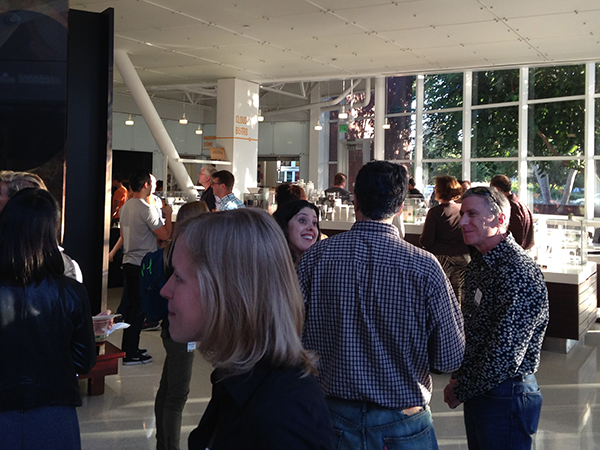
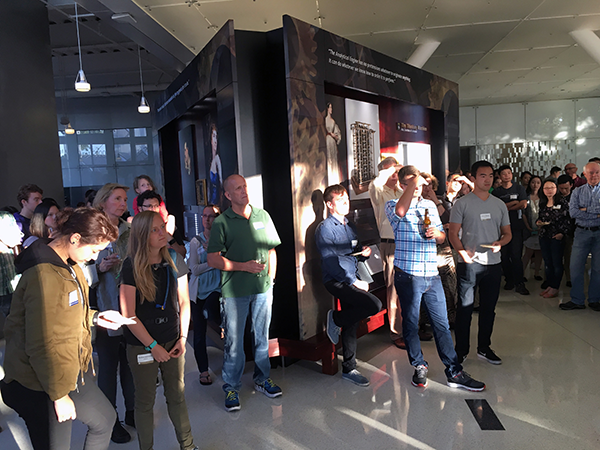
UW CSE faculty and guests at the Computer History Museum

UW CSE took over the Computer History Museum in Mountain View for our annual Bay Area alumni meet-up yesterday. Nearly 200 alumni and guests joined us at one of our favorite events of the year, where we enjoy connecting with old friends and new—and the chance to geek out over the museum’s fantastic exhibits. UW CSE faculty members Luis Ceze, Zorah Fung, Dan Grossman, Yoshi Kohno, Ed Lazowska, Hank Levy and Franzi Roesner met up with a couple of new colleagues currently in the Bay Area: UW CSE alum Kurtis Heimerl, who is joining our ICTD Lab faculty in the fall, and Justin Hsia, who also will arrive in the fall after finishing up a postdoc at UC Berkeley.

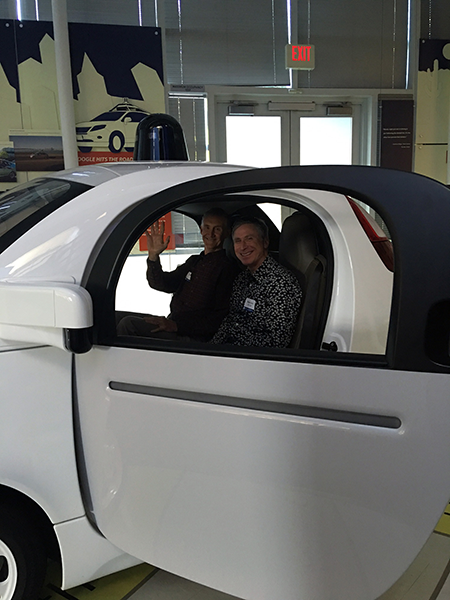
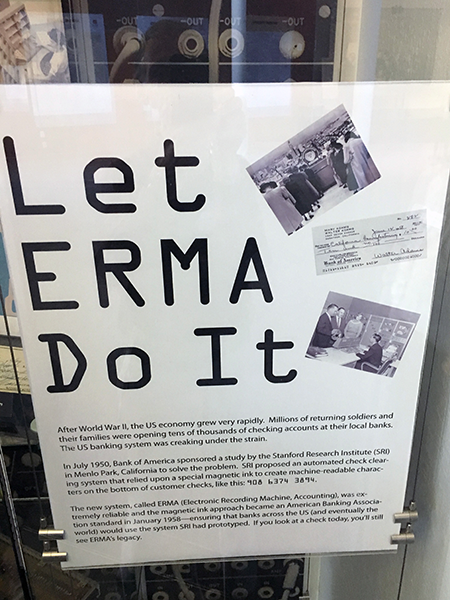
UWCSE-Bay-Area-Crowd-Speeches-2016During our visit, we took time out for a spin (not really!) in one of Google’s self-driving cars on display. We also celebrated CSE affiliate professor Dave Cutler’s selection as a Fellow of the Computer History Museum, in recognition of his “fundamental contributions to computer architecture, compilers, operating systems and software engineering.” Last but not least, we experienced a blast from the past when we found an exhibit highlighting the ERMA project. ERMA was the first electronic banking system and was developed by a team led by UW CSE’s founding chair, Jerre Noe, back when he was at Stanford Research Institute (SRI) in the 1950s.

Many thanks to the museum for being such a great host and to all of our wonderful alumni and friends who joined us at the event. You make UW CSE proud! See you next year!

UWCSE-Bay-Area-Google-Car-2016UWCSE-Bay-Area-CHM-Cutler-2016UWCSE-Bay-Area-ERMA-2016


  Read more →

Top 10 First-Choice Majors of UW Confirmed Incoming Freshmen – 2016 Edition

Top 10 with borderThe results are in: CSE is now the first choice major of more of the University of Washington’s confirmed incoming freshmen than any other field.

We need to grow in order to be able to accommodate more of these students! And we’re trying!


Our friends at GeekWire picked this up:

“‘At UW and across the nation, student interest in computer science is booming,’ said Ed Lazowska, the Bill & Melinda Gates chair in the UW department of Computer Science & Engineering, in an email to GeekWire this morning. ‘It’s visible in 3 ways: enrollment in introductory courses, interest in upper-division courses by students majoring in other fields, and demand for the major.’ …

“‘Inevitably there are cycles in demand,’ he concluded. ‘But the long-term trend is clear — due to the long-term role of computer science in the world. And our region is at the center of much of this.'”

Much more detail in the GeekWire post here.

And check out the job demand data, here – “It’s all computer science!” Read more →

Microsoft President Brad Smith reiterates call to expand UW CSE

Brad SmithThe Puget Sound Business Journal posted an article this week in which Microsoft President Brad Smith, a vocal proponent of expanding access to computer science education, reiterated his call for a significant expansion of UW CSE as the leading generator of computing talent in the state.

From the article:

“As Microsoft expands outside the country to mitigate the lack of engineering talent in the Puget Sound region, local technology industry leaders renew a call for investments in the next generation of local computer science graduates.

“‘It’s important for Puget Sound to continue to strengthen our own ability to develop more talent,’…Smith recently told the Puget Sound Business Journal. ‘We need to get more computer science into schools here in Washington state, including the University of Washington, which is a world leader. It’s so important to build a second UW computer science building.'”

The article points out that local technology companies are “talent-starved” due to a lack of qualified graduates and quotes UW CSE professor Ed Lazowska on the need to expand capacity to meet the explosive demand from employers and students.

“This will consolidate us as one of the preeminent programs in the country,” Lazowska said. “The tragedy is, most applicants don’t get in. These are terrific kids from Washington state who could graduate here, stay here and power our economy.”

Read the full article here. Learn more about the Campaign for UW CSE here. Read more →

UW CSE’s Kira Goldner wins Google Anita Borg Memorial Scholarship

Kira GoldnerUW CSE Ph.D. student Kira Goldner has been named a 2016 Google Anita Borg Memorial Scholar. Goldner, who works with professor Anna Karlin in UW CSE’s Theory group on algorithmic game theory and approximation algorithms, is one of only 20 student researchers from across the United States selected by Google to receive this award.

Google established the Anita Borg Memorial Scholarship in honor of Borg’s tireless dedication to advancing women and other underrepresented groups in the field of computing. The program celebrates recipients’ academic excellence and their potential to become active role models and leaders in the field. The scholarship includes an invitation to participate in the Google Scholars’ Retreat at the company’s Mountain View, California headquarters.

The scholarship includes an invitation to participate in the Google Scholars’ Retreat at the company’s Mountain View, California headquarters. Goldner is the latest in a distinguished line of UW CSE students who have received the award, including Nell O’Rourke and Irene Zhang (2015), Jenny Abrahamson and Nicki Dell (2012), Janara Christensen and Katie Kuksenok (2011), Lydia Chilton and Kristi Morton (2010), Saleema Amershi (2009), and Julie Letchner and Kate Everitt (2008).

Way to go, Kira! Read more →

UW CSE’s MegaFace Challenge shows bigger is better for facial recognition

Facial recognition photo collageJust how accurate are facial recognition algorithms—which may have been trained and tested on fewer than 15,000 photos—when put to the test on a larger scale? Researchers in UW CSE’s Graphics and Imaging Lab (GRAIL) aimed to find out by launching the MegaFace Challenge, a new competition in which teams from all over the world were invited to put their algorithms through their paces using the MegaFace dataset of one million images.

The results showed that, when it comes to the size of datasets used for training and testing these algorithms, bigger tends to be better.

From the UW News release:

“‘We need to test facial recognition on a planetary scale to enable practical applications—testing on a larger scale lets you discover the flaws and successes of recognition algorithms,’ said Ira Kemelmacher-Shlizerman, a UW assistant professor of computer science and the project’s principal investigator. ‘We can’t just test it on a very small scale and say it works perfectly.’

“The UW team first developed a dataset with one million Flickr images from around the world that are publicly available under a Creative Commons license, representing 690,572 unique individuals. Then they challenged facial recognition teams to download the database and see how their algorithms performed when they had to distinguish between a million possible matches.

“Google’s FaceNet showed the strongest performance on one test, dropping from near-perfect accuracy when confronted with a smaller number of images to 75 percent on the million person test. A team from Russia’s N-Tech.Lab came out on top on another test set, dropping to 73 percent.”

Testing against the larger dataset revealed differences in performance across facial recognition algorithms that were masked when tested against a much smaller dataset, with accuracy rates of some other algorithms that had previously performed well on a small scale—some surpassing 95%—falling to as low as 33% when using the larger dataset. Algorithms that were trained on larger datasets to begin with tended to outperform those that were trained on smaller datasets when tested on the MegaFace collection.

The team, which also includes UW CSE professor Steve Seitz, Master’s student Aaron Nech, undergraduate student Evan Brossard, and former student Daniel Miller, will present its results at the IEEE Conference on Computer Vision and Pattern Recognition (CVPR 2016) in Las Vegas next week.

In addition to the challenge—which is ongoing—researchers are building a large-scale training dataset that will incorporate multiple photos of half a million identities. This new dataset will benefit researchers who previously had to rely on smaller sample sizes to train their algorithms. The project could help enable new applications for facial recognition technology, such as face-based security features for mobile devices and the ability for enforcement to quickly and accurately identify individuals captured on video surveillance footage for public safety purposes.

Read the full news release here and the research paper here. Visit the MegaFace website here, and check out articles in TechCrunchThe Atlantic, IEEE Spectrum, and Silicon Republic. Read more →

UW CSE’s Anup Rao wins 2016 SIAM Outstanding Paper Prize

Anup RaoProfessor Anup Rao of UW CSE’s Theory group has been recognized by the Society for Industrial and Applied Mathematics (SIAM) with its Outstanding Paper Prize for the 2013 paper, How to Compress Interactive Communication. Each year, SIAM selects just three papers from among thousands published in its journals over the previous three years for the award, which honors authors who have made original contributions to the field of applied mathematics.

In 1948, Claude E. Shannon published his foundational paper on information theory. He defined the entropy of a message, and showed that this quantity captures the number of bits required for one party to communicate the message to another, thereby laying the mathematical groundwork for the field of data compression.

Shannon’s result addresses the setting of one-way communication tasks. But what if two parties engage in a conversation, possibly exchanging many short messages in order to accomplish a task interactively. Can such a protocol be compressed? If so, what is the appropriate notion of entropy?

The groundbreaking paper by Rao and co-authors Boaz Barak, Mark Braverman, and Xi Chen, addresses precisely these questions. They present sophisticated methods to compress interactive communication protocols. Intuitively, their idea is for the communicating parties to predict the future communication transcript based on their current partial knowledge. Moreover, they put forth a precise and appealing definition of the “information cost” of a protocol which measures the amount of information exchanged by the two parties.

The team’s work helped to launch the field of information complexity, and led to progress in many areas of computer science, including streaming computation, differential privacy, communication complexity, and quantum communication.

Learn more about the award here, and read the winning paper here.

Congratulations, Anup! Read more →

UW CSE’s Will Scott wins Best Student Paper Award at 2016 USENIX ATC

Arvind Krishnamurthy, Will Scott, Tom Anderson

Arvind Krishnamurthy, Will Scott, and Tom Anderson

Newly minted UW CSE Ph.D. Will Scott has captured the Best Student Paper Award at the 2016 USENIX Annual Technical Conference underway in Denver for the paper Satellite: Joint Analysis of CDNs and Network-Level Interference.

The winning paper presents Satellite, an efficient tool for understanding global trends in the distribution and accessibility of website content from a single vantage point. The system, which collects and analyzes data on DNS resolution and resource availability by monitoring the IPv4 address space, enables researchers to measure the growth and behavior of content distribution networks (CDNs) and prevalence of online censorship among the top 10,000 domains as ranked by Alexa.

Scott co-authored the paper with his Ph.D. advisers, Tom Anderson and Arvind Krishnamurthy, and CSE professor Yoshi KohnoRead the full paper here, and check out the Satellite website here.

This is the second year in a row that UW CSE research has been recognized at the conference. Last summer, the GRAPPA team collected the Best Paper Award for its work on software distributed shared memory for data-intensive applications.

Go team! Read more →

Team led by UW researchers reaches the finals of the GSK Bioelectronics Innovation Challenge

Josh Smith

Josh Smith

An international team led by researchers at the UW has been chosen as one of three finalists in the GlaxoSmithKlein Bioelectronics Innovation Challenge—and made itself eligible for $1 million in new research funding as a result.

UW CSE and electrical engineering professor Josh Smith is working with colleagues at UW’s Center for Sensorimotor Neural Engineering (CSNE), the University of Cambridge and University College London to develop an implantable device that would restore bladder function for people living with spinal cord injury or incontinence. Technology developed in Smith’s Sensor Systems Lab is being used to wirelessly power the implanted device.

From the UW News release:

“An international team led by researchers at the Center for Sensorimotor Neural Engineering (CSNE) based at the University of Washington is one of three finalists in a race to produce an implantable wireless device that can assess, stimulate and block the activity of nerves that control organs….

“‘For people with spinal cord injuries, restoring sexual function and bladder function are some of their top priorities — higher than regaining the ability to walk,’ said Chet Moritz, deputy director of the CSNE and UW associate professor of rehabilitation medicine and of physiology and biophysics.

“‘The vision is for these neural devices to be as ubiquitous as pacemakers or deep brain stimulators, where a surgeon implants the device and it’s seamless for the patient,’ he said. ‘We’re really excited to make a difference in people’s lives and to help push these technologies forward.’

Lollipop device

Prototype implanted device designed at the UW.

“The final implantable wireless device will be able to stimulate and block electrical signals that travel along the nerves and control specific organs. Stimulating the pelvic nerve causes the bladder to empty, for example, while blocking those signals could help someone who is unable to control his or her bladder.”

The team designed its device to interact with the pelvic nerve both electronically and optically. This approach, in which light is used to control neurons, means the researchers can stimulate the pelvic nerve without having to physically touch it, thus reducing the risk of swelling and scarring that can occur with direct nerve interfaces.

“It is gratifying to see the center’s hardware research efforts paying off so quickly,” said Smith. “Selection by GlaxoSmithKline in this rigorous international competition shows that technologies emerging from the CSNE are at the leading edge of what is possible.”

In addition to the $1 million prize for reaching the finals, GSK will award $1 million to the first team to deliver a functional device in small animal models. The other UW members of the GSK competition team include physiology and biolophysics professor Greg Horwitz, physiology and biophysics postdoc Tom Richner, biology professor and eScience Institute Data Science Fellow Bingni Brunton, and Ryan Solinsky, a resident in rehabilitation medicine. The CSNE is a NSF-funded partnership of multiple research institutions that is housed at the UW and directed by UW CSE professor Rajesh Rao.

Read the full UW News release here. Learn more about the GSK Bioelectronics Innovation Challenge here.

Amazing work—congratulations to Josh and the entire team! Read more →

« Newer PostsOlder Posts »