Oren Etzioni in Forbes: “The Serial Entrepreneur Who Leads Paul Allen’s AI Institute”

Oren EtzioniYesterday, Forbes published a terrific interview with UW CSE professor Oren Etzioni, CEO of the Allen Institute for Artificial Intelligence. During the conversation with magazine contributor Peter High, Etzioni shared his thoughts on a wide range of topics, including how artificial intelligence can benefit humanity, what he learned from starting multiple companies, and how his own students and interns help him to stay on the cutting edge of a fast-moving field.

Etzioni explained that he and institute founder Paul Allen aim to build a team “that punches above its weight” to advance AI research, saying, “Ultimately, to me, the computer is just a big pencil. What can we sketch using this pencil that makes a positive difference to society, and advances the state of the art, hopefully in an out-sized way?”

Read the full interview here or listen to the audio here. Read more →

Bill Gates says “Read Pedro Domingos’s book!”

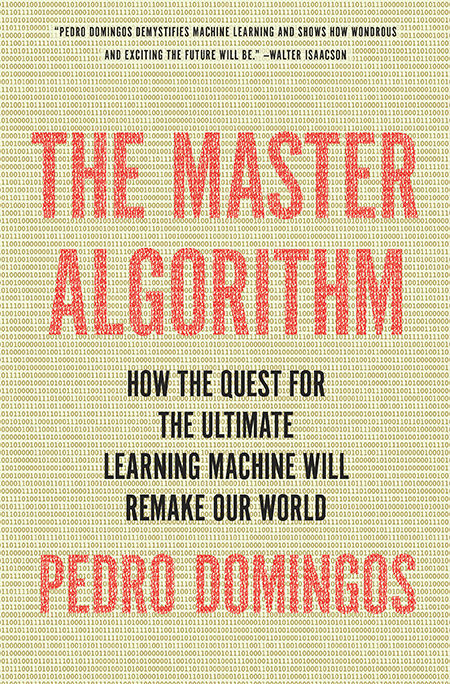
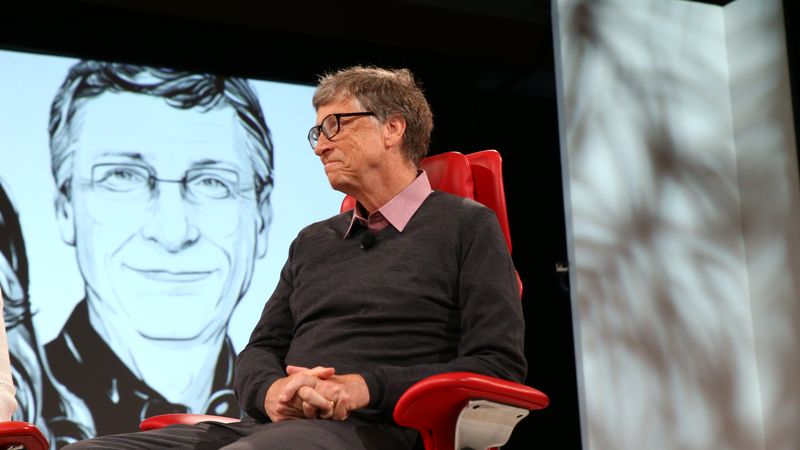
At this week’s Code conference, Bill Gates had a recommendation for the audience: Read “The Master Algorithm” by UW CSE’s Pedro Domingos.

Read about it in recode here and in Quartz here.

Learn about Pedro and “The Master Algorithm” here.

mstralg

REC_ASA_CODE2016-20160601-113604-1418.0.0


  Read more →

UW CSE hosts Youth Apps Challenge

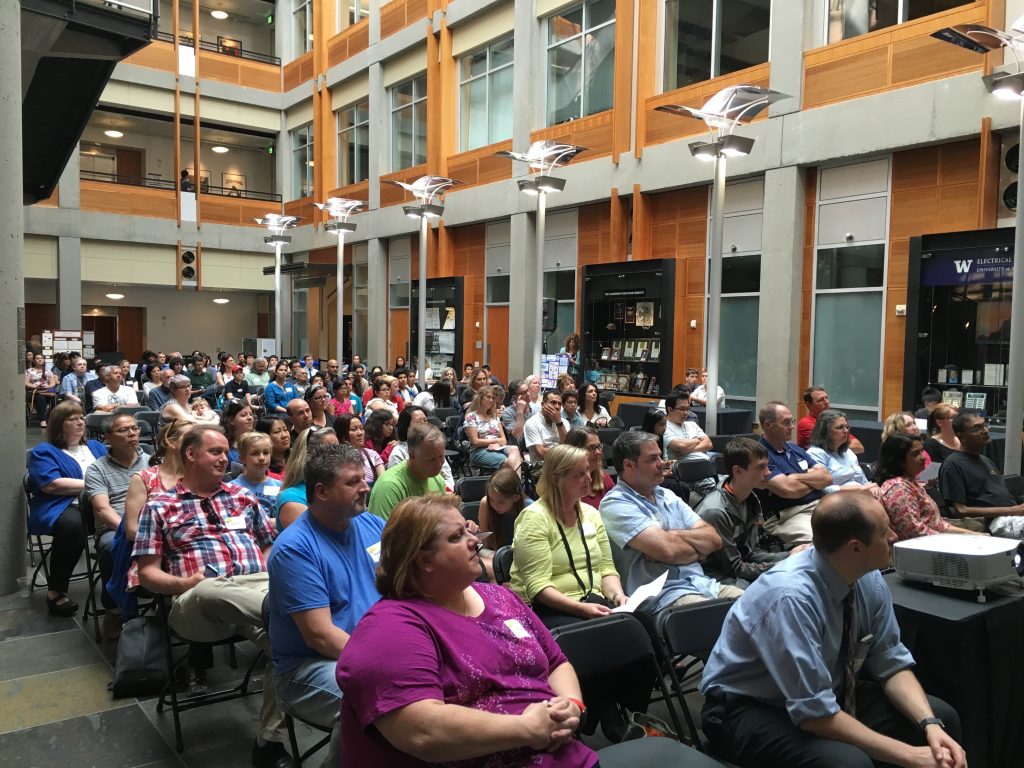
IMG_6876Again this year, UW CSE played host to the finalists in the Technology Alliance’s Youth Apps Challenge.

Youth Apps Challenge is a two-part program that introduces both teachers and students to the power and potential of programming. Youth Apps motivates teams of middle and high school students from across Washington to develop innovative computer applications that address everyday problems.

This year more than 50 teams of students (each with a faculty sponsor) submitted apps to the challenge. Fifteen finalists were selected to showcase their apps today in a live exhibition and pitch contest at the Allen Center.

Congratulations to all of the amazing participants in the 2016 Youth Apps Challenge – and to their amazing teachers and amazing parents! Read more →

UW CSE RFID spinoff Impinj files for IPO

impinj_logo_rgb_gray_red_600px_600_315-1Impinj, the Seattle-based RFID solutions company founded by UW CSE professor Chris Diorio and his legendary Caltech Ph.D. mentor Carver Mead, has filed for an IPO.

The RFID market took longer than the company expected to develop, but has taken off in the past few years.

RFID is “The Internet of Everything” (at a recent presentation, Diorio’s “prop” was a belt he had just purchased at Macy’s that sported an RFID tag), and Impinj has a leadership position.

Read more in GeekWire here. Read more →

New “intelligent water” venture launches with technology from UW’s UbiComp Lab

Shwetak Patel

Shwetak Patel

Electronics company Belkin International and plumbing and HVAC supplier Uponor Corp. recently announced the formation Phyn, a $40 million joint venture to further scale their intelligent water innovations based on technology that was developed by CSE and EE professor Shwetak Patel working with students in the UW’s UbiComp Lab.

The Belkin technology is based on HydroSense—a pressure-based sensor for monitoring home water usage developed by Patel, CSE Ph.D. alum Jon Froehlich, and EE Ph.D. alum Eric Larson—and ElectriSense, a plug-in sensor that monitors home energy consumption at the device level that was developed by Patel and CSE Ph.D. alum Sidhant Gupta. Froehlich and Larson are now faculty members at University of Maryland, College Park and Southern Methodist University, respectively, and Gupta is a researcher at Microsoft Research.

Belkin licensed the technology when it acquired Patel’s home sensing startup, Zensi, six years ago. As part of that deal, Belkin opened its Wemo Labs in Seattle under Patel’s leadership. The new venture, Phyn, will operate a research facility in Seattle as part of its efforts to bring projects such as Belkin’s Wemo Water system, which is built on the UW-licensed technology, to market.

Wemo Water system

Wemo Water system

From the GeekWire article:

“Phyn’s R&D lab, in Seattle’s Belltown neighborhood, is starting with 10 engineers, and the company plans to continue expanding the team, said Ryan Kim, the newly named Phyn CEO, who was previously Belkin’s vice president of engineering. Kim said in an email to GeekWire that the company ‘continues to be committed to and invested in both our relationship with UW and our R&D office in Seattle.’

“‘We’ve found the quality of thinking as well as the quality of execution by the team at the lab, under Shwetak’s guidance, to be excellent, cooperative, and highly productive,’ Kim said. ‘Phyn will absolutely continue to work closely with Shwetak and the lab as we move forward.'”

Read the full GeekWire article here and a related Seattle Times article here.

UW CSE and EE professor Matt Reynolds collaborated on the ElectriSense project. Collaborators on the HydroSense project include former Mechanical Engineering undergraduate Tim Campbell, EE Ph.D. alum Gabe Cohn, EE Ph.D. students Tien-jui Lee and Elliot Saba, EE Master’s alum Eric Swanson, CSE professor James Fogarty, and EE professor Les Atlas. Read more →

DNA data storage project by UW and Microsoft researchers featured in Scientific American

Georg Seelig, Luis Ceze, Karin Strauss

MISL researchers Georg Seelig, Luis Ceze, and Karin Strauss

Scientific American published a terrific article this week highlighting the work of UW and Microsoft researchers in the Molecular Information Systems Lab (MISL) as part of a broader examination of efforts to re-purpose DNA as a digital data storage medium. The magazine spoke with UW CSE and Electrical Engineering professor Georg Seelig and Microsoft researcher and CSE affiliate professor Karin Strauss about the project, which is generating a lot of buzz for its potential to revolutionize digital storage—offering massive expansion in both density and durability—in the age of big data.

From the article:

“Humans will generate more than 16 trillion gigabytes of digital data by 2017, and much of it will need to be archived: Think: legal, financial and medical records as well as multimedia files. Data is stored today on hard drives, optical disks or tapes in energy-hogging, warehouse-size data centers. These media last anywhere from a few years to three decades at most. Plus, says Microsoft Research computer architect Karin Strauss, ‘we’re producing a lot more data than the storage industry is producing devices for, and projections show that this gap is expected to widen….’

“In April Microsoft’s Strauss and computer scientists Georg Seelig and Luis Ceze at the University of Washington reported being able to write three image files, each a few tens of kilobytes, in 40,000 strands of DNA using their own encoding scheme—and then reading them individually with no errors. They presented this work in April at an Association for Computing Machinery conference. With the 10 million strands Microsoft is buying from Twist Bioscience, the team plans to prove that DNA data storage can work on a much larger scale. ‘Our goal is to demonstrate an end-to-end system where we encode files to DNA, have the molecules synthesized, store them for a long time and then recover them by taking DNA out and sequencing it,’ Strauss says. ‘Start with bits and go back to bits.’

Seelig and Strauss co-authored the paper referenced in the article with CSE Ph.D. student James Bornholt, Bioengineering Ph.D. student Randolph Lopez, Microsoft researcher and CSE affiliate professor Douglas Carmean, and CSE professor Luis Ceze. The team presented its work at ASPLOS 2016 earlier this year.

Read the full article here, visit the MISL website here, and check out our past blog coverage here.

Photo credit: Tara Brown Photography Read more →

eScience Institute’s VizioMetrix search engine featured in MIT Technology Review

VizioMetrix screenshotVizioMetrix—the world’s first visual search engine for scientific diagrams, developed by a team at the UW’s eScience Institute—was the subject of a great article that appeared in MIT Technology Review over the weekend. The article reports on researchers’ efforts to understand the presentation of visual information in scientific literature, or viziometrics, based on a paper co-authored by Electrical Engineering Ph.D. student Po-Shen Lee, iSchool professor and Data Science Fellow Jevin West, and Associate Director, Senior Data Science Fellow and CSE affiliate professor Bill Howe.

From the article:

“Most scientists recognize the importance of good graphics for communicating complex ideas. It’s hard to describe the structure of DNA, for example, without a diagram.

“And yet, there is little if any evidence showing that good graphics are an important part of the scientific endeavor. The significance of good graphics may seem self-evident, but without evidence, it is merely a hypothesis.

“Today, that changes thanks to the work of Po-shen Lee [and] pals at the University of Washington in Seattle who have used a machine-vision algorithm to search for graphics in scientific papers and then analyze and classify them. This work reveals for the first time that graphics play an important role in the scientific process.”

The article goes on to explain how the team assembled a searchable database of 10 million scientific visuals by training a machine vision algorithm to separate multi-chart figures into their component parts and classify different types of figures. In analyzing the resulting data, the team found a significant correlation between the most successful scientific papers and the amount of information conveyed visually within the publication—information that has been largely ignored by current bibliometrics and scientometrics. This work will almost certainly influence how we present and access scientific information in the future.

Additional contributors to the VizioMetrix project include EE Ph.D. student Sean Yang, CSE Ph.D. student Maxim Grechkin, and CSE Ph.D. alum Hoifung Poon of Microsoft Research.

Read the full article here, and try VizioMetrix here. Read the research paper here. UPDATE: Check out a terrific article on VizioMetrics that appeared in the print and online edition of The Economist here. Read more →

Lazowska featured on @techvitamin podcast

AAEAAQAAAAAAAAkbAAAAJDk5MDJmYTljLTFlYWYtNDYzYy1hYjU2LTdmMDM1NWFjYjk5OA“Are our Tesla’s going to band together in the Costco lot and attack us? Find out. In this episode Ed Lazowska (@lazowska), the eminent and long-time member of UW’s Computer Science faculty, joins Facebook’s Michael Cohen and me to discuss everything from big data, deep learning, to how Universities are responding to the massive demand for computer savvy graduates.”

Listen here. Read more →

UW CSE faculty, staff, alums and friends @ Paul Allen’s Living Computer Museum

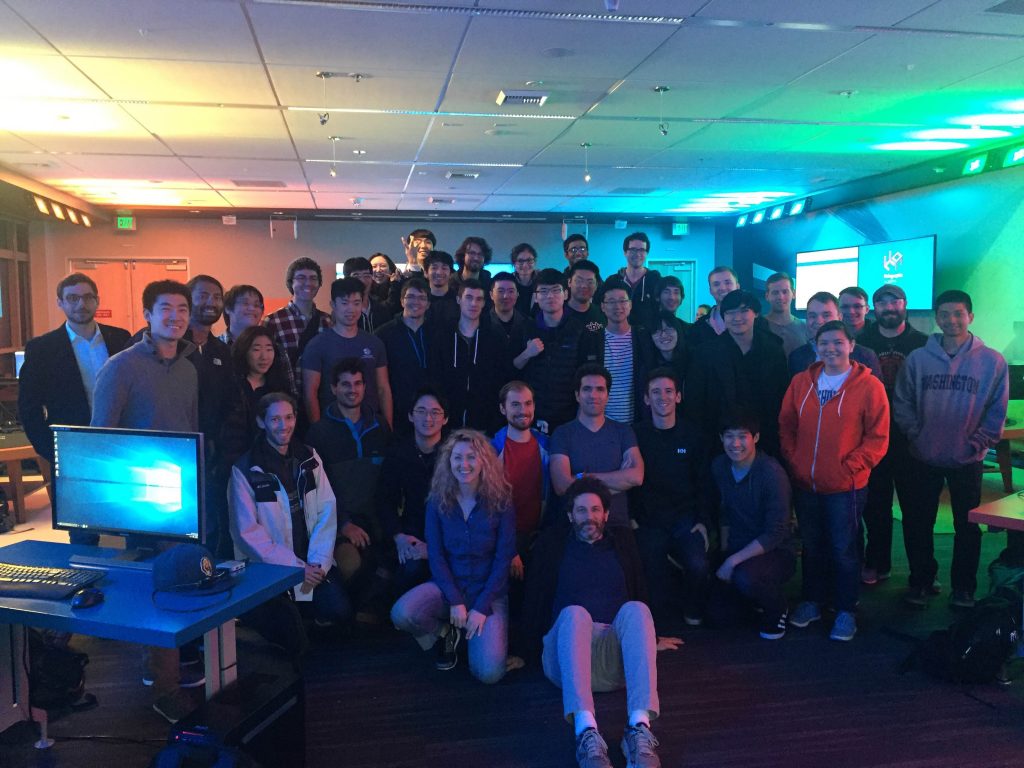
IMG_0497(1)More than 200 UW CSE faculty, staff, alums, and friends gathered at Paul Allen’s Living Computer Museum on Wednesday for a meetup.

If you haven’t been to the LCM … it’s phenomenal.

Bay Area alums and friends: See you at the Computer History Museum at the end of June! Read more →

Yin Tat Lee to join the UW CSE faculty

Yin Tat LeeWe are thrilled to announce that Yin Tat Lee, who works in algorithms and optimization, will join the UW CSE faculty.

Lee’s research focuses on the design of fast algorithms for fundamental optimization problems. Leaders in convex optimization acknowledge that his work has yielded the most important breakthroughs in interior point methods in the past two decades. Together with his co-authors, Lee has developed the fastest known algorithms for linear programming, submodular function minimization, and the maximum flow problem. He has been the recipient of a variety of Best Paper and Best Student Paper awards from flagship theory conferences, including FOCS and SODA.

After finishing his Ph.D. at MIT, Lee will spend a one-year postdoc at Microsoft Research in Redmond  before starting at UW CSE. He joins Shayan Oveis Gharan and Thomas Rothvoss as rising stars in theory who have chosen UW CSE in recent years.

Welcome, Yin Tat! Read more →

« Newer PostsOlder Posts »