UW’s “Power Over WiFi” named a top innovation of 2015 by Popular Science

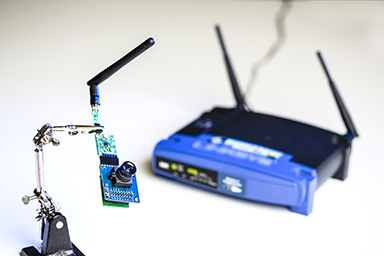
UW WiFi powered surveillance cameraResearchers from UW CSE and EE announced in June that they had developed Power Over WiFi, “PoWiFi” for short, to harvest energy from Wi-Fi routers to wirelessly power devices. The technology, which has appeared in MIT Technology Review, Wired, BBC News, and several other media outlets, was chosen this week as one of Popular Science’s “Best of What’s New 2015” – a list of the top 100 innovations that the magazine believes will shape the future and change the world.

From the UW media release:

“The technology made headlines earlier this year when researchers published an online paper showing how they harvested energy from Wi-Fi signals to power a simple temperature sensor, a low-resolution grayscale camera and a charger for a Jawbone activity tracking bracelet….

“Although initial experiments harvested relatively small amounts of power, the UW team believes there’s opportunity to make the PoWiFi system more efficient and robust.

“‘In the future, PoWiFi could leverage technology power scaling to further improve the efficiency of the system to enable operation at larger distances and power numerous more sensors and applications,’ said co-author Shyam Gollakota, assistant professor of computer science and engineering.”

In addition to Gollakota, the research team includes CSE and EE professor Josh Smith, EE graduate students Vamsi Talla, Bryce Kellogg, and Saman Naderiparizi, and former CSE postdoc Ben Ransford. They will present their final paper on PoWiFi at the ACM’s CoNEXT 2015 conference in Heidelberg, Germany this December.

Read the Popular Science article here, and the UW media release here. Check out our previous blog coverage of the project here and here.

Congratulations to the entire PoWiFi team! Read more →

UW CSE’s Alvin Cheung wins Sprowls Award from MIT

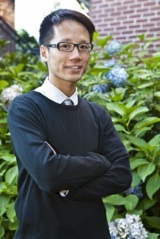
Alvin CheungUW CSE professor Alvin Cheung was honored by his alma mater this week with the George M. Sprowls Award, which recognizes the most outstanding Ph.D. theses in computer science submitted to MIT each year.

Cheung received the award for his dissertation titled “Rethinking the Application-Database Interface,” in which he puts forward a novel approach for optimizing the performance of applications that interact with database management systems (DBMSs). Cheung showed that real-world applications are sped up by multiple orders of magnitude when both the programming system and the DBMS are considered in tandem, using a combination of declarative database optimization and modern program analysis and synthesis techniques.

See the MIT announcement here. Or, hey, test your mettle by reading Alvin’s winning dissertation here.

Congratulations, Alvin! Read more →

Let’s lead the nation in Hour of Code participation!

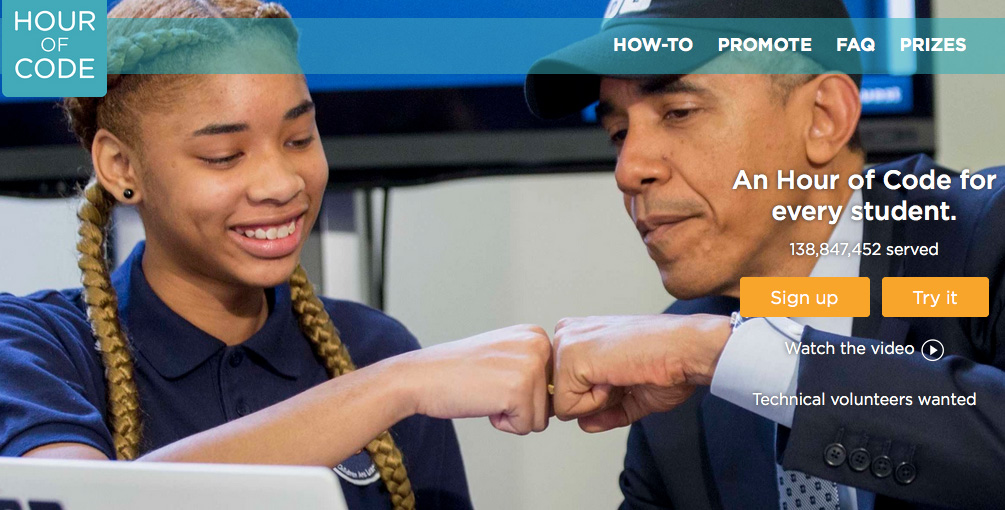
ObamaCan Washington State lead the nation in Hour of Code participation in 2015?

A message to the state’s students, parents, teachers, and superintendents from the Governor’s STEM Education Innovation Alliance, on which UW CSE’s Ed Lazowska serves, reads:

I’m contacting you with an exciting opportunity for Washington’s students – to lead the nation in Hour of Code participation. Students are guaranteed to have FUN while learning the building blocks of computer science.

WHY: Every time we check a text on our smartphone, play Minecraft or swipe our credit card at a store, we’re engaging with a product of computer science. In Washington State we’re going to have almost 50,000 unfilled jobs that require science, technology, education, and math skills by 2017, yet less than 10% of our schools currently offer computer science classes.  In addition, computer science reinforces computational thinking, logical reasoning and creative problem solving – all 21st Century skillsets that set our kids up for opportunity and success.

HOW: We want to engage kids with computer science so they see themselves in these careers and learn exciting 21st Century skills. The Hour of Code makes that easy, engaging and fun.

HOW YOU CAN HELP: We’d like every student in Washington State to participate in the Hour of Code. Please help us reach that goal by encouraging your school, District, or community organization to spend one hour on the Hour of Code during Computer Science Education Week, December 7-13. Schools can register their participation here.

Join the hundreds of schools in Washington are already taking part! Join districts like Highline, Everett, Pasco, Bremerton, Spokane, South Kitsap and Pasco and many more that are promoting the Hour of Code across Washington state.

You don’t need any preparation or computer science experience to host an Hour of Code event. Students from kindergarten to high school learn from the Hour of Code. This year, the Hour of Code is partnering with Microsoft to feature a Minecraft lesson. The Hour of Code also features a fun lesson from Star Wars characters Princess Leia, Rey, R2D2, C3PO, and BB8.

Let’s make Washington State the leader in the Hour of Code in 2015. Get started here!

Let’s do it! And while you’re at it, kick off Computer Science Education Week at UW CSE’s Open House for K-12 students, 1:00-5:00 on Saturday December 5. Read more →

Happy 90th Birthday, Bill Gates Sr.!

Bill Gates Sr. tribute book coverUW CSE was honored to host a very special gathering this morning to celebrate the contributions of Bill Gates Sr. to our university, the community, the world, and countless lives on the occasion of his 90th birthday.

Bill is a UW double-alum (Bachelors and Law School), a giant in the legal profession and in the community, and long-time co-chair of the Bill & Melinda Gates Foundation. Throughout his life, Bill has been hands-on in his support for education, reproductive and child health, the arts, the United Way, and many other civic causes. He has been a longtime supporter of his alma mater, serving as a UW Regent from 1997 to 2012 and leading the UW’s Creating Futures campaign. In 2013, UW bestowed upon Bill its highest alumni honor, designating him Alumnus Summa Laude Dignatus.

To honor Bill’s amazing legacy, nearly 100 individuals who have been touched by Bill’s generosity of spirit assembled stories of lessons they had learned from him into a book: Thanks for Showing Up in My Life: Lessons We Learned from Bill Gates Sr. The project was spearheaded by Marty Smith (a long-time legal colleague of Bill’s, and former Chair of the Technology Alliance, a civic organization Bill founded in the mid-90’s), Susannah Malarkey (Executive Director of the Technology Alliance since its inception), Ed Lazowska (UW CSE professor and long-time Technology Alliance board member), and Dan Evans (former Governor and U.S. Senator, and a dear friend of Bill’s for more than 50 years). Contributors included UW President Ana Mari Cauce, PATH President & CEO Steve Davis, Starbucks Chairman & CEO Howard Schultz, U.S. Secretary of the Interior Sally Jewell, and others from Bill’s past and present.

From the book’s foreword:

“As we go about our daily lives, our actions send out ripples – just like the ripples emanating from a single pebble dropped into a shallow pond. And like the ripples from that pebble, the ripples we send out interact with and affect those around us in ways we may never fully understand. If you could somehow capture just a portion of the ripples a single person has sent out over the course of that one lifetime, you would have a wonderful and amazing view into who that person is, how that life has been lived, and the impact that person has had on others.

“This book is an attempt to do just that for a very special person, Bill Gates Sr. Each of the storytellers has had the great fortune of being one of the many people impacted by the ‘ripples’ Bill Sr. has sent out over his 90 years of ‘showing up’ and living life to the fullest.”

Few people have created so many ripples and touched so many people’s lives through their leadership, philanthropy and just plain human decency as Bill Gates Sr. The University of Washington – not to mention the world! – is a better place thanks to him.

Happy birthday and thank you, Bill, from all of us here at UW CSE!

(In addition to the photos below, many more here and here.)

Ed Lazowska tribute to Bill Gates Sr.

UW CSE professor Ed Lazowska pays tribute to Bill as his longtime friend Llew Pritchard looks on

Dan Evans tribute to Bill Gates Sr.

Governor Dan Evans shares one of many stories on friendship and compassion from the “book of Bill”

Ana Mari Cauce

UW President Ana Mari Cauce offers a toast and leads the singing of “Happy Birthday”

Bill Gates Sr and Ruth Gerberding

Bill looks over the book with Ruth Gerberding, widow of former UW President Bill Gerberding


Bill Gates Sr., Marty Smith, Ed Lazowska

Bill with Marty Smith, his former colleague from Preston Gates & Ellis, and UW CSE’s Ed Lazowska

Bill Gates Sr.

Bill thanks everyone for joining in the celebration

Read more →

Vote for UW CSE’s Nanocrafter to win a Vizzie!

Nanocrafter logoWe’re so good we’re competing against ourselves! Not only is Ph.D. student Ricardo Martin nominated in the Video category for time-lapse mining from internet photos, but Nanocrafter, the game developed by UW CSE’s Center for Game Science to advance synthetic biology research, is nominated in the Interactive category.

While theoretically only one can win the “People’s Choice” award, we are hoping there will be a tie and both UW CSE projects will be able to share bragging rights (in addition to winning their respective categories, of course). Vote for Nanocrafter here, and for Ricardo Martin here you can cast one vote in each category.

You know how the saying goes…vote early and vote often! Read more →

UW CSE Ph.D. alum Igor Mordatch and his “robot toddler” featured in MIT Technology Review

Darwin the robotMIT Technology Review recently published a nice article about robotics research led by UW CSE Ph.D. alum Igor Mordatch, who worked with UW CSE professor Emo Todorov in the Movement Control Laboratory before taking up a postdoc position with Pieter Abbeel at UC Berkeley. Igor is the lead researcher on a project in which Darwin, a humanoid robot with simulated neural networks, learns how to move by “imagining” how to do it, and to adjust its movements based on real-world conditions.

From the article:

“Like many toddlers, Darwin sometimes looks a bit unsteady on its feet. But with each clumsy motion, the humanoid robot is demonstrating an important new way for androids to deal with challenging or unfamiliar environments. The robot learns to perform a new task by using a process somewhat similar to the neurological processes that underpin childhood learning….

“‘It practices in simulation for about an hour,’ says Igor Mordatch, a postdoctoral researcher at UC Berkeley who carried out the study. ‘Then at runtime it’s learning on the fly how not to slip.'”

The article also quotes UW CSE professor Dieter Fox, who is enthusiastic about the potential for neural network learning in robotics.

“‘I’m very excited about this whole research direction,’ Fox says. ‘The problem is always if you want to act in the real world. Models are imperfect. Where machine learning, and especially deep learning comes in, is learning from the real-world interactions of the system.'”

Read the full article and watch a video featuring Darwin here. Read more →

UW CSE’s René Just earns ACM SIGSOFT Distinguished Paper Award at ASE 2015

Rene JustUW CSE is a recognized powerhouse in software engineering research. Our strength was once again on display at ASE 2015, the 30th IEEE/ACM International Conference on Automated Software Engineering, where postdoc René Just captured the ACM SIGSOFT Distinguished Paper Award for the paper, “Do Automatically Generated Unit Tests Find Real Faults? An Empirical Study of Effectiveness and Challenges.”

Just and colleagues at the University of Sheffield and University of Luxembourg analyzed the effectiveness of three automated unit test generation tools, which are used by software developers in place of more burdensome manual testing to identify faults in their code. The researchers evaluated each tool on 357 real-world faults. They found that while the automatically generated test suites detected more than half of the faults overall, only 19.9 percent of the individual test suites detected a fault, and 15.2 percent were flaky. The team’s insights will support the development of more reliable automated unit test generators that achieve a higher fault detection rate.

Overall, UW authors had five papers accepted to ASE, and another six papers at the conference were authored by previous advisees or postdocs of UW CSE professor Michael Ernst – a strong but not unexpected showing from members past and present of our world-class PLSE group!

Read the award-winning paper here. Congratulations to René and to the entire PLSE team! Read more →

Vote for Ricardo Martin’s video!!!!!

UntitledA video illustrating UW CSE Ph.D. student Ricardo Martin’s AMAZING research on “Time-Lapse Mining from Internet Photos” has been nominated for a Vizzie award from the National Science Foundation.

Vote for the Ricardo of your choice, but vote!  HERE! Read more →

UW CSE’s Pedro Domingos in the WSJ: “Time to start getting acquainted with our digital alter egos”

Hand with binary code

The Wall Street Journal/Getty Images

UW CSE professor Pedro Domingos recently penned a column for The Wall Street Journal envisioning a not-too-distant future in which machine learning will enable us to build and control a digital model of ourselves, transforming how we approach everything from shopping, to job-hunting, to finding a mate.

From the column:

“Entrusting your money to a bank once seemed strange and risky. Similarly, entrusting all of your data to a company and letting its algorithms build a detailed model of you from it might seem to be an odd or even dangerous idea, but we’ll all soon take it for granted.

“A decade from now, your personal model will be more indispensable than your smartphone, and the company that provides it may well be the world’s first trillion-dollar business. So it is time to start getting acquainted with our digital alter egos—and what they’ll mean for our lives.”

Domingos points out that today’s digital models, such as those Google builds from our web searches or that Amazon bases on what we buy, fall short for two reasons: they are driven by the companies’ own profit motive, and they are built using incomplete data. He suggests a new approach, one in which we intentionally construct a complete digital model of ourselves and deploy it online for our own benefit.

“Today’s models don’t yet interact with us: You can’t tell them they’re wrong or ask them questions. Machine-learning algorithms are black boxes that only computer scientists can open up. But that will change as more of us realize how important machine learning is and demand a say in how it occurs,” Domingos writes.

Read the full column here. Check out our past coverage of Domingos and his new book, The Master Algorithm, here and here. Read more →

“Where Does Technological Innovation Come From?”

BN-LE718_myhrvo_FR_20151110170602Many thanks to Nathan Myhrvold for providing a deeply substantive rebuttal to a nonsensical Wall Street Journal piece by Matt Ridley. Nathan writes, in email:

Matt Ridley wrote a recent piece in the WSJ (to promote a new book) arguing that basic science has nothing to do with technology and that the government should stop funding it. It’s natural for writers to want to come out with a contrarian piece that reverses all conventional wisdom, but it tends to work out better if the evidence one quotes is factually true. Alas Ridley’s evidence isn’t – his examples are all, so far as I can tell, either completely wrong or at best, selectively quoted. I also think his logic is wrong and to be honest, I don’t think much of the ideology that drives his argument either. …

A lot of wrong things aren’t worth correcting (there are so many!), but this one is. The idea that we should cut science funding will be too tempting for politicians to let stand. While the current system could certainly be improved, Ridley’s piece, and the ideology behind it, isn’t constructive. It will only play into the hands of people who are anti-science or anti-technology.

Read Nathan’s superb rebuttal here. Read more →

« Newer PostsOlder Posts »