Skip to main content
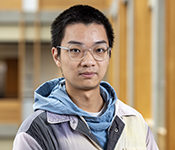 Allen School Ph.D. student Shangbin Feng aims to build a more open and democratic artificial intelligence future. To that end, his research focuses on model collaboration, where “multiple AI models, trained on different data, by different people, and thus possess diverse skills and strengths, collaborate, compose and complement each other.” In December, Feng was named among the 2026 class of NVIDIA Graduate Fellows in recognition of his work. The NVIDIA Graduate Fellowship program supports graduate students from around the world whose outstanding research puts them at the forefront of accelerated computing and is relevant to the company’s interests. Read more →
May 12, 2026
 At the recent ACM CHI Conference on Human Factors in Computing Systems (CHI 2026), Allen School researchers brought home multiple accolades for their innovative work in human-computer interaction (HCI) and artificial intelligence. Their projects ranged from interactive systems that allow users to collaborate with AI agents on projects with more flexibility, to an AI-based tool that helps screen-reader users make sense of geovisualizations, to a method for customizing LLM outputs based on user objectives — and much more. Read more →
May 5, 2026
 As the director of the Allen School’s Makeability Lab, Allen School professor and alum Jon Froehlich (Ph.D., ‘11) utilizes human-computer interaction (HCI) and machine learning to tackle high-impact socially relevant problems. Already, his work has led to improved city planning and sidewalk infrastructure across the globe, and he has developed technologies that enable blind and low-vision users to prepare meals, participate in sports and even engage with children’s artwork. The ACM Special Interest Group on Computer-Human Interaction (SIGCHI) recently honored Froehlich with its SIGCHI Societal Impact Award, which recognizes mid-career to senior researchers whose HCI work “demonstrates social benefit.” Read more →
April 7, 2026
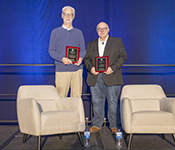 Although Allen School professor emeritus Richard Ladner started his career as one of the founders of the University of Washington’s theoretical computer science group, he has grown to become a leading researcher in accessible technology and an advocate for expanding access to computer science for students with disabilities.Through mentoring and advocacy, he has directly helped hundreds of students with disabilities to gain exposure to computing as a potential career path. The Association for Computing Machinery’s Special Interest Group on Computer Science Education (SIGCSE) recently recognized Ladner with the ACM SIGCSE Award for Outstanding Contribution to Computer Science Education. The award honors researchers who have made a long-lasting impact and significant contribution to computing education. Read more →
March 26, 2026
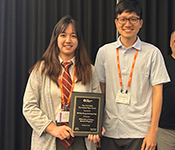 Program obfuscation, which aims to obscure the inner workings of a computer program while maintaining its functionality, is a central goal in cryptography and software protection. Allen School Ph.D. student Er-Cheng Tang and collaborator Mi-Ying (Miryam) Huang, a Ph.D. student at the University of Southern California recently developed the first quantum state obfuscation scheme for unitary quantum programs, which are the backbone of quantum computing, in the classical oracle model. Tang and Huang presented their research at the 66th IEEE Symposium on Foundations of Computer Science (FOCS 2025) last December where they received the Machtey Award for Best Student Paper. Read more →
March 12, 2026
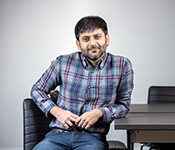 As a computer systems researcher, Allen School professor and alum Ratul Mahajan (Ph.D., ‘05) has helped develop technologies powering the networks that support multiple aspects of modern society — from operating online banking accounts to scrolling social media. The Association for Computing Machinery (ACM) recognized Mahajan among its for his groundbreaking “contributions to network verification and network control systems and their transfer to industrial practice.” Read more →
February 27, 2026
 Last month, the Computing Research Association (CRA) recognized a select group of undergraduate students from across North America who have made notable contributions to the field through research. This year’s cohort in the CRA Outstanding Undergraduate Researcher Awards included four Allen School undergraduates — awardee Haoquan Fang, finalist Hao Xu and honorable mention recipients Kaiyuan Liu and Lindsey Wei.
Read more →
Last month, the Computing Research Association (CRA) recognized a select group of undergraduate students from across North America who have made notable contributions to the field through research. This year’s cohort in the CRA Outstanding Undergraduate Researcher Awards included four Allen School undergraduates — awardee Haoquan Fang, finalist Hao Xu and honorable mention recipients Kaiyuan Liu and Lindsey Wei.
Read more →
February 19, 2026
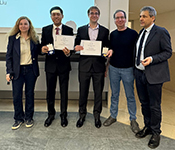 Allen School professor Thomas Rothvoss has carved a career out of complexity. As a member of the school’s Theory of Computation Group, Rothvoss examines the theoretical limits of computer algorithms that are designed to analyze large, complex datasets. His aim is to settle long-standing problems in the field of combinatorial optimization — an area where he has made notable progress since his arrival at the University of Washington in 2014. Last month, Rothvoss collected the inaugural Trevisan Prize in the mid-career category for his breakthrough contributions in the study of optimization problems. Read more →
February 9, 2026
 In the 1995 movie “Clueless,” lead character Cher Horowitz has a digital closet that allows her to virtually try on outfits. Proving some ideas never go out of style, Allen School professor Ira Kemelmacher-Shlizerman, director of the UW Reality Lab and member of the UW Graphics & Imaging Group (GRAIL), has spent the past two decades working to make that and other futuristic technologies a reality. The Institute of Electrical and Electronics Engineers (IEEE) recently recognized her in the 2026 class of IEEE Fellows for her “contributions to face, body, and clothing modeling from large image collections.” Read more →
February 3, 2026
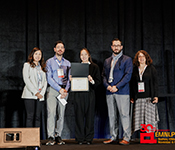 As large language models become more popular and widespread, it becomes increasingly important to understand the composition of their training data and how it affects the model’s behavior. The first step is to make these texts searchable. To make searching on such a large scale more efficient and affordable, researchers at the University of Washington and Allen Institute for Artificial Intelligence (Ai2) developed
infini-gram mini, an efficient search engine designed to handle exact-match search on arbitrarily long queries across Internet-scale corpora with minimal storage overhead. The team received the Best Paper Award at the 2025 Conference on Empirical Methods in Natural Language Processing (EMNLP) last November. Read more →
As large language models become more popular and widespread, it becomes increasingly important to understand the composition of their training data and how it affects the model’s behavior. The first step is to make these texts searchable. To make searching on such a large scale more efficient and affordable, researchers at the University of Washington and Allen Institute for Artificial Intelligence (Ai2) developed
infini-gram mini, an efficient search engine designed to handle exact-match search on arbitrarily long queries across Internet-scale corpora with minimal storage overhead. The team received the Best Paper Award at the 2025 Conference on Empirical Methods in Natural Language Processing (EMNLP) last November. Read more →
January 29, 2026
Older Posts »