UW CSE generates three of the 10 “Best of UW” news stories of 2015

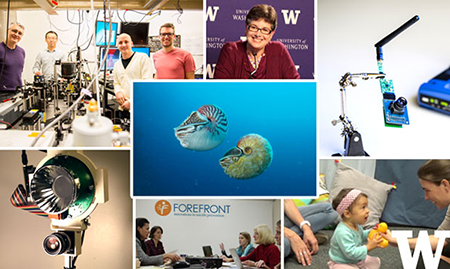
Best of UW 2015 image collageWe love data here at UW CSE – especially when it makes us look good. And we’re looking pretty good as 2015 comes to a close: according to our friends in UW’s Office of News & Information, UW CSE research inspired three of their 10 most viewed news stories over the past year. So join us in raising a toast to the amazing year that was – and to our amazing faculty and students!

Here are the ways UW CSE has been making headlines, according to the “Best of UW,” 2015 edition:

Popular Science names ‘Power Over Wi-Fi’ one of the year’s game-changing technologies

A team of UW CSE and EE researchers earned accolades for developing a novel way to power devices by tapping into a readily available, but largely ignored, energy source: the signals emitted by your WiFi router. Popular Science included the project affectionately known as “PoWiFi” in its annual “Best of What’s New” awards in November after researchers demonstrated its ability to power a small camera and temperature sensor without degrading the quality of the Wi-Fi signal. (UW CSE professor Shyam Gollakota; CSE and EE professor Josh Smith, EE graduate students Vamsi Talla, Bryce Kellogg and Saman Naderiparizi; and former CSE postdoc Ben Ransford)

Affordable camera reveals hidden details invisible to the naked eye

In October, members of the Ubiquitous Computing Lab and Microsoft Research revealed HyperCam, an affordable hyperspectral imaging camera that can capture what lies beneath the surface of an object, such as the veins in your hand or the flesh of an avocado. The technology could be used for a host of health and safety and consumer applications, from food quality monitoring, to biometric security, to gaming. (UW CSE and EE professor Shwetak Patel; CSE professor Gaetano Borriello; CSE graduate students Mayank Goel, Eric Whitmire and Alex Mariakakis; and Scott Saponas, Neel Joshi, Dan Morris, Brian Guenter and Marcel Gavriliu of Microsoft Research)

New UW app can detect sleep apnea events via smartphone

UW CSE and the UW Medicine Sleep Center collaborated on the development of an affordable, contactless mobile phone app that is capable of detecting sleep apnea, a respiratory disorder that affects one in 13 Americans, without requiring patients to leave their bedrooms. In 300 hours of testing, ApneaApp was shown to be 95 to 99 percent accurate in tracking respiratory events compared to the more costly – and much less convenient – intensive polysomnography test. (UW CSE professor Shyam Gollakota; CSE graduate student Rajalakshmi Nandakumar; and Dr. Nathaniel Watson of the UW Medicine Sleep Center)

View the complete list of the “Best of UW” in 2015 here. Go team! Read more →
UW Center for Sensorimotor Neural Engineering scores major NSF funding to reanimate paralyzed limbs

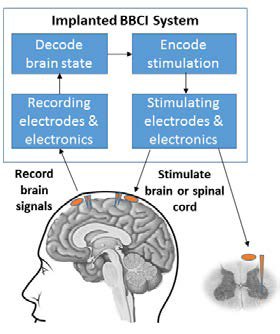
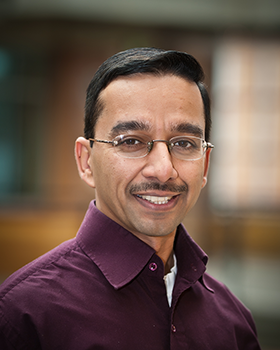
Raj RaoThe Center for Sensorimotor Neural Engineering, led by UW CSE professor Raj Rao, will receive $16 million over the next four years from the National Science Foundation to support the development of implantable devices that will enable patients who have suffered stroke or spinal cord injury to move again. The new funding will enable CSNE to continue its groundbreaking work on bi-directional brain-computer interfaces that interpret and wirelessly transmit brain signals across damaged regions of the nervous system.

From the UW News release:

“‘There’s a huge unmet need, especially with an aging population of baby boomers, for developing the next generation of medical devices for helping people with progressive or traumatic neurological conditions such as stroke and spinal cord injury,’ said CSNE director and UW professor of computer science and engineering Rajesh Rao….

“‘When Christopher Reeve sustained a spinal cord injury due to a fall from his horse, his brain circuits were still intact and able to form the intention to move, but unfortunately the injury prevented that intention from being conveyed to the spinal cord,’ Rao said.

“‘Our implantable devices aim to bridge such lost connections by decoding brain signals and stimulating the appropriate part of the spinal cord to enable the person to move again.'”

Brain interface graphicCSNE researchers aim to not only restore movement with the new devices, but also to promote brain plasticity and enable rehabilitation of the affected areas. Rao and his colleagues intend to conduct proof-of-concept demonstrations in humans within the next five years. They are also working to improve existing implantable technologies—for example, deep brain simulators used to treat people with Parkinson’s disease—to reduce negative side effects and cut down on the number of replacement surgeries required for patients living with such devices.

CSNE was first established with an initial grant from NSF in 2011. The center engages faculty and students in computer science, engineering, neuroscience and other disciplines from the UW, MIT, San Diego State University, the University of British Columbia and several other academic and industry partners.

Read the full UW media release here and a great article in the Seattle Times here. Learn more about CSNE by visiting its website here.

Congratulations to Raj and the entire CSNE team! Read more →

Kathryn Barnard, 1938-2015

kbThere are many reasons why the University of Washington’s School of Nursing has consistently been ranked among the very best in the nation. One of them is Kathryn Barnard, who passed away on June 27 at the age of 77.

Kathryn was one of 29 individuals profiled in today’s New York Times Magazine, in the annual “The Lives They Lived” issue that marks the end of the year. She was an internationally recognized pioneer in the field of infant mental health, which studies the social and emotional development of children during the first five years of life. She was a renowned researcher, teacher and innovator.

Read the New York Times Magazine profile here. Read more →

UW CSE Ph.D. alum Igor Mordatch aims to teach robots to learn for themselves

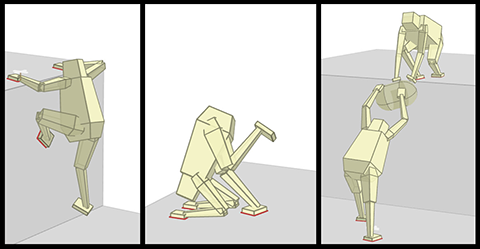
Robot learningUW CSE alum Igor Mordatch (Ph.D., ’15), now a postdoc at UC Berkeley, is attracting attention for his efforts to enable robots to teach themselves how to perform complex movements and tasks. Mordatch’s latest work, which is featured in MIT Technology Review, relies in part on his past collaboration with UW CSE professors Emo Todorov, who leads the Movement Control Laboratory, and Zoran Popović, director of the Center for Game Science.

From the article:

“For all the talk of machines becoming intelligent, getting a sophisticated robot to do anything complex, like grabbing a heavy object and moving it from one place to another, still requires many hours of careful, patient programming.

“Igor Mordatch, a postdoctoral fellow at the University of California, Berkeley, is working on a different approach–one that could help hasten the arrival of robot helpers, if not overlords. He gives a robot an end goal and an algorithm that lets it figure out how to achieve the goal for itself….

“As he works on a better teaching process, Mordatch is mainly using software that simulates robots. This virtual model, first developed with his Ph.D. advisor at the University of Washington, Emo Todorov, and another professor at the school, Zoran Popović, has some understanding of how to make contact with the ground or with objects. The learning algorithm then uses these guidelines to search for the most efficient way to achieve a goal.”

Read the full article here, and check out our previous blog post on Mordatch’s work here. Read more →

UW’s Ubicomp Lab and Oculus VR develop magnetic sensing technology for virtual reality

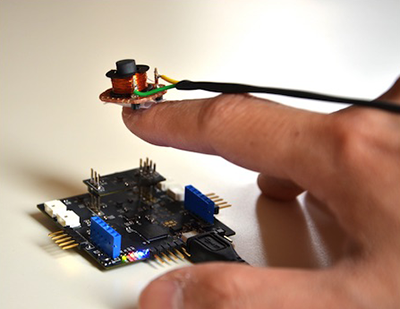
Ke-Yu Chen and Shwetak PatelThe Ubiquitous Computing Lab led by UW CSE and EE professor Shwetak Patel has teamed up with virtual reality pioneer Oculus VR on the development of a novel system for precisely tracking finger movements that could pave the way for a more immersive and elegant virtual reality experience.

The system, called Finexus, uses four magnetometers to track small electromagnets placed on a user’s fingertips. Unlike camera-based motion tracking systems, the new technology does not require a direct line of site between the sensor and the magnets to accurately determine a user’s movements.

From an article in MIT Technology Review:

“A research project may hint at how Facebook’s Oculus device will let you explore virtual reality someday: by using a bunch of electromagnets and sensors to track the motions of your individual fingers in three dimensions….

Keyu Chen, a graduate student at the University of Washington’s Finexusubiquitous-computing lab, started the project while he was an intern at Oculus Research in Redmond, Washington, last summer. He imagines Finexus being used for games as well as tasks that require a variety of delicate finger motions, like playing a virtual piano, painting, or writing in the air….

“The interactions Chen imagines could be more detailed than what many of us will experience early on with virtual reality.”

The team, which includes Patel, Chen (an EE Ph.D. candidate), and Oculus researcher Sean Keller, will present Finexus at CHI 2016 in San Jose, California next May.

Read the full article here and watch a video demonstration of Finexus here. Read more →

A holiday thank you to UW Facilities Services

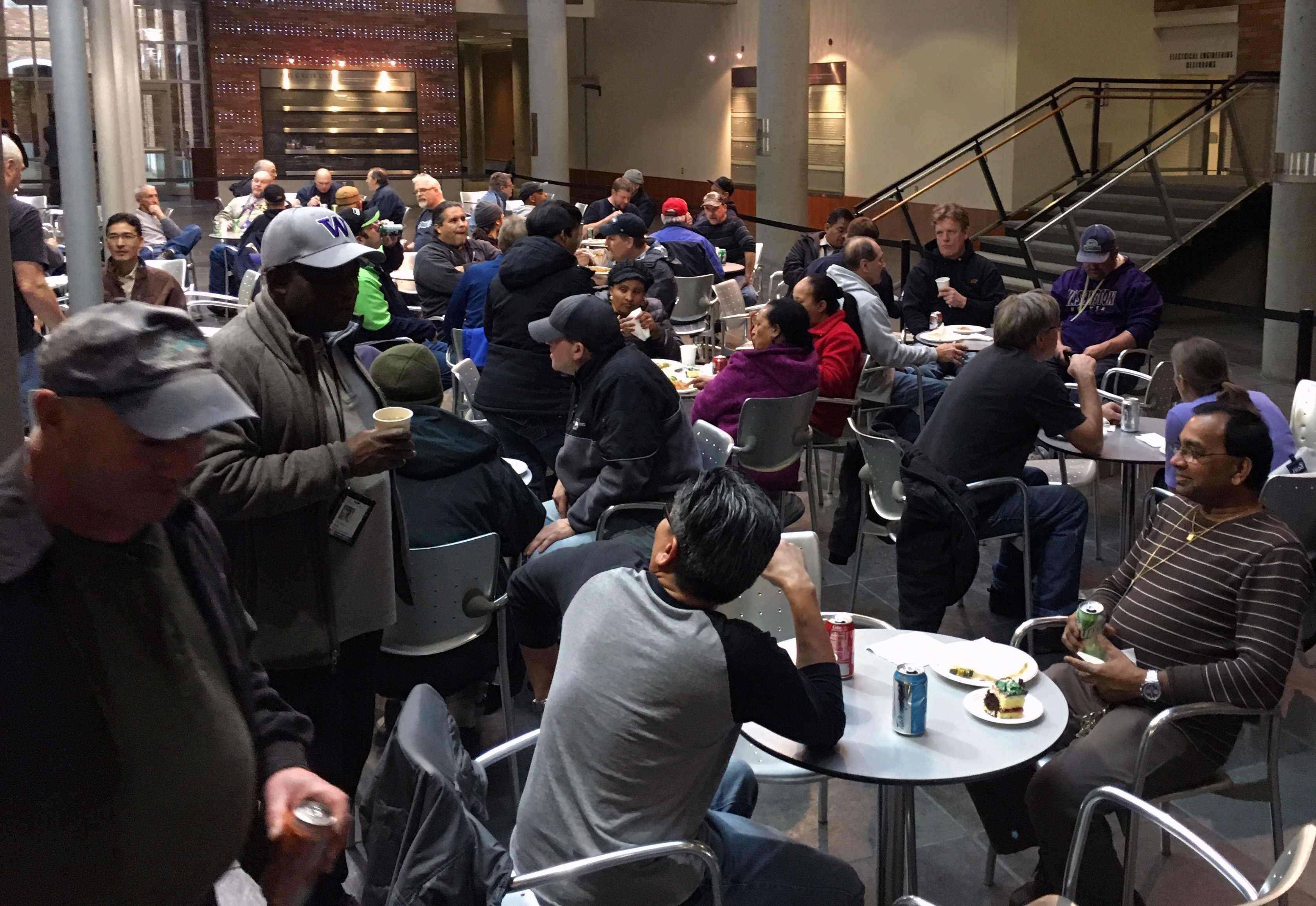
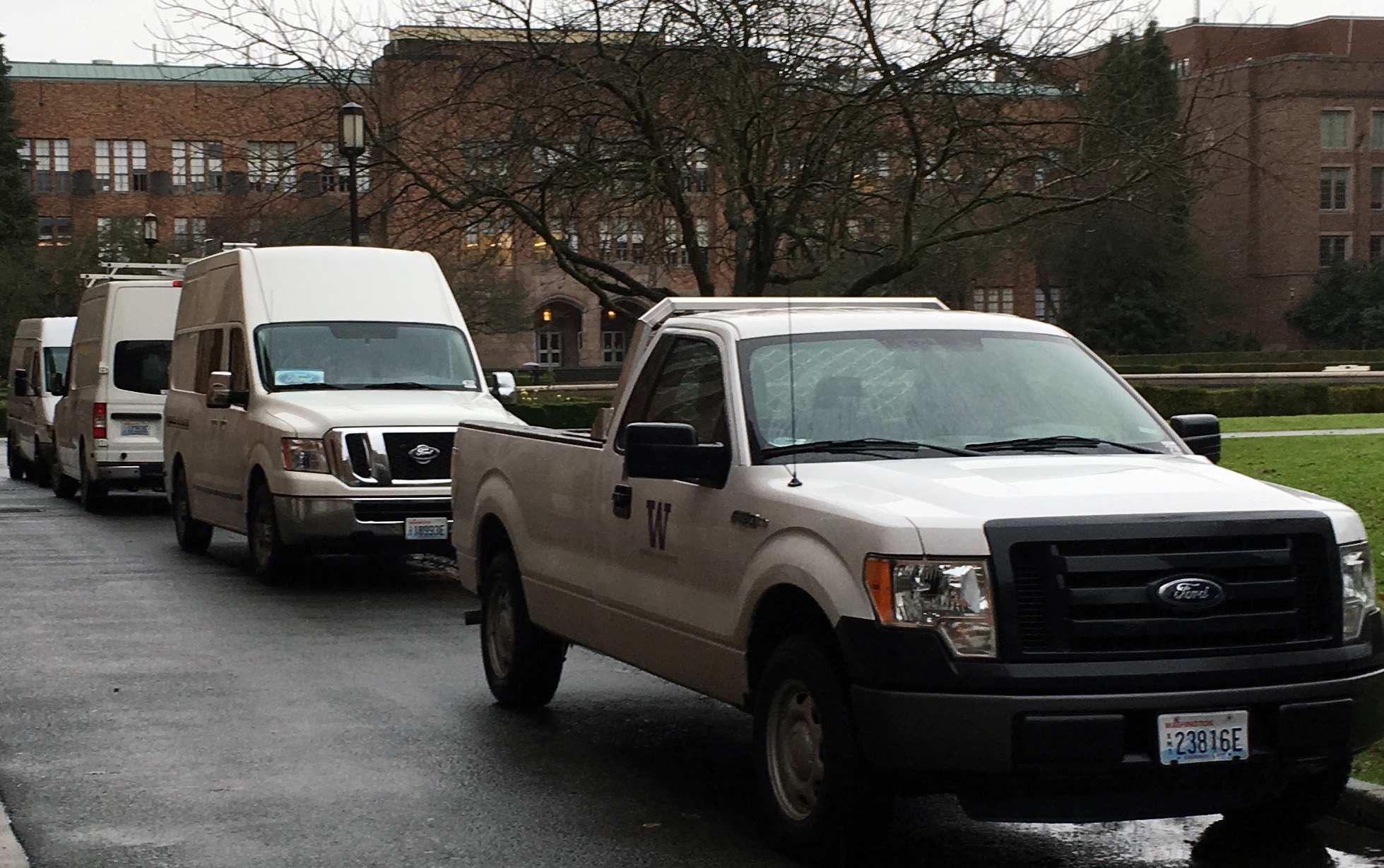
IMG_6071Monday marked UW CSE’s annual holiday luncheon for our friends from UW Facilities Services – the men and women who keep the Paul G. Allen Center for Computer Science & Engineering looking great and working great. 110 Facilities Services professionals joined us.
Thanks for all you do! IMG_6066

IMG_6065 Read more →

UW CSE’s Ed Lazowska in the Seattle Times: “Now is the wrong time and the UW is the wrong place for a unionized faculty”

c35be5f4-a5c9-11e5-9c4b-70aea859ce73-1560x1500UW CSE’s Ed Lazowska and UW Chemistry’s Paul Hopkins in a Sunday Seattle Times op-ed regarding the effort by the Service Employees International Union to represent UW faculty:

“Unionization is like throwing sand in the gears of what is, by any measure, an institution that performs at an extraordinarily high level.”

Read the op-ed here. Visit the UW Excellence website here.

(This op-ed represents the personal opinion of Lazowska and Hopkins.) Read more →

UW CSE’s Luis Ceze speaks on “The Record” about groundbreaking DNA data storage research

Luis CezeUW CSE professor Luis Ceze spoke to Bill Radke on NPR radio station KUOW yesterday about the DNA data storage project spearheaded by the UW’s Molecular Information Systems Lab and Microsoft Research.

Speaking on “The Record,” Ceze explained what makes DNA attractive to computer scientists as a storage vehicle, pointing out that “nature evolved it and tested it for us.” He also noted that, as DNA is unlikely to become obsolete any time soon (unlike those old floppy disks sitting in your desk drawer), it is the ideal storage technology for archiving all of human knowledge for posterity.

“As long as there is DNA-based life on earth, there will be DNA,” Ceze said.

When Radke asked what interested him personally in the project, Ceze cited the importance of preserving history – and learning from it.

“Think of it as a data trust fund…The same way that archaeology learns about the past today, we could enable future digital archaeologists.”

Listen to the full interview here, and read the New York Times article on the DNA data storage project here. It’s just one example of many wonderful partnerships between UW and Microsoft Research. Read more →

PLSE fashion statement …

PLSE

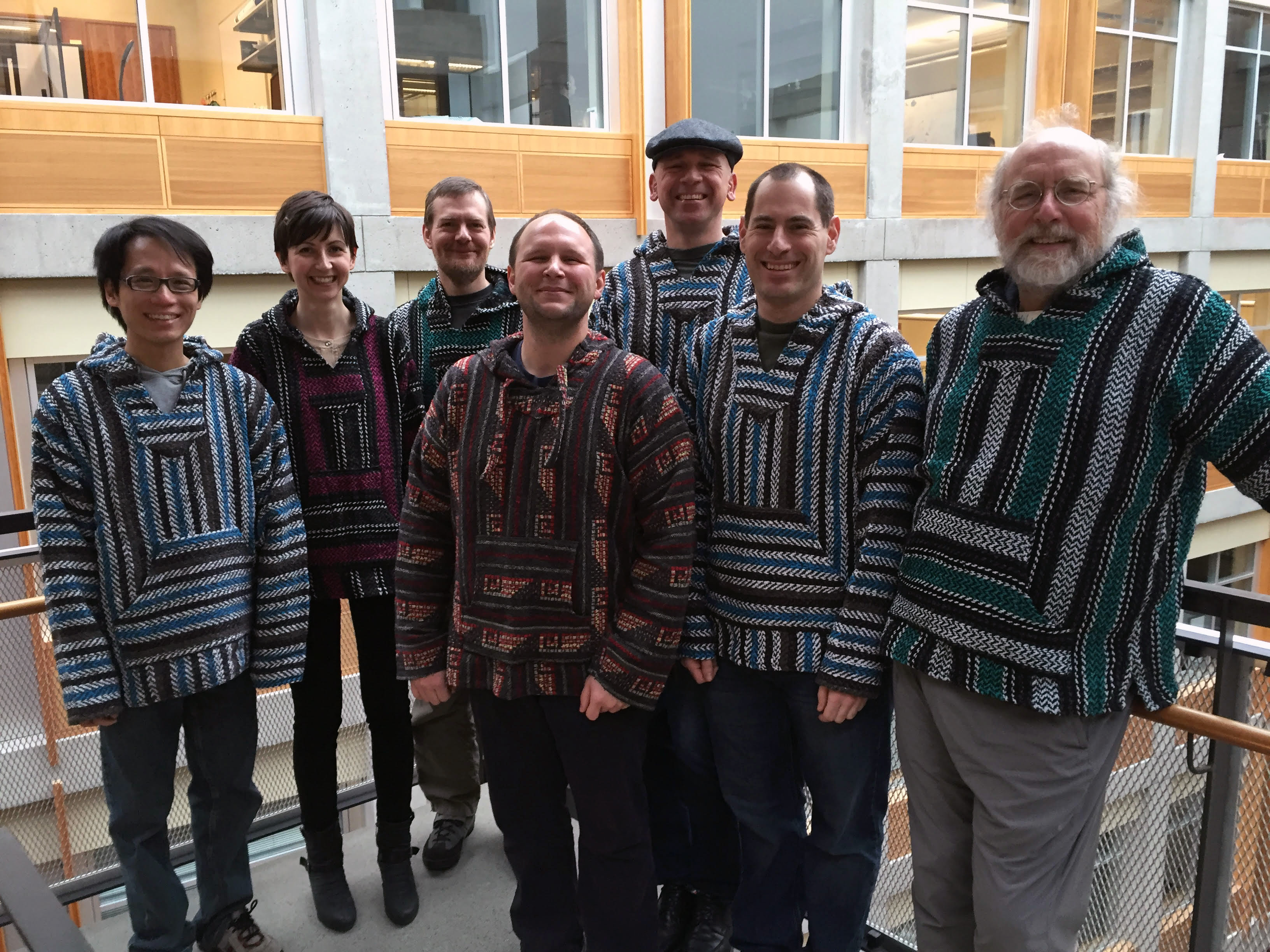
UW CSE PLSE faculty Alvin Cheung, Emina Torlak, Mike Ernst, Zach Tatlock, Ras Bodik, Dan Grossman, and Alan Borning

The UW CSE PLSE (Programming Languages and Software Engineering) faculty – following their domination of the faculty skit at the UW CSE holiday party (Ras Bodik as Linus, Alvin Cheung as Schroeder, Zach Tatlock as Charlie Brown, and Emina Torlak as Little Red-Haired Girl) – salute 2015 on its way out the door by making a fashion statement in their new Zach Tatlock lookalike outfits! Read more →

UW CSE leads the nation in CRA Outstanding Undergraduate Researcher Awards

Krittika D'Silva, Darby Losey, Daryl Zuniga Each year, the Computing Research Association recognizes stellar undergraduate students throughout North America in its Outstanding Undergraduate Researcher Awards program. This year, three UW CSE students – Krittika D’Silva, Darby Losey and Daryl Zuniga – were cited by CRA for excellence in research as part of its 2016 competition.

Krittika D’Silva, who was named a finalist by CRA, is completing a double major in computer engineering and bioengineering. She worked with the late professor Gaetano Borriello and Ph.D. alum Nicki Dell in UW CSE’s ICTD Lab, where she developed hands-free smartphone technology for use by health care providers in low-resource settings. D’Silva also worked on the CGNet Swara app for Android. The app, which leveraged a popular interactive voice forum in India to enable citizen journalism in remote areas, was featured in National Geographic. Currently, she works with Luis Ceze researching ways in which DNA molecules can be used for long-term data storage – read a recent New York Times article on this work here, and listen to a KUOW interview withi Ceze here.

Darby Losey and Daryl Zuniga each received honorable mentions. Losey is an honors candidate in computer science and neurobiology. He works with UW CSE professor Raj Rao on the development of non-invasive brain-computer interfaces. Zuniga, who is co-advised by Dan Grossman and Zach Tatlock in UW CSE’s Programming Languages & Software Engineering group, is working on verifying peephole optimizations for compilers.

In the past 10 years, the University of Washington has had 28 students recognized in the CRA Outstanding Undergraduate Researcher Awards competition – more than any other school. Princeton is nipping at our heels with 27, followed by Cornell (23), Harvey Mudd (22), UC Berkeley (19), the University of Virginia (19), Harvard (17), the University of Illinois (16), and Carnegie Mellon (15). Find more information on the CRA Outstanding Undergraduate Researcher Awards here.

Congratulations, Krittika, Darby and Daryl – you make UW CSE proud! Read more →

Older Posts »