Holy cow! UW CSE alum Joe Heitzeberg launches crowdsourced cattle-sharing venture

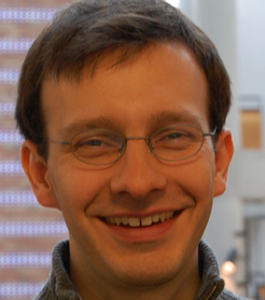
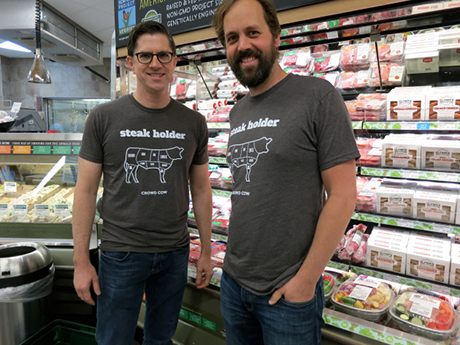
Joe Heitzeberg and Ethan Lowry

Joe Heitzeberg (left) and Ethan Lowry (Kurt Schlosser/GeekWire)

Crowd Cow, a new company launched by UW CSE alum Joe Heitzeberg (B.S., ’05) and fellow startup veteran Ethan Lowry, offers a different kind of meat market—one in which Northwest steak lovers become “steak holders” by crowdsourcing their evening meal.

Unlike typical cattle-sharing arrangements that require a significant investment in freezer space, Crowd Cow enables customers to purchase only the quantity and cuts that they want online, from sources that are committed to sustainable and humane practices. By tapping into the crowdsourcing trend and uniting quality with convenience, the company hopes to transform the way people shop for meat.

From a recent article on GeekWire:

“Crowd Cow removes the mystery by working directly with select Washington ranches that are producing the best possible meat from start to finish. It also brings a high-tech sensibility to the age-old practice of processing and buying meat, taking the crowdsourced funding techniques popular among tech products and non-profit initiatives and applying them to the pasture, instead….

“The first cow, or ‘event’ as they call it, was launched with an email to 100 friends. Six hundred people ended up coming to the site, and Lowry and Heitzeberg knew they were on to something.

“‘We knew the mechanics of crowdfunding as a way to engage an audience and essentially pre-sell something….We’re the only online retailer, that I can find, where you can buy meat and know exactly where it came from, from a variety of ranchers, of the exact cuts and quantity you want,’ Heitzeberg said.”

Read the full GeekWire article here, and check out the KOMO 4 News story here. Read more →
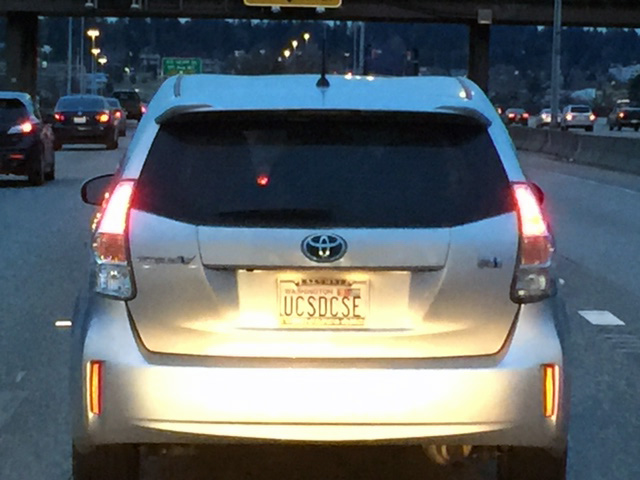
Repel the invaders from California!

IMG_4366

Photo by UW CSE professor and hands-free driver Mark Oskin

We in UW CSE have been pretty laid back about the migration of Californians to Seattle. Sure, they drive up our housing prices, crowd our roads, and take our jobs, but what’s not to like?

What’s not to like is this license plate! We send many of our best Ph.D. alums to UCSD to build a world class computer science department, and they respond with propaganda like this?

We’re with Donald! It’s time to close the borders!

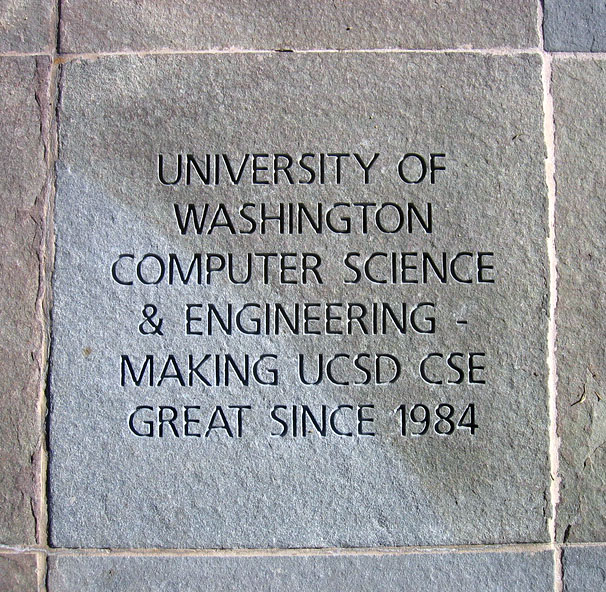
uw-tile(OK, maybe it’s payback for the paver we purchased in front of UCSD CSE’s new building 9 years ago …) Read more →

Where are the STEM jobs, 2014-2024?

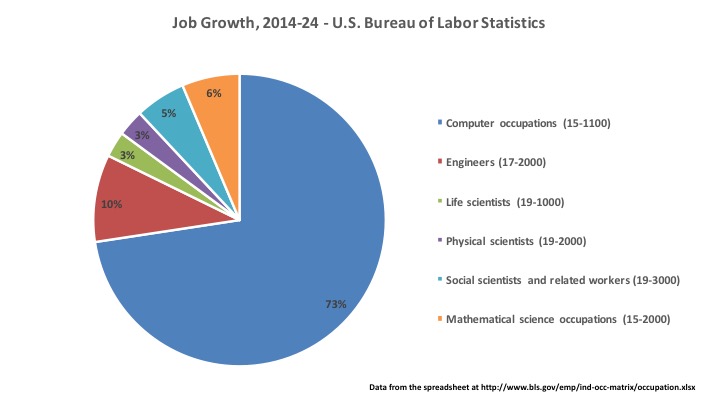
Slide1Better late than never, the U.S. Bureau of Labor Statistics has released its workforce projections for the decade 2014-2024.

We focus here on STEM jobs – jobs in computer science, engineering, the life sciences, the physical sciences, the social sciences, and the mathematical sciences.

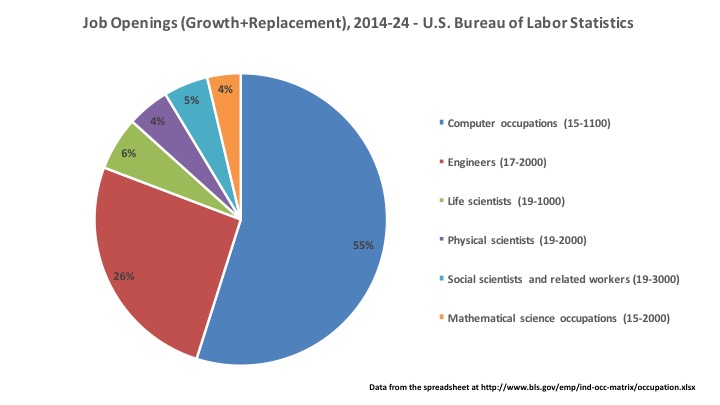
BLS projects both job growth (newly-created jobs) and job openings (all available jobs, whether newly-created or available due to retirements).

Slide2BLS projects that 73% of all job growth in STEM between 2014 and 2024 will be in computer occupations. (This is up from 71% in the 2012-2022 projections. Engineering fields are down to 10% from 15%.)

BLS projects that 55% of all available jobs in STEM between 2014 and 2024, whether newly-created or available due to retirements, will be in computer occupations – 1,083,800 jobs during the decade, more than 100,000 per year. (We’re a younger field – fewer retirements.)

Whoaboy!

(BLS data from Table 1.2 here.) Read more →

UW researchers shine at CSCW 2016

Our friends at Georgia Tech’s GVU Center prepared an interactive graphic showing the number of papers and authors by organization at the upcoming ACM Conference on Computer-Supported Cooperative Work and Social Computing (CSCW 2016). UW tops the list, with 15 papers at the conference representing contributions from 46 distinct authors—ahead of such heavyweights as Carnegie Mellon, Cornell, MIT and Georgia Tech itself. The variety of submissions involving UW authors illustrates the strength of our collaboration across multiple departments and with outside research organizations, and teams with UW authors earned a total of three Best Paper Awards and three Honorable Mentions.

CSCW

The award-winning paper Boundary Negotiating Artifacts in Personal Informatics: Patient-Provider Collaboration with Patient-Generated Data is  the product of a collaboration between UW CSE professor James Fogarty, HCDE professors and CSE adjuncts Julie Kientz and Sean Munson, HCDE Ph.D. students Chia-Fang Chung and Kristin Dew, Family Medicine professor Allison Cole and physician Jasmine Zia. The paper examines how patients and providers collaborate in the age of patient-generated data enabled by wearable sensors and smartphone apps, and makes recommendations for the future development of personal informatics systems and practices to address privacy concerns and remove barriers to more effective patient-provider collaboration.

Another Best Paper winner, You Get Who You Pay for: The Impact of Incentives on Participation Bias, was co-authored by HCDE professor (and CSE adjunct) Gary Hsieh and HCDE Ph.D. student Rafal Kocielnik. That paper examines how incentives influence who participates in crowdsourced tasks, and how participant self-selection results in different outcomes.

Other CSCW contributors with a UW CSE connection include UW CSE professors Oren Etzioni, Jeffrey Heer and Dan Weld; Ph.D. students Jonathan Bragg and Shih-Wen Huang; and HCDE professors and CSE adjuncts Cecilia Aragon, Daniela Rosner and Kate Starbird (whose papers earned Honorable Mentions) and iSchool professor and CSE adjunct Jacob Wobbrock.

Check out the GVU Center graphic here and explore the complete list of CSCW papers here.

Way to go, everyone! Read more →

Computer scientists power our region’s aerospace industry!

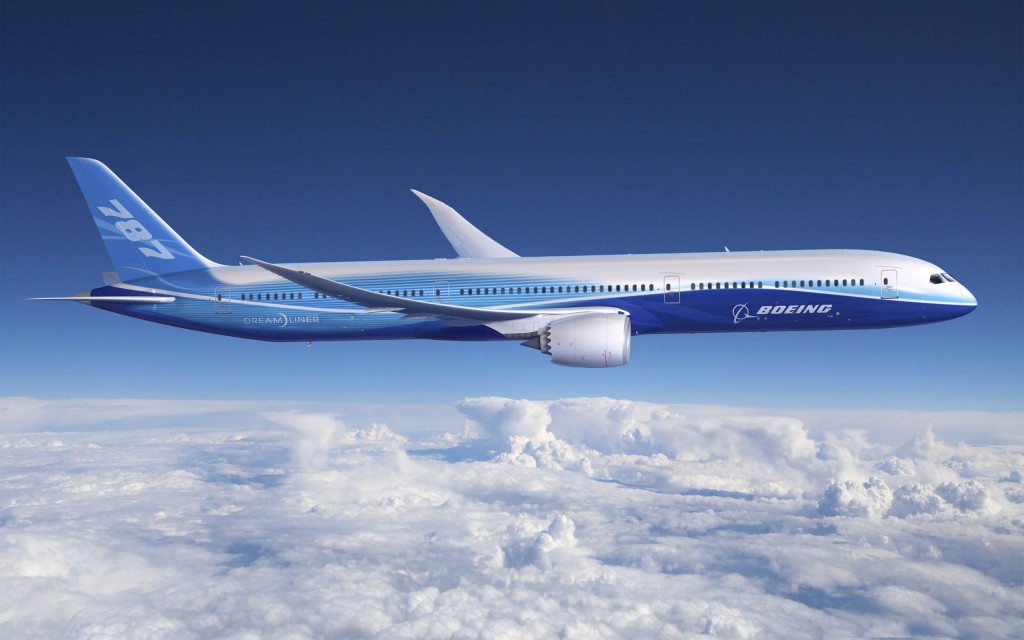
boeing-787-dreamlinerWashington state – and particularly King County Washington, Seattle’s home – is a leader in aerospace and in information technology. There’s no news there.

What is news comes from an ongoing study of King County’s aerospace industry talent pipeline by Community Attributes Inc. working with the Workforce Development Council of Seattle – King County:

  • What field has the largest total number of current employees in King County’s aerospace industry? COMPUTER SCIENCE
  • What field has the greatest predicted number of new employees needed by King County’s aerospace industry from 2013-2023? COMPUTER SCIENCE
  • What field has the greatest predicted compound annual growth rate for King County’s aerospace industry from 2013-2023? COMPUTER SCIENCE
  • What field has the greatest predicted annual gap between supply and demand for King County’s aerospace industry from 2013-2023 (where “supply” is not “degrees granted” but rather the industry’s current ability to hire)? COMPUTER SCIENCE

The bottom line: the importance of computer science extends far beyond Washington’s world-leading software industry – for example, it powers Washington’s world-leading aerospace industry. Every field is becoming an information field. Computer science is increasingly central to everything – great preparation for any career.

Check it out here. And check out an excellent related GeekWire post here.

(In this context, it’s also worth noting that more people are employed in Washington state’s software industry than in our aerospace industry.) Read more →

Watch, listen and read: UW’s Shwetak Patel and “The Human Face of Big Data”

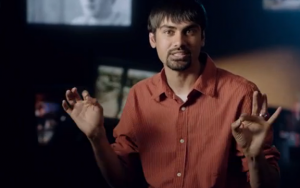
Shwetak Patel in The Human Face of Big DataLast night the new documentary The Human Face of Big Data premiered on PBS. UW CSE and EE professor Shwetak Patel contributed his expertise and insights to the film, which examines how the vast amounts of data collected in our increasingly connected world is changing the way we live and shaping our future. As big data’s big night approached, Patel and executive producer Rick Smolan joined Jeremy Hobson, host of NPR’s “Here & Now,” to talk about the anticipated benefits and potential pitfalls associated with the age of big data.

One of the benefits Patel highlighted was health care. In contrast to the traditional visit to a doctor’s office, where a patient’s vitals are taken and perhaps more tests are ordered to come up with a diagnosis, “Think about what you could do if you could collect physiological information throughout the day, and in non-invasive ways,” he suggested, “and then using artificial intelligence and machine learning to gain some interesting insights about what may happen in the future…to diagnose and predict disease before it’s too late.”

Another topic discussed by the trio was the need for transparency around what data is being collected and how it is being used. Patel agreed that it is a conversation we need to have, and that technology could help broker that. “One of the issues is that people really don’t know what’s possible with the data and what’s actually happening behind the scenes,” he said.

Although on the one hand, many people may react negatively to the concept of big data, Patel noted that they are “voting with their feet” by using the apps and services. “At the end of the day, it’s really the data analytics that’s enabled this whole technology revolution and this new paradigm,” he said.

Listen to the full interview on the NPR website, and watch clips from the documentary online courtesy of PBS. Also check out related coverage on GeekWire and the original book on which the film is based. Read more →

UW’s Passive Wi-Fi named one of the 10 breakthrough technologies of 2016

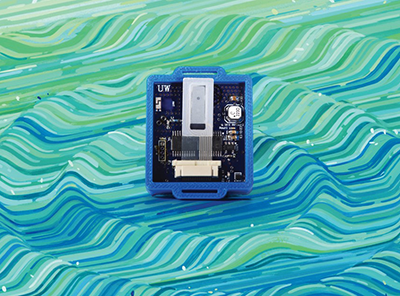
Passive Wi-FiPassive Wi-Fi, a new low-power Wi-Fi communications system developed by researchers at UW CSE and EE, has been named one of MIT Technology Review’s 10 Breakthrough Technologies of 2016. The system, which can generate Wi-Fi transmissions using 10,000 times less power than conventional methods, was developed in UW CSE professor Shyam Gollakota’s Networks & Mobile Systems Lab by a team that includes EE graduate students Bryce Kellogg and Vamsi Talla and joint UW CSE and EE professor Joshua Smith.

From the article:

“Even the smallest Internet-connected devices typically need a battery or power cord. Not for much longer. Technology that lets gadgets work and communicate using only energy harvested from nearby TV, radio, cell-phone, or Wi-Fi signals is headed toward commercialization. The University of Washington researchers who developed the technique have demonstrated Internet-connected temperature and motion sensors, and even a camera, powered that way….

“One version of the University of Washington technology, dubbed passive Wi-Fi, is being commercialized through a spin-off company, Jeeva Wireless. It lets battery-free gadgets connect with conventional devices such as computers and smartphones by backscattering Wi-Fi signals. In tests, prototype passive Wi-Fi devices have beamed data as far as 100 feet and made connections through walls.”

A UW News release explains how the team decoupled the digital and analog operations involved in transmitting the signals, assigning the power-intensive analog functions to a single device plugged into a wall. Passive sensors can then produce Wi-Fi packets using very little energy by reflecting and absorbing the signal using a digital switch—enabling communication with any Wi-Fi-enabled device straight out of the box.

“‘We wanted to see if we could achieve Wi-Fi transmissions using almost no power at all,’ said co-author Shyam Gollakota…’That’s basically what Passive Wi-Fi delivers. We can get Wi-Fi for 10,000 times less power than the best thing that’s out there….’

“Aside from saving battery life on today’s devices, wireless communication that uses almost no power will help enable an ‘Internet of Things’ reality where household devices and wearable sensors can communicate using Wi-Fi without worrying about power.”

The team will present its research paper on Passive Wi-Fi at the NSDI 2016 conference next month.

Read the MIT Technology Review article here. Read the UW news release here, and watch our video demonstrating Passive Wi-Fi here. Also check out some of the great coverage of this story by the Seattle Times, Wired, Ars TechnicaPC World, GizmodoGeekWire and local ABC affiliate KOMO 4 News.

Image: MIT Technology Review Read more →

Zootopia @ UW CSE

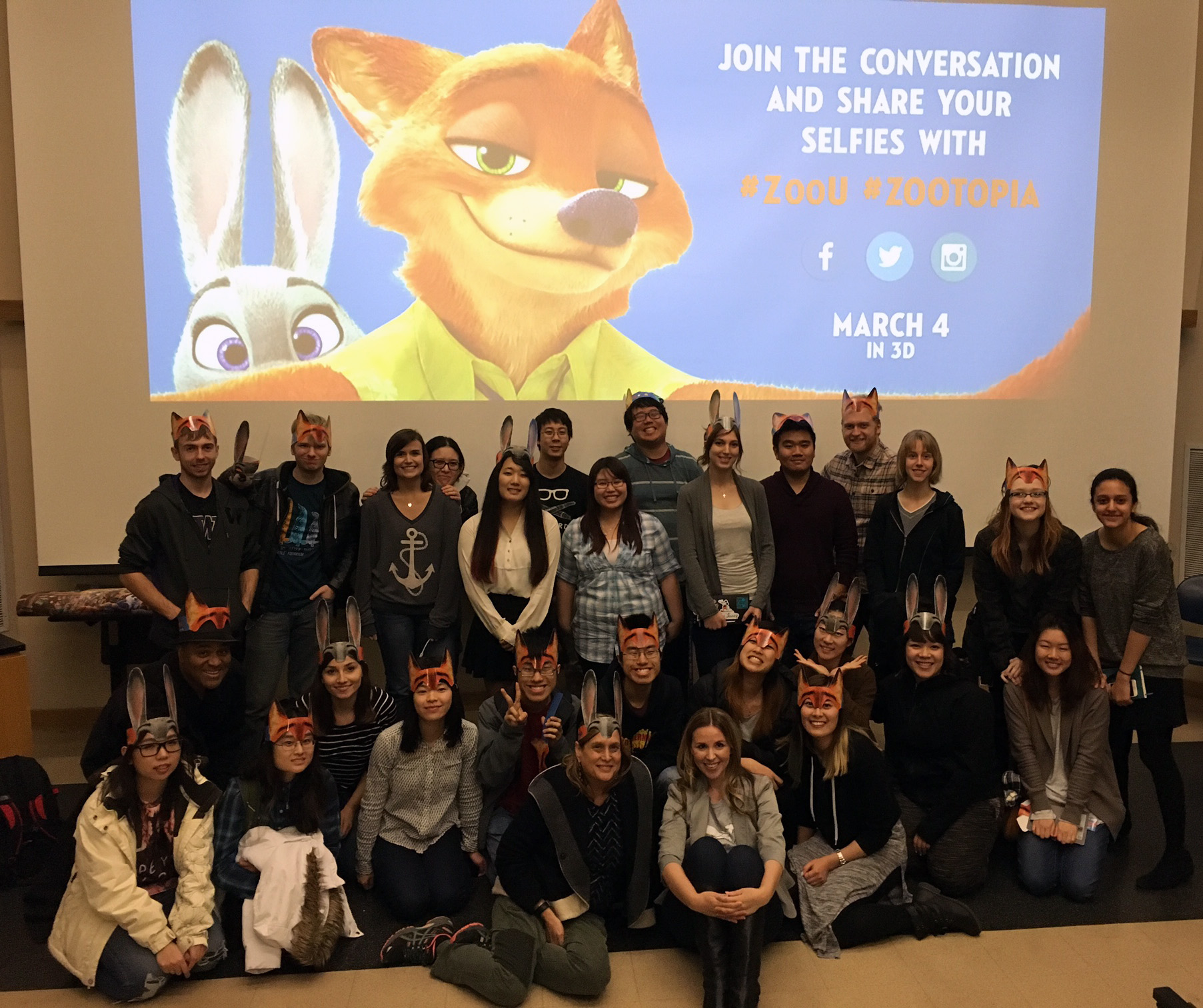
PosterUW’s Animation Research Labs, led by CSE’s Barbara Mones, brings students from CSE, Art, Music, and other programs together each year for an intensive set of capstone courses in digital animation, culminating in the production of an animated short shown at our graduation ceremony (and often at major festivals).

On Monday, UW CSE / ARL alum Kira Lehtomaki, who joined Walt Disney Animation Studios in 2007, enthralled current students with a special behind-the-scenes Q&A.

See a subsequent interview with Kira here.

Kira Read more →

UW CSE’s Emina Torlak, Mike Cafarella, Roxana Geambasu win Sloan Research Fellowships

Emina Torlak

Emina Torlak

UW CSE professor Emina Torlak and Ph.D. alums Mike Cafarella and Roxana Geambasu were recognized by the Alfred P. Sloan Foundation today with Sloan Research Fellowships. Recipients of these prestigious awards are nominated by their peers and selected by the foundation based on their early-career research accomplishments and for showing outstanding promise of making fundamental contributions to their fields.

From the Sloan Foundation news release:

“‘Getting early-career support can be a make-or-break moment for a young scholar,’ said Paul L. Joskow, President of the Alfred P. Sloan Foundation. ‘In an increasingly competitive academic environment, it can be difficult to stand out, even when your work is first rate. The Sloan Research Fellowships have become an unmistakable marker of quality among researchers. Fellows represent the best-of-the-best among young scientists.'”

Mike Cafarella

Mike Cafarella

Torlak is a member of our Programming Languages & Software Engineering (PLSE) group and develops tools and programming models for computer-aided design, verification and synthesis of software. She was recently named the winner of the 2016 junior AITO Dahl-Nygaard Prize, an award that recognizes an early-career researcher who demonstrates exceptional potential in the area of programming and simulation. Torlak becomes one of 20 current UW CSE faculty members who have held one of these prestigious fellowships.

Cafarella is on the faculty of University of Michigan. His research focuses on databases, information extraction, data mining and data integration. He completed his UW CSE Ph.D. in 2009 working with professors Dan Suciu and Oren Etzioni.

Geambasu is a professor at Columbia University. Her research spans distributed systems, operating systems, databases, security and privacy. She completed her UW CSE Ph.D. in 2011 working with professors Hank Levy and Yoshi Kohno.

Roxana Geambasu

Roxana Geambasu

The Sloan Foundation awards a total of 126 fellowships each year to early-career researchers across the United States and Canada, based on nominations from their fellow scientists, spread across eight fields: chemistry, computer science, economics, mathematics, computational and evolutionary molecular biology, neuroscience, ocean sciences and physics. 16 were awarded this year in computer science.

Read the complete list of 2016 fellowship recipients here, the Sloan Foundation press release here and the UW News release here.

Congratulations, Emina, Mike and Roxana! Read more →

UW CSE’s Emina Torlak wins 2016 AITO Dahl-Nygaard Prize

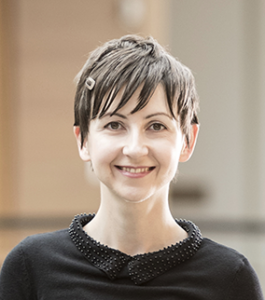
Emina TorlakUW CSE professor Emina Torlak has been named the recipient of the 2016 Dahl-Nygaard Junior Prize from the Association Internationale pour les Technologies Objets (AITO), an organization devoted to advancing research in object-oriented technology. Torlak—a member of UW CSE’s Programming Languages & Software Engineering group (PLSE), which is widely recognized as one of the best in the business—will be honored at the European Conference on Object-Oriented Programming (ECOOP) in Rome this summer.

The Dahl-Nygaard Junior Prize recognizes an early career researcher who demonstrates exceptional potential in the areas of programming and simulation. The prize is named for Ole-Johan Dahl and Kristen Nygaard, whose pioneering work in object-oriented programming transformed software design and development. Torlak is being recognized for her work on automated tools for analyzing and synthesizing software artifacts. Examples include Rosette, a new solver-aided programming language that enables programmers to create their own domain-specific tools for verification, synthesis, and debugging, and Kodkod, an efficient constraint solver for relational logic used in a variety of applications, including code checking and test-case generation.

Read AITO’s citation honoring Torlak here.

The broader UW CSE family is no stranger to the Dahl-Nygaard Prize. Former faculty member Craig Chambers won the senior prize in 2011, and two of our Ph.D. alumni received the junior prize: Jonathan Aldrich in 2007, and Gail Murphy in 2005.

Way to go, Emina! Read more →

« Newer PostsOlder Posts »