UW CSE’s Pedro Domingos in the WSJ: “Time to start getting acquainted with our digital alter egos”

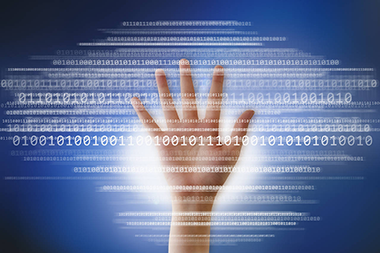
Hand with binary code

The Wall Street Journal/Getty Images

UW CSE professor Pedro Domingos recently penned a column for The Wall Street Journal envisioning a not-too-distant future in which machine learning will enable us to build and control a digital model of ourselves, transforming how we approach everything from shopping, to job-hunting, to finding a mate.

From the column:

“Entrusting your money to a bank once seemed strange and risky. Similarly, entrusting all of your data to a company and letting its algorithms build a detailed model of you from it might seem to be an odd or even dangerous idea, but we’ll all soon take it for granted.

“A decade from now, your personal model will be more indispensable than your smartphone, and the company that provides it may well be the world’s first trillion-dollar business. So it is time to start getting acquainted with our digital alter egos—and what they’ll mean for our lives.”

Domingos points out that today’s digital models, such as those Google builds from our web searches or that Amazon bases on what we buy, fall short for two reasons: they are driven by the companies’ own profit motive, and they are built using incomplete data. He suggests a new approach, one in which we intentionally construct a complete digital model of ourselves and deploy it online for our own benefit.

“Today’s models don’t yet interact with us: You can’t tell them they’re wrong or ask them questions. Machine-learning algorithms are black boxes that only computer scientists can open up. But that will change as more of us realize how important machine learning is and demand a say in how it occurs,” Domingos writes.

Read the full column here. Check out our past coverage of Domingos and his new book, The Master Algorithm, here and here. Read more →
UW CSE’s Nell O’Rourke to address Rising Stars workshop at MIT

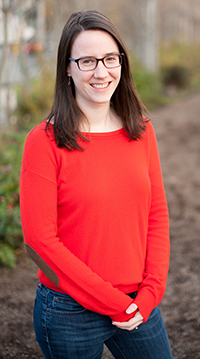
Nell O'RourkeUW CSE Ph.D. candidate Nell O’Rourke will be a featured speaker at the annual Rising Stars career-building workshop for women in computer science and electrical engineering. More than 60 promising graduate students and postdocs from around the world will gather at MIT next week for a series of research talks, career advice and networking aimed at supporting young female scholars interested in pursuing careers in academia.

Nell, who works with professor Zoran Popović in UW CSE’s Center for Game Science, is one of only a dozen computer science participants selected to address the group. Her talk, “Educational Systems for Maximizing Learning Online and in the Classroom,” describes the design and evaluation of novel systems to support motivation, personalization and formative assessment in educational environments.

From the abstract:

“My findings provide new insights into how students learn and how computing systems can support the learning process. The ultimate goal of my research is to build personalized data-driven systems that transform how we teach, assess, communicate, and collaborate in learning environments.”

Learn more about the Rising Stars program, which MIT launched in 2012, here.

Read our previous coverage of Nell, who is also a 2015 Google Anita Borg Memorial Scholar, here.

Congratulations, Nell, and thanks for representing UW CSE! (And, good luck on the job market this year!) Read more →

UW CSE’s Yoshi Kohno, Franzi Roesner and Tamara Denning co-author policy primer on augmented reality

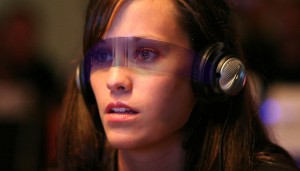
Augmented realityUW CSE professors Yoshi Kohno and Franzi Roesner and Ph.D. alum Tamara Denning (now on the faculty at the University of Utah) are among the lead authors of a new white paper that examines policy issues associated with emerging augmented reality technologies. The paper is the first of its kind published by the UW’s Tech Policy Lab, which brings together faculty and students from UW CSE, the School of Law, the iSchool and other units on campus to explore the potential implications of emerging technologies in a way that is useful for policy makers.

From the UW media release:

“Though still in its relative infancy, augmented reality promises systems that can aid people with mobility or other limitations, providing real-time information about their immediate environment as well as hands-free obstacle avoidance, language translation, instruction and much more. From enhanced eyewear like Google Glass to Microsoft’s wearable HoloLens system, tech, gaming and advertisement industries are already investing in and deploying augmented reality devices and systems.

“But augmented reality will also bring challenges for law, public policy and privacy, especially pertaining to how information is collected and displayed. Issues regarding surveillance and privacy, free speech, safety, intellectual property and distraction — as well as potential discrimination — are bound to follow.”

The report was co-authored by School of Law professor Ryan Calo, iSchool professor Batya Friedman, Tech Policy Lab associate director Emily McReynolds, iSchool alum Bryce Newell, iSchool student Lassana Magassa and School of Law alum Jesse Woo.

Read the full release here, and read the white paper, “Augmented Reality: A Technology and Policy Primer,” here.

Kohno will be joined by his Tech Policy Lab co-directors, Calo and Friedman, for a panel discussion tonight on “responsible innovation” and the impact of new technologies on security and privacy. Learn more about the event, which is the final installment of the UW Alumni Association’s 2015 Engineering Lecture Series, here. Read more →

UW CSE alum Brandon Lucia recognized for “Valor” at OOPSLA 2015

Brandon LuciaUW CSE alum Brandon Lucia (Ph.D., ’13), now on the faculty at Carnegie Mellon, collected a Distinguished Paper Award and a Distinguished Artifact Award at OOPSLA 2015 last week for the paper, “Valor: Efficient, Software-Only Region Conflict Exceptions.”

Valor is a novel, software-only region conflict detection analysis that achieves high performance by eliminating the costly analysis on each read operation required by previous approaches. Existing techniques either modify hardware or slow programs dramatically, precluding always-on use. As the first region conflict detector to provide strong semantic guarantees for racy program executions with less than 2X slowdown, Valor represents the state of the art in always-on support for strong behavioral guarantees for data races. With Valor, Brandon and his fellow researchers address a fundamental barrier to providing well-defined programming language specifications and to writing correct shared-memory, multithreaded programs.

Read the winning paper, which was co-authored by Swarnendu Biswas, Minjia Zhang and Michael Bond of Ohio State University, here.

Congratulations to Brandon and his colleagues on the double win! Read more →

UW’s eScience Institute to co-lead new big data innovation hub

UW eScience Institute logoThe National Science Foundation (NSF) announced that the University of Washington – a recognized leader in data management and visualization and data-intensive discovery – will co-lead the new Big Data Regional Innovation Hub for the western United States. Members of the UW’s eScience Institute and UW CSE faculty will partner with colleagues at the University of California, San Diego and UC Berkeley on the new initiative, which is one of four university-led hubs established by NSF to catalyze big data solutions to real-world problems.

From the UW media release:

“The ability to access, analyze and draw insights from massive amounts of data is already driving innovation in fields from medicine and manufacturing to the way cities are managed. To accelerate this emerging field, the NSF is establishing four ‘Big Data brain trusts’ to catalyze new collaborations among university researchers, tech companies, national labs, local and state government and non-profits.

“‘Our selection to help lead the West’s Big Data Hub affirms our position as a leader in data science and our track record in building successful partnerships,’ said Ed Lazowska, the Bill & Melinda Gates Chair in Computer Science & Engineering and director of the UW eScience Institute. ‘The Puget Sound region in particular is an excellent laboratory for this.'”

Lazowska is joined by Bill Howe, associate director and senior data science fellow at the eScience Institute; data scientist Ariel Rokem; and program director Sarah Stone on the UW’s hub leadership team. The western hub will focus on promoting collaborations and advancing solutions in five areas: big data technologies, managing natural resources and hazards, precision medicine, metro data science, and data-enabled scientific discovery and learning.

Read the full UW announcement here, and the NSF announcement here.

Check out the White House Office of Science and Technology Policy’s blog post on the new initiative here, and the Seattle Times article here. Read more →

Catch part two of “Lunch Break” featuring UW CSE’s Ed Lazowska

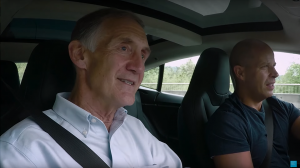
Ed Lazowska on Lunch BreakLast week, we shared a video of Brad Anderson, corporate vice president at Microsoft, conducting a lunchtime interview on the go with UW CSE professor Ed Lazowska. That was part one; today, we bring you part two, which covered topics ranging from preparing students to succeed in a technology-driven world, to changing the world through computer science (and many other topics in between).

Watch this week’s episode of Lunch Break here, and check out Brad’s blog post here. Read more →

UW CSE’s software verification research proves a hot topic at JavaOne

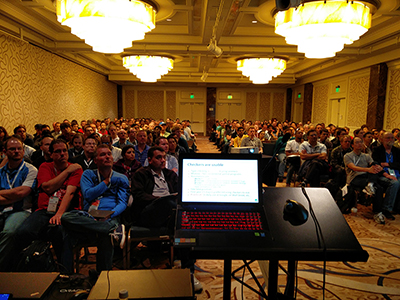
JavaOne audienceUW CSE professor Michael Ernst and former postdoc Werner Dietl (now a professor at the University of Waterloo) killed it at Oracle’s JavaOne conference in San Francisco this week, delivering three well-received talks that drew upon UW CSE research: “Preventing Errors Before They Happen,” “Collaborative Verification of the Information Flow for a High-Assurance App Store” (about the SPARTA project), and “Using Type Annotations to Improve Your Code.”

The common theme of the three talks was lightweight software verification. Ernst, Dietl and colleagues at UW CSE have created widely-used tools for verifying Java programs. In the course of their work, they observed that the usual approaches to verification are powerful but impractical. While the main success of formal verification is type systems, the built-in type system of a language like Java permits too many incorrect programs.

Checker Framework logoTo address this, the UW team devised new ways to strengthen type systems, such as making them flow-sensitive, while retaining their speed and ease of use. They also created a tool called the Checker Framework that makes it easy to create a type system for all of Java.

The Checker Framework ships with dozens of powerful type systems that are very effective at finding bugs. More importantly, these type systems give a guarantee: if a type system does not issue any warnings, then the program contains no bugs (of a certain variety). The type systems are used at companies from Wall Street to Silicon Valley (Google runs them on hundreds of projects every day). Oracle was so impressed with the Checker Framework that they added syntactic support for it to the Java 8 language, enabling 9 million programmers to improve their code. The type systems are also backward compatible with previous versions of Java.

If you want to improve your Java code, download the Checker Framework here. Read more →

UW CSE accessibility research earns Best Paper accolades at ASSETS 2015

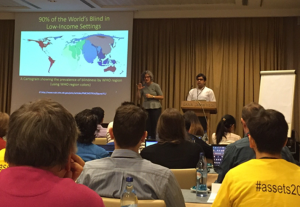
Aditya Vashistha at ASSETS 2015The 17th International ACM SIGACCESS Conference on Computers and Accessibility (ASSETS 2015) is taking place this week in Lisbon, Portugal, and UW CSE is in the thick of the action. First, Ph.D. student Aditya Vashistha captured the Best Student Paper award for “Social Media Platforms for Low-income Blind People in India.” The paper, which presents the first-ever analysis of how visually impaired users in rural and peri-urban India benefit from social media platforms such as Facebook, Twitter, and WhatsApp and investigates barriers to social media engagement among this group, was co-authored by UW CSE Ph.D. alum Nicola Dell, professor Richard Anderson, and Ed Cutrell of Microsoft Research India.

Another team with a UW CSE connection captured a second Best Paper award. Affiliate faculty member Merrie Ringel Morris of Microsoft Research, along with her colleague Andrew Begel and Ben Wiedermann of Harvey Mudd College, earned top honors for their study of neurodiverse workers in the software industry. The project aims to improve employers’ understanding of the experiences and needs of individuals with autism spectrum disorder and other cognitive differences to support a more inclusive workforce – a topic that has received very little attention before now.

Read Aditya’s paper here, and Merrie’s paper here.

Nice job, everyone! Read more →

UW CSE’s Luis Ceze receives Distinguished Alumni Educator Award from CS@Illinois

Luis CezeUW CSE professor Luis Ceze, who earned his Ph.D. in 2007 from the Computer Science Department at the University of Illinois at Urbana-Champaign, was recognized by his alma mater with its Distinguished Alumni Educator Award. The award, which is based on nominations by members of the UIUC computer science community, recognizes faculty and alumni “who have made outstanding contributions to computer science education and research, and…who excel at motivating computer science students.”

That certainly describes Luis, who has advised a dozen graduate students and received the 2010 ACM Undergraduate Teacher of the Year Award here at UW CSE.

Congratulations to Luis on this latest, well-deserved recognition!

Luis and his fellow award recipients were recognized at a banquet on Friday. Read more about it here. Read more →

Seattle Times explores the data-driven commute, with a little help from UW CSE

King County Metro busesThe Seattle Times published an article yesterday examining how developers are using data to tame traffic and aid commuters in the region. One of the featured apps, OneBusAway, originated as a UW CSE research project to help public transit users plan their trip by providing real-time system information. Another, Access Map, was developed by a team of students advised by UW CSE professor Alan Borning and Anat Caspi, executive director of UW CSE’s Taskar Center for Accessible Technology, to enable people with limited mobility to identify accessible routes throughout the city. The app, which won first place at the City of Seattle’s Hack the Commute competition, was further refined as part of the UW eScience Institute’s Data Science for Social Good program over the summer.

From the article:

“Commuters have turned to a variety of apps for relief — from Waze to OneBusAway. And behind the scenes, governments, private companies and garage hobbyists are tinkering with a mixture of public and private data that feeds those apps. They believe better information could help make stressed infrastructure more efficient.

“‘It’s expensive to run additional bus service and really expensive to build rail systems and increase road capacity,’ said Alan Borning, a University of Washington computer science professor and a OneBusAway board member.

“‘Better information is cheaper.’”

Read the full article, which also quotes UW CSE Ph.D. alum (and creator of OneBusAway) Brian Ferrishere. Check out a sampling of our previous coverage of OneBusAway here and here, and of Access Map here and here. Read more →

« Newer PostsOlder Posts »