UW’s “PoWiFi” could power the Internet of Things, says MIT Technology Review

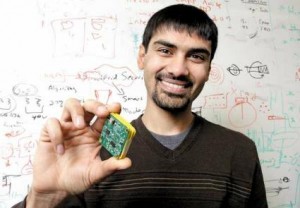
PoWiFi examplesA UW research project that seeks to power the Internet of Things using Wi-Fi signals – dubbed “power over Wi-Fi” or “PoWiFi” for short – is the topic of a recent paper and an article in MIT Technology Review. The project was developed by a team that includes CSE professor Shyam Gollakota, CSE and EE professor Josh Smith, EE Ph.D. student Vamsi Talla, CSE alum (and current EE Ph.D. student) Bryce Kellogg, former CSE postdoc Ben Ransford, and EE Ph.D. student Saman Naderiparizi.

From the article:

“The idea is simple in concept. Wi-Fi radio broadcasts are a form of energy that a simple antenna can pick up. Until now, Wi-Fi receivers have all been designed to harvest the information that these broadcasts carry. But Talla and co point out that there is no reason why the energy shouldn’t be harvested as well. The question is how much can be gathered in this way. And therein lies the challenge …

“The problem is that Wi-Fi broadcasts are not continuous. Routers tend to broadcast on a single channel in bursts. This provides enough power for the sensor but as soon as the broadcast stops, the voltages drop … That gave Talla and pals an idea. Why not program the router to broadcast noise when it is not broadcasting information and employ adjacent Wi-Fi channels to carry it so that it doesn’t interfere with data rates.”

Calling the results “impressive,” the article explains how the researchers used their new PoWiFi system to wirelessly power a battery-free temperature sensor and a camera without compromising network performance, in real-world conditions. They also were able to recharge coin-cell batteries using PoWiFi from distances of up to 28 feet.

The article concludes:

“The ability to deliver power wirelessly to a wide range of autonomous devices and sensors is hugely significant. But the real icing on the cake here is the ability to do this with ordinary technology that is commonly available all over the developed world and beyond. As such, PoWi-Fi could be the enabling technology that finally brings the Internet of Things to life.”

Read the complete article here.

Read a PDF of the team’s paper, “Powering the Next Billion Devices with WiFi,” here. Read more →

Seattle Times: “Legislature should fund UW computer science expansion”

d3154eb8-0a4c-11e5-938d-f2889198f979-780x1257The Seattle Times editorial board writes:

“WHILE computer science and engineering jobs boom in Washington, the state is graduating too few of its own residents in this field, which plays such a crucial role in the state’s fortunes.

“The University of Washington argues persuasively that it needs more space to address the demand both from students and employers.

“The state Legislature should appropriate funds this year to help pay for a new 130,000-square-foot computer science and engineering building.

“The university asked lawmakers for $40 million of the $105 million total, with plans to raise the remaining costs from private donors. So far, the Senate’s capital budget set aside $32 million, while the House budget appropriated only $6 million …

“Washington is fortunate to have a thriving technology industry. State lawmakers and educators must enable more homegrown students to prepare for and seize these opportunities.”

Read more here. Read more →

TUNE and Seattle Women in Tech team up in support of UW CSE’s DawgBytes program

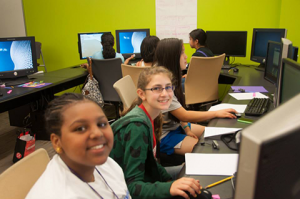
DawgBytes middle school campersUW CSE’s DawgBytes is one of three programs recently selected by mobile marketing company TUNE (formerly HasOffers) and Seattle Women in Technology as beneficiaries of a new partnership that aims to cultivate more women leaders in technology fields. DawgBytes, which hosts girls-only and co-ed summer day camps in computing, in addition to engaging in teacher support, community partnerships and other outreach activities, is part of a long tradition at UW CSE of encouraging women to pursue computer science education and careers.

Each summer, DawgBytes engages 88 middle and high school girls in computer science through our girls-only camps and reaches many more through its co-ed camps, including a session for elementary school students. This is part of a multi-pronged approach aimed at increasing the diversity of our student body and of our industry. We outperform our peers when it comes to cultivating the next generation of women computer scientists, awarding 30 percent of our CS bachelor’s degrees to women (roughly twice the national average). We also have made it a priority to recruit women who are rising stars in the field to the UW CSE faculty, including recent hires Maya Cakmak (robotics), Yejin Choi (natural language processing), Ira Kemelmacher-Shlizerman (computer vision), Franzi Roesner (security and privacy), and Emina Torlak (programming languages and software engineering).

While UW CSE is a recognized leader in advancing women in computer science education and careers, there is more work to be done. To support our efforts and those of other like-minded organizations, TUNE, in partnership with Seattle WiT, is encouraging donations to DawgBytes, Tech Trek and Ada Developers Academy in the run-up to its big annual event, Postback, which will be held July 23-24 in Seattle.

Read more about the partnership on the TUNE company blog here and check out the details on Postback 2015 here.

Check out our DawgBytes 2015 summer camp lineup here.

Read earlier coverage of UW CSE’s nationally recognized efforts to engage more women in computer science here, here and here.

Many thanks to our friends at TUNE and Seattle Women in Technology for their support! Read more →

Seattle: Tops for well-read cities, opportunities for new STEM grads

seattletraffic-shutterstock_129266042-620x412Amazon ranks Seattle as the #1 “well-read city.”

NerdWallet ranks Seattle top 5 in opportunities for new STEM grads (but you wouldn’t want to live in the other 4).

Read more here and here. Read more →

UW CSE’s Brian Ferris brings real-time transit data to Google Maps

Brian FerrisUW CSE Ph.D. alum Brian Ferris is the patron saint of transit riders. Not only did he create the wildly popular app OneBusAway while a Ph.D. student here, but now he has gone one better: he and his team at Google have added enhanced real-time transit data to Google Maps for a handful of cities, including Seattle. The new feature will enable transit riders to make judgments about which mode or route to use based on actual traffic conditions and transit performance, using data from King County Metro and Sound Transit.

Brian is quoted by GeekWire on the new functionality:

“With traffic congestion in Seattle getting worse every year, real-time information is essential for making our transit system usable … I might not be able to build a new light-rail line through Seattle or add new bus service myself, but I can help build tools to make everyone’s commute a little more pleasant.”

Read more on GeekWire here and on VentureBeat here.

Thanks, Brian, for helping to keep Seattle commuters – including many of us here at UW CSE – rolling! Read more →

Why Washington?

UntitledA terrific new short video from the Washington Tech Industry Association, “Why Washington,” explains why the Puget Sound region is the software capital of America.

Watch it here. Read more →

Sergey Levine joins UW CSE faculty

slWe’re delighted to announce that Sergey Levine, who works at the intersection of robotics, machine learning, graphics, and animation, will join the UW CSE faculty.

Sergey pioneered the recent trend in using deep learning to create neural network controllers for animated characters and robots. His learning techniques enable robots to solve control tasks that have been elusive using traditional approaches. This past week he won the Best Robotic Manipulation Paper Award at ICRA, the IEEE flagship robotics conference, for his work on learning controllers for complex manipulation tasks.

Sergey received his Ph.D. in 2014 from Stanford University and joins CSE following a postdoc with Pieter Abbeel at UC Berkeley.

Welcome, Sergey!

(We had previously announced the recruiting this year of Ras Bodik, Sham Kakade, and Dan Ports. More news to follow!) Read more →

UW CSE’s Steve Seitz and Google’s Jump

635682540226528021-card2UW CSE’s Steve Seitz is the engineering lead on Jump, announced this week as a dramatic enhancement of Google’s Cardboard “VR for the masses” system. UW CSE postdoc alum Sameer Agarwal leads the computer vision team that built the assembler – work carried out at Google Seattle by the computer vision group that Steve assembled and leads there. The Jump team also includes UW CSE bachelors alums Riley Adams and Sam Riesland.

USA Today writes:

“But the biggest news involves Google’s new partnership with camera-maker GoPro, which could solve the missing link for VR: enough content to make using the headsets worthwhile. GoPro is putting the finishing touches on a merry-go-round-like rig that will support 16 GoPro Hero4 cameras whose spherical footage will record the content VR watchers will see.”

Read the USA Today article and watch the video here.

Read about Jump in the context of Google’s overall VR effort in The Verge here.

Article in Wired with specific reference to Seitz’s team’s contributions here.

And learn about all of UW’s phenomenal work in computer graphics and computer vision here. Read more →

UW CSE accepting applications for summer K-12 teacher workshop, CS4HS

CS4HS participants in a computer labEach summer, UW CSE welcomes middle school and high school teachers from around the state at our computer science education workshop, CS4HS. Math and science teachers are invited to participate in an action-packed, three-day program designed to give them the knowledge and resources to integrate computer science into their classrooms and to build student interest in our exciting and rapidly growing field.

The 2015 workshop will take place July 15th – 17th at UW’s Paul G. Allen Center for Computer Science & Engineering. Thanks to the generous donors who support CSE’s K-12 outreach programs, the registration fee for teachers is just $50. CS4HS participants will enjoy breakfast and lunch each day, an evening networking reception, parking or transit reimbursement, dorm accommodations for out-of-town participants, and 20 clock hours from the Washington Science Teachers Association – not to mention fantastic demos, faculty and guest presentations, hands-on learning, and idea sharing among peers.

Teachers who have no computer science background or programming experience are welcome and encouraged to attend. CS4HS is a joint undertaking between UW CSE, Carnegie Mellon University and Tim Bell’s CS Unplugged.

Interested educators are invited to apply for a slot at the 2015 workshop here. Read more →

Congrats to UW CSE’s Melody Kadenko!

IMG_5067UW CSE’s Melody Kadenko has received the 2015 UW College of Engineering Professional Staff Award.

Melody manages more than 100 research grants from multiple agencies. In her “spare time,” she mentors UW’s National Collegiate Cyberdefense Competition team, and shakes the tin cup to fund the CSE espresso room (appropriating a page from the NPR playbook: “We need $2500 before I quit sending email!”).

A faculty member writes, “Melody uses creativity and persistence to solve any kind of thorny research grant problem.”

A student writes, “Melody has been the single most useful person I’ve met since coming to UW.”

Melody writes, “I’m ‘Plan B.’ If you want the rules followed in every detail, see Alicen. When that doesn’t work, come see me. I’m OK with that.”

Congratulations, Melody! And thanks for your many years of phenomenal work as part of the UW CSE team! Read more →

« Newer PostsOlder Posts »