UW CSE’s Dylan Hutchison earns *two* Best Paper Awards at HPEC 2016

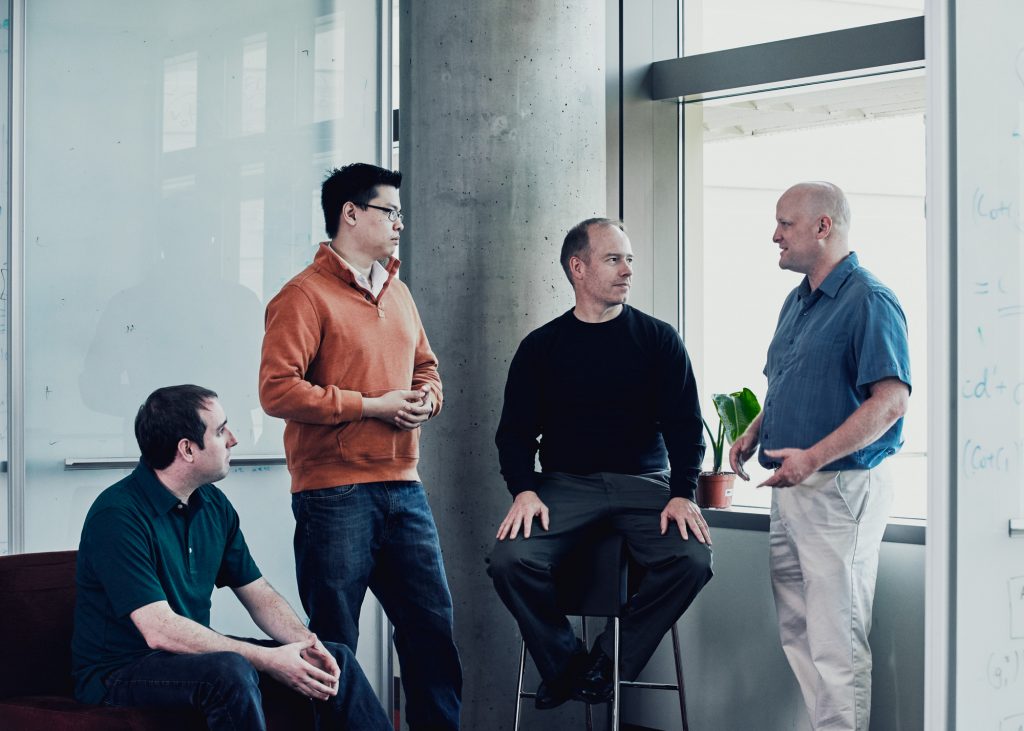
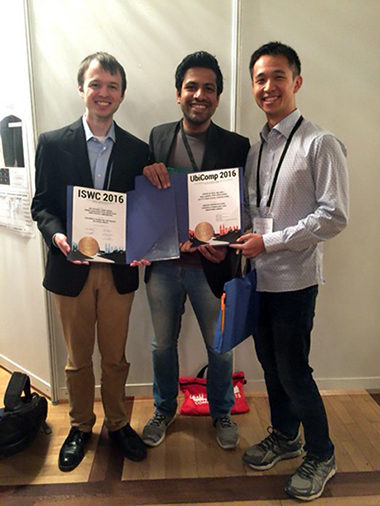
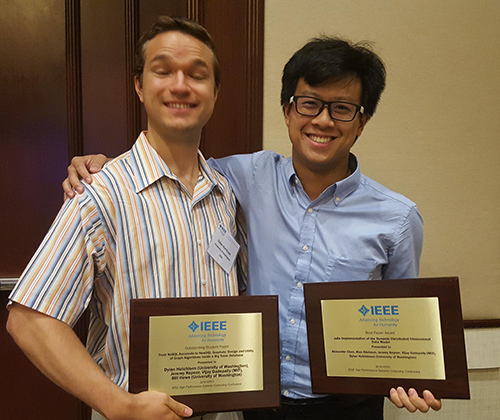
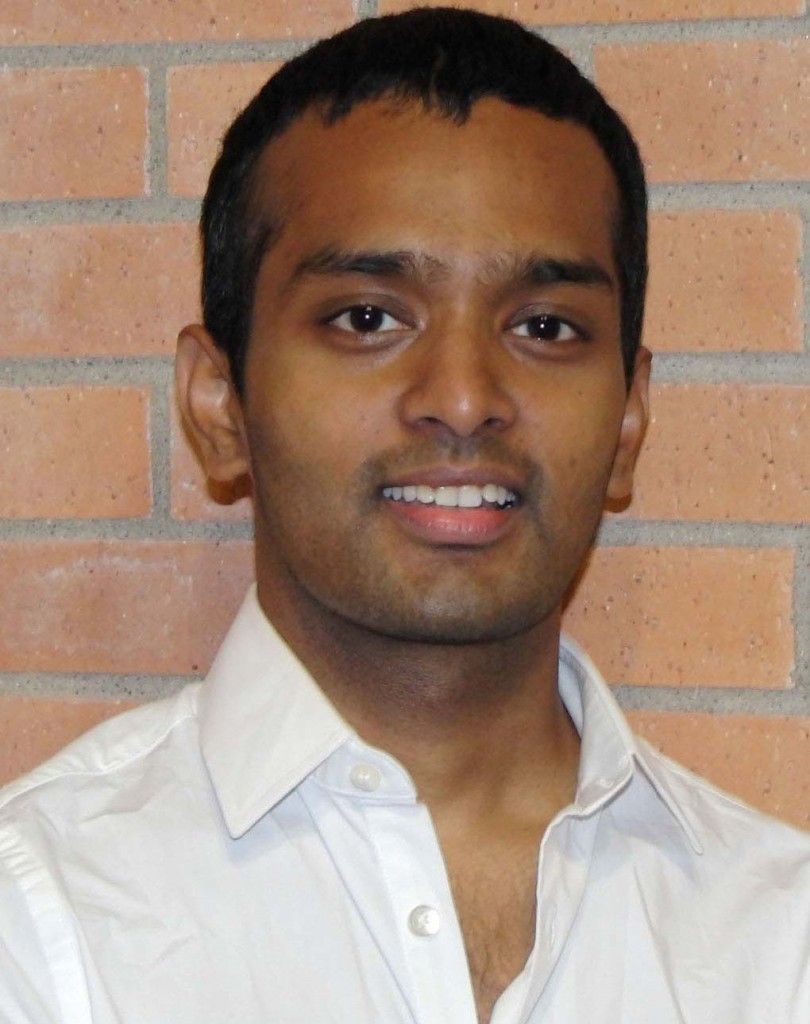
Dylan Hutchison and Alex Chen

UW CSE’s Dylan Hutchison (left) and MIT’s Alex Chen

We like our Best Paper Awards around here, but UW CSE Ph.D. student Dylan Hutchison took it to a new level this week by contributing not one, but two Best Papers at IEEE’s High Performance Extreme Computing Conference (HPEC 2016). Hutchison, a member of UW CSE’s Database group, collected the Best Student Paper Award as lead author of “From NoSQL Accumulo to New SQL Graphulo: Design and Utility of Graph Algorithms inside a BigTable Database.” He also co-authored the Best Paper winner, “Julia Implementation of the Dynamic Distributed Dimensional Data Model.”

In the first paper, Hutchison and his colleagues illustrate how Graphulo—a library for executing graph algorithms inside Apache Accumulo—enables the execution of GraphBLAS kernels in a BigTable database. The team, which includes UW iSchool professor and CSE adjunct Bill Howe, and MIT researchers Jeremy Kepner and Vijay Gadepally, compared the performance of two graph algorithms implemented with Graphulo to that of two main-memory matrix math systems. Their work yields new insights into whether it is faster to execute a graph algorithm inside a database versus an external system, showing that memory requirements and relative I/O are critical factors.

The second paper, which was co-authored by a group of MIT researchers that includes student and lead author Alex Chen, professor Alan Edelman, Kepner and Gadepally, details implementation of D4M in Julia, a new language for writing data analysis programs that are easy to implement and run at high performance. The team illustrated that D4M.jl matches or outperforms its Matlab counterpart, thanks to Julia’s well-structured syntax and data structure.

Read the Graphulo paper here and view the conference presentation here. Read the Julia paper here.

Way to go, Dylan! Read more →

Happy 80th to UW CSE’s Jean-Loup Baer!

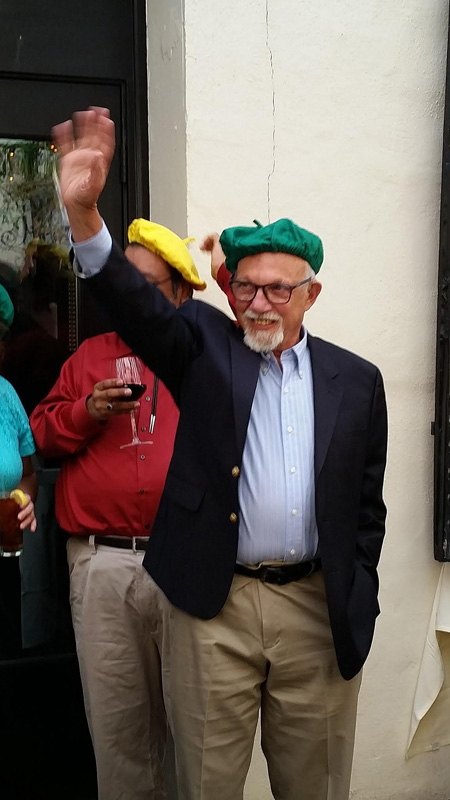
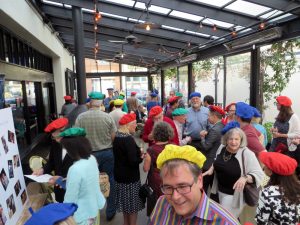
Jean-Loup BaerOn Saturday evening, more than 60 of Jean-Loup Baer’s family members, friends and colleagues – including 10 Ph.D. alums from as far away as Taiwan and Korea – gathered at Bastille Café to wish him a happy 80th birthday.

An internationally recognized expert in computer architecture, Jean-Loup was UW CSE’s first “junior hire,” arriving in 1969 after completing his Ph.D. at UCLA. He served as CSE department chair from 1988-93, and joined the ranks of the emeriti in 2004.

Photos of the event here.jlb2 Read more →

The Man Who Powers Devices with Wi-Fi: UW CSE’s Shyam Gollakota named one of Popular Science’s “Brilliant 10”

Shyam GollakotaUW CSE professor Shyam Gollakota devises ways to pull power out of thin air to enable the growth of a true Internet of Things. This awesome ability to harvest the airwaves — with implications for health care, security, sustainability, and a host of other potential applications — has earned him a place in Popular Science’s “Brilliant 10” of 2016 celebrating the most brilliant minds in science and engineering.

Gollakota leads the Networks & Mobile Systems Lab at UW CSE, where he and his fellow researchers develop systems that enable battery-free devices to harvest energy and communicate by reflecting existing wireless signals. Gollakota refers to this method of communication as “ambient backscatter,” and in recent years he has partnered with colleagues and students at UW CSE and Electrical Engineering, including professor Josh Smith, postdoc Vamsi Talla and Ph.D. student Bryce Kellogg, to develop new capabilities for an increasingly impressive array of devices, from tiny cameras, to personal fitness trackers, to implanted medical devices.

In 2015, Gollakota’s team devised a way to harvest energy from Wi-Fi routers to continuously power devices without sacrificing signal quality. The technology — Power over Wi-Fi, or “PoWiFi” for short — earned a place on Popular Science’s “Best of What’s New” list of innovations that are likely to shape the future and change the world.

Earlier this year, he and his team went further, demonstrating the ability to generate Wi-Fi transmissions using 10,000 times less power than conventional methods. Called Passive Wi-Fi, the system can transmit Wi-Fi signals at rates up to 11 megabits per second to the billions of off-the-shelf devices with Wi-Fi connectivity.

“We wanted to see if we could achieve Wi-Fi transmissions using almost no power at all,” Gollakota told UW News. “That’s basically what Passive Wi-Fi delivers.”

It also delivered recognition as one of the 10 breakthrough technologies of 2016 by MIT Technology Review for its potential to liberate devices from the constraints of batteries and power cords, which in turn could usher in a new and exciting era of smart homes and wearable devices.

The latest innovation to emerge from Gollakota’s lab is interscatter, a system that, for the first time, enables devices such as smart contact lenses, credit cards, and even medical implants to connect to the Internet and wirelessly communicate with a smartphone or laptop.  It is the latest in a line of innovations emerging from his UW lab that are designed, in his own words, to “unleash the power of ubiquitous connectivity” — and in the case of interscatter, to transform health care in the process.

These and other projects, such as a mobile app for contactless detection of sleep apnea, reflect his drive to push the boundaries of computer science and engineering to solve human problems.

“There is a lot of innovation that can happen when we get scientists and engineers with a diverse set of skills into the same room and provide an environment that enables an open flow of ideas,” Gollakota said. “I have great faculty collaborators and graduate students at the UW who make this kind of work possible.”

He also credits UW CSE’s culture of innovation, which allows him the freedom to explore.

“As an assistant professor I was encouraged by the department not to focus on the safe stuff, to get tenure, but to do the stuff that truly drives me.”

This drive has earned him numerous awards and recognition, including a National Science Foundation CAREER Award, a Sloan Research Fellowship, appointment as a UW CoMotion Presidential Innovation Fellow, a feature in CNN Money’s Visionaries 2020 program, a 2015 World Technology Award in communications technology, and inclusion in MIT Technology Review’s Innovators Under 35.

Read the Popular Science article and learn more about Gollakota and his work by visiting his website.

Congratulations, Shyam!

And congratulations, too, to some previous UW CSE “Brilliant Ten” honorees: Ph.D. alum Roxana Geambasu in 2014, postdoc alum Justin Cappos in 2013, and faculty member Carlos Guestrin in 2008. Read more →

UW researchers target Fitbit guilt

Fitbit figureResearchers from UW CSE and UW Human Centered Design & Engineering have released the results of a new study that examines how people’s experience with Fitbit and other personal tracking tools could be improved with different design approaches. Their insights could help inspire people who have abandoned such tools to reconsider that “device in the drawer” and get back on track. From the UW News release:

“The research team surveyed 141 people who had lapsed in using Fitbit. They showed the subjects seven different visual representations and ways of framing previously collected data, to see if the data could offer additional support and encouragement to be healthy if portrayed in new and interesting ways.

“Half of these Fitbit users described feeling guilty about their lapsed Fitbit use, and nearly all of those said they would like to return to activity tracking. Twenty-one said they got no value out of tracking, found it annoying, or struggled to connect the data to behavior change. Five participants felt they had learned enough about their habits, and 45 reported mixed feelings about abandoning their Fitbit.”

According to lead author and CSE Ph.D. student Daniel Epstein, “People feel more guilt when it comes to abandoning health tracking, as compared to something like location tracking, which is more of a fun thing…we wanted to see if there are design opportunities to better support people who have had different experiences using Fitbit.”

The researchers found that users’ preferences for what data was presented – and how – changed based on how long they had been engaged in personal tracking and whether comparisons to their peers carried positive or negative connotations. The results indicate that designers should eschew a one-size-fits-all approach in favor of supporting a variety of users.

For example, CSE professor and study co-author James Fogarty suggests that it’s a mistake to assume everyone will track forever. “Given that some people feel relief when they give it up, there may be better ways to help them get better value out of the data after they’re done, or reconnect them to the app for weeklong check-ins or periodic tune-ups that don’t presume they’ll be doing this every day for the rest of their lives.”

The team, which also included HCDE professor (and CSE adjunct) Sean Munson, CSE and iSchool bachelor’s alum Jennifer Kang, and CSE and HCDE postdoc Laura Pina, will present its findings at the Ubicomp 2016 conference next week in Heidelberg, Germany.

Read the full UW News release here and the research paper here. Watch a slideshow about the project here. Read more →

UW’s HemaApp takes the sting out of blood screening

HemaAppResearchers in UW’s UbiComp Lab led by CSE and EE professor Shwetak Patel have developed a new mobile tool that enables the non-invasive monitoring of blood hemoglobin. HemaApp uses a smartphone’s camera flash to shine light through a patient’s finger and analyzes the color of his/her blood to estimate the concentration of hemoglobin. The app provides a way to screen for anemia and other conditions, and to monitor patients’ response to treatment, without the pain or risk of infection associated with blood draws—particularly in low-resource settings.

From the UW News release:

“In an initial trial of 31 patients, and with only one smartphone modification, HemaApp performed as well as the Masimo Pronto, the more expensive Food and Drug Administration-approved medical device that non-invasively measures hemoglobin by clipping a sensor onto a person’s finger.

“‘In developing countries, community health workers have so much specialized equipment to monitor different conditions that they literally have whole bags full of devices,’ said lead author and UW electrical engineering doctoral student Edward Wang. ‘We are trying to make these screening tools work on one ubiquitous platform — a smartphone.'”

HemaApp is not intended to replace blood tests completely; rather, it provides an effective and low-cost way for providers to initially screen patients and determine whether more invasive testing is needed. The app is the latest development from UW CSE’s UbiComp Lab that makes use of smartphones’ increasingly sophisticated sensing capabilities to provide low-cost, mobile health care solutions. Others include BiliCam, which uses a smartphone’s camera to screen for newborn jaundice, and SpiroSmart, which uses a smartphone’s microphone to measure lung function.

According to Patel, “We’re just starting to scratch the surface here. There’s a lot that we want to tackle in using phones for non-invasively screening disease.”

The research paper was co-authored by EE undergraduate researcher William Li, pediatric oncologist Doug Hawkins of Seattle Children’s Hospital, and hematologist Terry Gernsheimer and research nurse Colette Norby-Slycord of UW Medicine. The team will present HemaApp at the UbiComp 2016 conference taking place next week in Heidelberg, Germany.

Read the full news release here, and watch a video demonstrating HemaApp here. Check out coverage of HemaApp in MIT Technology Review, Engadget, New Atlas, and Digital Trends. Read more →

UW CSE+EE wireless power startup WiBotic exits stealth mode

unspecified-4-630x420GeekWire reports:

“‘WiBotic is creating the infrastructure for robots to charge whenever and wherever – so companies can focus on robot tasks rather than keeping their robots charged,’ WiBotic CEO and co-founder Ben Waters said in a statement. ‘Enabling better access to power and autonomous charging opens up a whole new world of possibilities for robots.’

WiBotic also said its adaptive near-field wireless charging technology provides higher efficiency than standard inductive and other resonant systems, while also minimizing maintenance costs. The product also works in varying weather conditions and underwater.”

WiBotic‘s technology was developed in UW’s Sensor Systems Laboratory, led by Computer Science & Engineering and Electrical Engineering professor Joshua Smith.

Read more in GeekWire here. Read more →

UW CSE’s Oren Etzioni: We need “AI guardians” that adhere to human law and values

Human-robot handshakeIn a thought-provoking new piece published in the Communications of the ACM, UW CSE professor and Allen Institute for Artificial Intelligence CEO Oren Etzioni and sociologist Amitai Etzioni of George Washington University make the case for development of “AI guardians” to provide oversight for increasingly autonomous AI systems. (Aside: How cool is it to publish papers with your parent?!?!) The guardians, they argue, would ensure that operational AI adheres to our laws and ethical norms. They write:

“All societies throughout history have had oversight systems. Workers have supervisors; businesses have accountants; schoolteachers have principals. That is, all these systems have hierarchies in the sense that the first line operators are subject to oversight by a second layer and are expected to respond to corrective signals from the overseers….

“AI systems not only need some kind of oversight, but this oversight must be provided—at least in part—not by mortals, but by a new kind of AI system, the oversight ones. AI needs to be guided by AI.”

The duo offer three reasons why such oversight is needed: AI systems are learning systems, and therefore have the potential to stray from the initial guidelines given to them by their programmers; they are becoming more opaque to humans—either intentionally, or due to public incomprehension or sheer scale of the application; and these systems increasingly function autonomously, empowered by complex algorithms to make decisions independently of human input. Likening their proposed guardians to a home’s electrical circuit breaker—a system considerably less sophisticated than the electrical system it is designed to monitor and intervene when something goes awry—they suggest that the guardians don’t need to be more intelligent than the systems they oversee; just sufficiently intelligent to avoid being outwitted or short-circuited by those systems. The authors go on to examine the various forms such oversight might take when it comes to AI systems, from auditors and monitors, to enforcers and ethics bots.

In the case of both the operational and the oversight systems, they conclude, “humans should have the ultimate say.”

Read the full article here.

For more on the topic of AI and society from UW CSE researchers, see professor Dan Weld‘s column, The Real Threat of Artificial Intelligence, published in GeekWire earlier this year, and professor Pedro Domingos’ book, The Master Algorithm, exploring how machine learning will remake our world. Read more →

How Seattle became “King of the Cloud” (with help from UW CSE)

Clouds and sun over the Seattle skylineGeekWire’s Dan Richman published an excellent article today examining the Seattle region’s dominance in cloud computing and how our region is poised, once again, to transform technology.

“The rise of Amazon Web Services — along with the growth of Microsoft Azure, a burgeoning cloud startup scene, and a vibrant cloud and IT developer community — has turned the Seattle region into the epicenter of cloud technology, in the view of many tech and business leaders,” Richman writes.

“Silicon Valley is the undisputed king of the tech world, but Seattle increasingly rules the cloud…The Bay Area is more likely to churn out the next hot messaging app or social network, but Seattle ‘deals with the plumbing’ — the real and lasting infrastructure that provides the foundation for the new tech economy.

“Forty years ago, ‘technology in Seattle’ meant Boeing airplanes, Fluke digital voltmeters and Physio-Control defibrillators, said Ed Lazowska, a veteran University of Washington computer science professor.

“Then Microsoft essentially created the entire software industry.

“The region spawned desktop publishing, with Aldus; and created streaming media, with Microsoft spin-off RealNetworks. It created modern online retailing, with Amazon, and just about every derivative, from jewelry (Blue Nile) to real estate (Redfin and Zillow) to groceries (HomeGrocer and Amazon Fresh) to travel (Expedia).

“‘Today,’ Lazowska said, ‘we totally ‘own’ the cloud.'”

And one of the drivers is UW CSE. As real estate broker Dylan Simon put it, “Students come for the professor and the program and they stay for the jobs,” citing UW CSE professor Oren Etzioni, CEO of the Allen Institute for Artificial Intelligence, as an example.

Not a region to rest on its laurels, many people see the potential for Seattle to similarly emerge as a center for artificial intelligence, machine learning, and the Internet of Things. We have clearly earned the title “King of the Cloud”—perhaps “Emperor of AI” is not far behind.

Read the full article here.

Photo credit: Kevin Lisota via GeekWire Read more →

UW team captures Best Paper at SIGCOMM 2016 for interscatter

UW interscatter team photo

From left: Bryce Kellogg, Vamsi Talla and Vikram Iyer

A team of UW CSE and EE researchers has won the Best Paper Award at ACM SIGCOMM 2016 for interscatter, the groundbreaking technology that enables implanted devices to communicate using Wi-Fi and has the potential to transform health care as we know it. Interscatter was developed by EE Ph.D. students Vikram Iyer and Bryce Kellogg, CSE postdoc and EE Ph.D. alum Vamsi Talla, CSE professor Shyam Gollakota, and CSE and EE professor Josh Smith. The Best Paper accolades are shared with two other submissions: Eliminating Channel Feedback in Next-Generation Cellular Networks (MIT, CMU), and Don’t Mind the Gap: Bridging Network-wide Objectives and Device Configurations (Princeton, Microsoft Research, UCLA).

Way to go team! And congratulations to all of the winners!

Read our previous blog coverage here. Read more →

Remembering UW CSE Ph.D. alum Jonathan Ko

Jonathan Ko at graduationJonathan Ko, a UW CSE Ph.D. alum who worked with professor Dieter Fox in the Robotics and State Estimation Lab, passed away earlier this month after a courageous five-year battle with cancer.

During his early Ph.D. research, Jonathan was a member of UW CSE’s Centibots research team working on DARPA’s Software for Distributed Robotics (SDR) project. The Centibots framework enabled large teams of robots to explore, plan and collaborate on search and surveillance tasks in previously unknown environments. He then turned to the application of machine learning techniques to robotics, where his work on GP-BayesFilters has received a lot of attention in the robotics community.

After graduating from UW CSE in 2011, Jonathan joined Google as a software engineer. That also was the year he was diagnosed with cancer.

Fellow UW CSE alum Yaw Anokwa—who became a lifelong friend after Jonathan hosted him as a prospective graduate student—recalled that he loved motorcycles. Yaw pointed us to a touching tribute on Cycle World, “A Reminder to Live While You’re Alive,” about Jonathan’s quest to ride every MotoGP track in the world in the time he had left, and how the cycle community rallied to his cause. Ultimately, Jonathan only got to ride five of the 15 tracks, but his determination inspired countless numbers of fellow riders around the world.

Jonathan Ko with a motorcycle at track dayJonathan is remembered for making “a deep impression on all who had the honor of knowing him, with his intellect, openness, energy, and kindness.” Our hearts go out to Jonathan’s family, friends and colleagues, especially his loving mother Jackie, siblings Clara and Paul, niece Abigail, and nephew Alexander.

Read Jonathan’s obituary here. Donations can be made in his memory to the Seattle Cancer Care Alliance here. Read more →

« Newer PostsOlder Posts »