UW CSE’s Anup Rao wins 2016 SIAM Outstanding Paper Prize

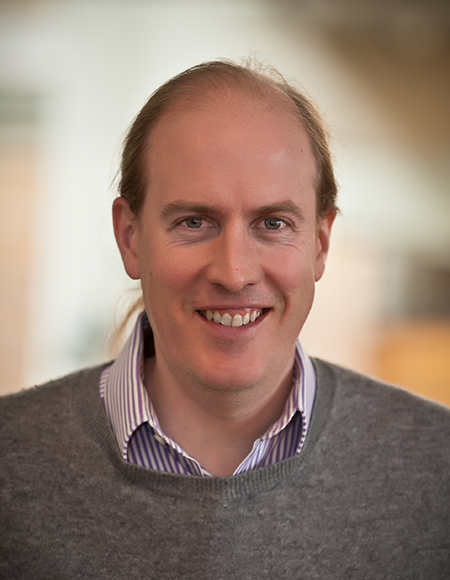
Anup RaoProfessor Anup Rao of UW CSE’s Theory group has been recognized by the Society for Industrial and Applied Mathematics (SIAM) with its Outstanding Paper Prize for the 2013 paper, How to Compress Interactive Communication. Each year, SIAM selects just three papers from among thousands published in its journals over the previous three years for the award, which honors authors who have made original contributions to the field of applied mathematics.

In 1948, Claude E. Shannon published his foundational paper on information theory. He defined the entropy of a message, and showed that this quantity captures the number of bits required for one party to communicate the message to another, thereby laying the mathematical groundwork for the field of data compression.

Shannon’s result addresses the setting of one-way communication tasks. But what if two parties engage in a conversation, possibly exchanging many short messages in order to accomplish a task interactively. Can such a protocol be compressed? If so, what is the appropriate notion of entropy?

The groundbreaking paper by Rao and co-authors Boaz Barak, Mark Braverman, and Xi Chen, addresses precisely these questions. They present sophisticated methods to compress interactive communication protocols. Intuitively, their idea is for the communicating parties to predict the future communication transcript based on their current partial knowledge. Moreover, they put forth a precise and appealing definition of the “information cost” of a protocol which measures the amount of information exchanged by the two parties.

The team’s work helped to launch the field of information complexity, and led to progress in many areas of computer science, including streaming computation, differential privacy, communication complexity, and quantum communication.

Learn more about the award here, and read the winning paper here.

Congratulations, Anup! Read more →

UW CSE’s Will Scott wins Best Student Paper Award at 2016 USENIX ATC

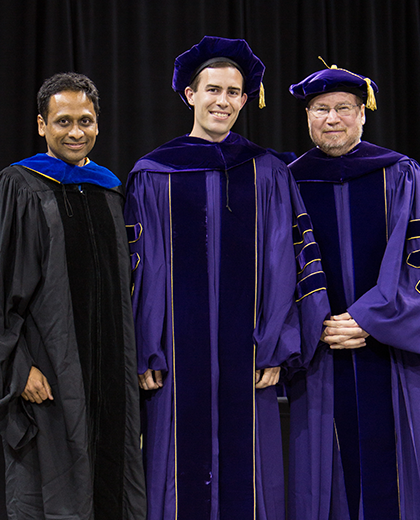
Arvind Krishnamurthy, Will Scott, Tom Anderson

Arvind Krishnamurthy, Will Scott, and Tom Anderson

Newly minted UW CSE Ph.D. Will Scott has captured the Best Student Paper Award at the 2016 USENIX Annual Technical Conference underway in Denver for the paper Satellite: Joint Analysis of CDNs and Network-Level Interference.

The winning paper presents Satellite, an efficient tool for understanding global trends in the distribution and accessibility of website content from a single vantage point. The system, which collects and analyzes data on DNS resolution and resource availability by monitoring the IPv4 address space, enables researchers to measure the growth and behavior of content distribution networks (CDNs) and prevalence of online censorship among the top 10,000 domains as ranked by Alexa.

Scott co-authored the paper with his Ph.D. advisers, Tom Anderson and Arvind Krishnamurthy, and CSE professor Yoshi KohnoRead the full paper here, and check out the Satellite website here.

This is the second year in a row that UW CSE research has been recognized at the conference. Last summer, the GRAPPA team collected the Best Paper Award for its work on software distributed shared memory for data-intensive applications.

Go team! Read more →

Team led by UW researchers reaches the finals of the GSK Bioelectronics Innovation Challenge

Josh Smith

Josh Smith

An international team led by researchers at the UW has been chosen as one of three finalists in the GlaxoSmithKlein Bioelectronics Innovation Challenge—and made itself eligible for $1 million in new research funding as a result.

UW CSE and electrical engineering professor Josh Smith is working with colleagues at UW’s Center for Sensorimotor Neural Engineering (CSNE), the University of Cambridge and University College London to develop an implantable device that would restore bladder function for people living with spinal cord injury or incontinence. Technology developed in Smith’s Sensor Systems Lab is being used to wirelessly power the implanted device.

From the UW News release:

“An international team led by researchers at the Center for Sensorimotor Neural Engineering (CSNE) based at the University of Washington is one of three finalists in a race to produce an implantable wireless device that can assess, stimulate and block the activity of nerves that control organs….

“‘For people with spinal cord injuries, restoring sexual function and bladder function are some of their top priorities — higher than regaining the ability to walk,’ said Chet Moritz, deputy director of the CSNE and UW associate professor of rehabilitation medicine and of physiology and biophysics.

“‘The vision is for these neural devices to be as ubiquitous as pacemakers or deep brain stimulators, where a surgeon implants the device and it’s seamless for the patient,’ he said. ‘We’re really excited to make a difference in people’s lives and to help push these technologies forward.’
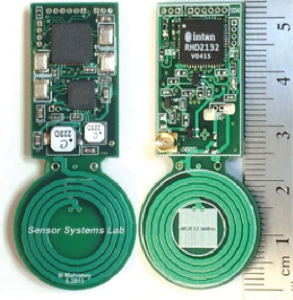
Lollipop device

Prototype implanted device designed at the UW.

“The final implantable wireless device will be able to stimulate and block electrical signals that travel along the nerves and control specific organs. Stimulating the pelvic nerve causes the bladder to empty, for example, while blocking those signals could help someone who is unable to control his or her bladder.”

The team designed its device to interact with the pelvic nerve both electronically and optically. This approach, in which light is used to control neurons, means the researchers can stimulate the pelvic nerve without having to physically touch it, thus reducing the risk of swelling and scarring that can occur with direct nerve interfaces.

“It is gratifying to see the center’s hardware research efforts paying off so quickly,” said Smith. “Selection by GlaxoSmithKline in this rigorous international competition shows that technologies emerging from the CSNE are at the leading edge of what is possible.”

In addition to the $1 million prize for reaching the finals, GSK will award $1 million to the first team to deliver a functional device in small animal models. The other UW members of the GSK competition team include physiology and biolophysics professor Greg Horwitz, physiology and biophysics postdoc Tom Richner, biology professor and eScience Institute Data Science Fellow Bingni Brunton, and Ryan Solinsky, a resident in rehabilitation medicine. The CSNE is a NSF-funded partnership of multiple research institutions that is housed at the UW and directed by UW CSE professor Rajesh Rao.

Read the full UW News release here. Learn more about the GSK Bioelectronics Innovation Challenge here.

Amazing work—congratulations to Josh and the entire team! Read more →

UW CSE Ph.D. alum Martha Kim wins 2016 Borg Early Career Award

Martha KimUW CSE alum Martha Kim, now a member of the computer science faculty at Columbia University, has been honored with a 2016 Borg Early Career Award from the Committee on the Status of Women in Computing Research (CRA-W). This award—named in honor of the late Anita Borg, an early member of CRA-W and a leading advocate for increasing women’s participation in computing—recognizes one or two women each year in the early stages of their careers who have made significant contributions to the computing community through research and through efforts to advance women and diversity in the field.

Kim completed her Ph.D. in 2008 working with UW CSE professor Mark Oskin and currently directs Columbia’s Architecture and Design (ARCADE) Lab, where her research focuses on developing ways to increase power and efficiency and reduce energy consumption while meeting the growing demands on computing systems of big data sets. She is particularly interested in developing hardware and software techniques to improve usability of hardware accelerators and data-centric accelerator design. In each of the past three years, papers she has co-authored have been selected among IEEE’s “Top Picks in Computer Architecture” for their novelty and long-term impact. Kim has won numerous awards, including a NSF CAREER Award in 2013, in recognition of her research and teaching.

In announcing the award, CRA-W cited Kim’s outreach to high school students, including participation in conferences such as “Code Like A Girl” and service as a faculty advisor for the Artemis Project, which is a summer school for girls in grades 9 and 10 from underserved schools. Kim also served on a working group charged with revamping her own high school’s approach to STEM education. Kim’s extensive outreach efforts are bearing fruit: her first two Ph.D. graduates are women, as are two-thirds of her current Ph.D. students.

Read the CRA-W award citation here, and a nice post on the Columbia CS department blog here.

Way to go, Martha! Read more →

UW CSE’s Ras Bodik wins Influential Paper Award at ISCA 2016

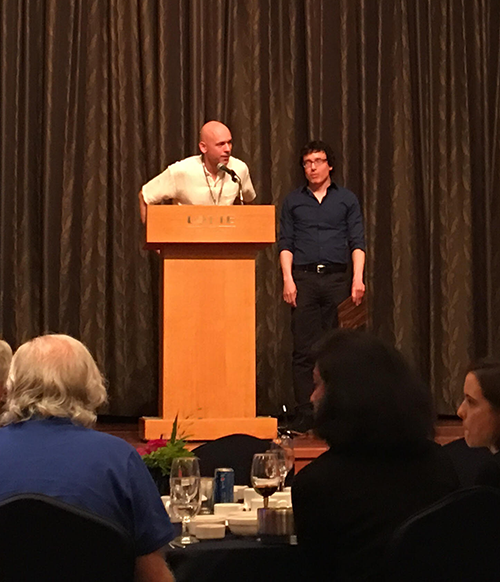
Ras Bodik onstage at ISCA

Ras Bodik accepts the Influential Paper Award at ISCA.

Professor Ras Bodik, a member of UW CSE’s Programming Languages & Software Engineering (PLSE) group, collected the 2016 ACM SIGARCH and IEEE-CS TCCA ISCA Influential Paper Award (a “test of time” award) at the International Symposium on Computing Architecture being held this week in Seoul, South Korea. Bodik and his co-authors, former University of Wisconsin-Madison Ph.D. students Brian Fields and Shai Rubin, received the award for their 2001 ISCA paper, Focusing Processor Policies via Critical-Path Prediction, in which they introduced a simple yet effective hardware predictor of instruction criticality to optimize performance.

The predictor employs a dependence-graph model of the microarchitectural critical path that incorporates both data and machine-specific dependences to identify execution bottlenecks, and uses a token-passing algorithm to compute the critical path without having to actually build the dependence graph. By focusing processor policies on critical instructions, the predictor enables the prioritization of critical instructions for scarce resources, and suppressed speculation on non-critical instructions to reduce the risk of misspeculations. 

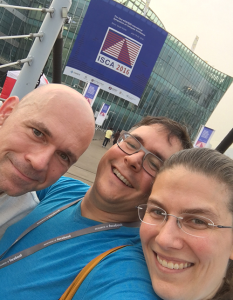
Ras Bodik, Luis Ceze, Karin Strauss

Ras Bodik, Luis Ceze and Karin Strauss at ISCA 2016.

Bodik and his colleagues demonstrated their predictor was capable of supporting fine-grain optimizations and producing significant improvements in performance—as high as 21%, and 10% on average, in the case of cluster instruction scheduling and steering.

Read the winning paper here.

Congratulations, Ras!

Ras is at ISCA with CSE professor Luis Ceze and affiliate faculty member Karin Strauss of Microsoft Research. In addition to Ras’ big win, they are cheering on their colleague from the Molecular Information Systems Lab, CSE affiliate faculty member Doug Carmean of Microsoft Research, who delivered a keynote talk titled Quantum and Cryo and DNA oh my! Sights Along the New Yellow Brick Road. Read more →

Sen. Maria Cantwell @ UW CSE

Ubicomp

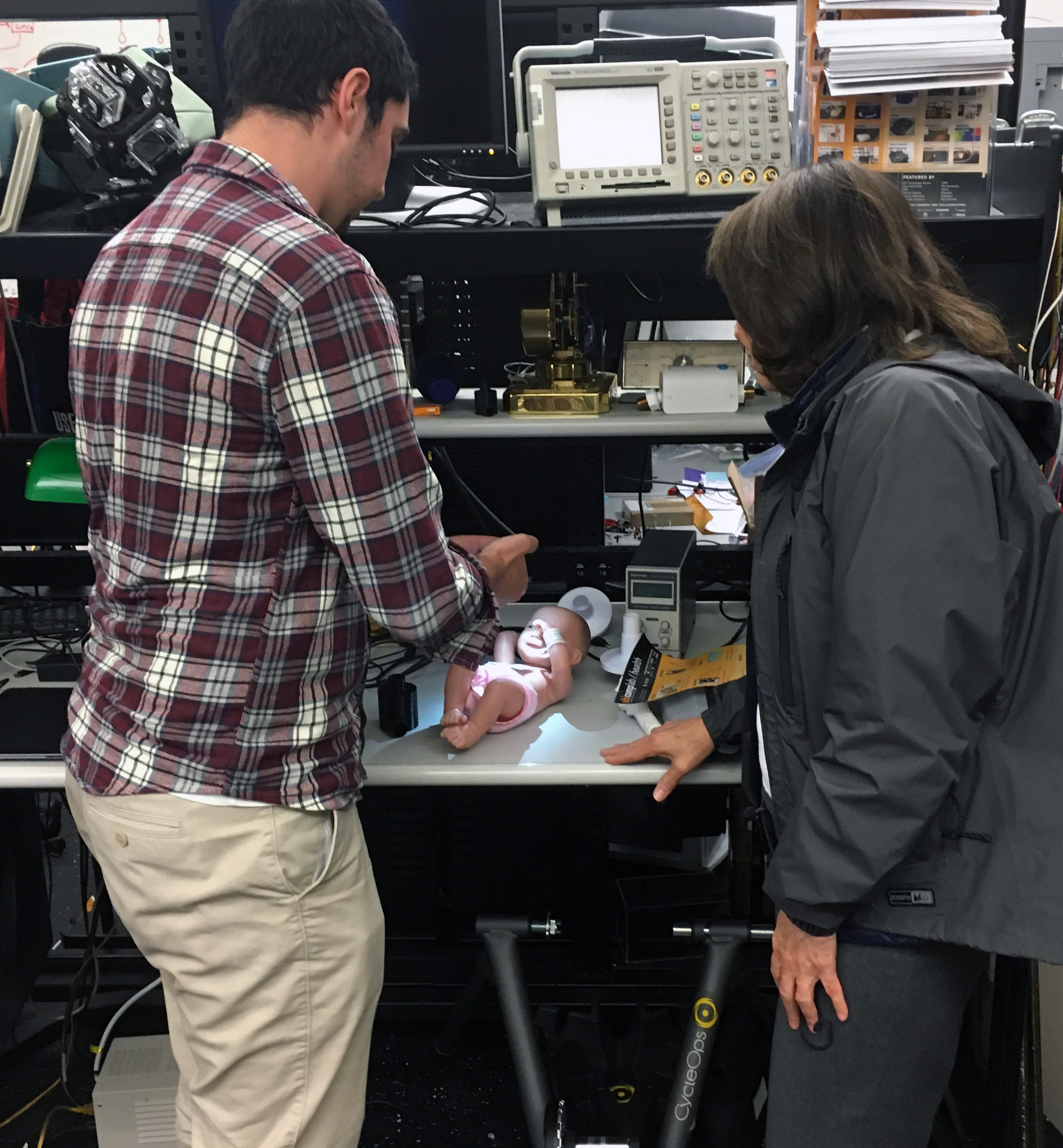
Alex Mariakakis demonstrates Bilicam to Sen. Cantwell. (No actual babies were harmed during this demonstration!)

U.S. Senator Maria Cantwell spent nearly two hours at UW CSE on Saturday afternoon, along with staffers Dayna Lurie and Nate Caminos. The agenda:

GRAIL

Steve Seitz demonstrates content created using Cardboard Camera, software developed by his team at Google.

Many thanks to Senator Cantwell for taking time from her busy schedule to learn more about what we do. Washington State is blessed with an extraordinary Congressional delegation. Read more →

What courses do high school students like “a lot”?

border

Original study by Change the Equation, the Amgen Foundation, and C+R Research

What courses do high school students like “a lot”?

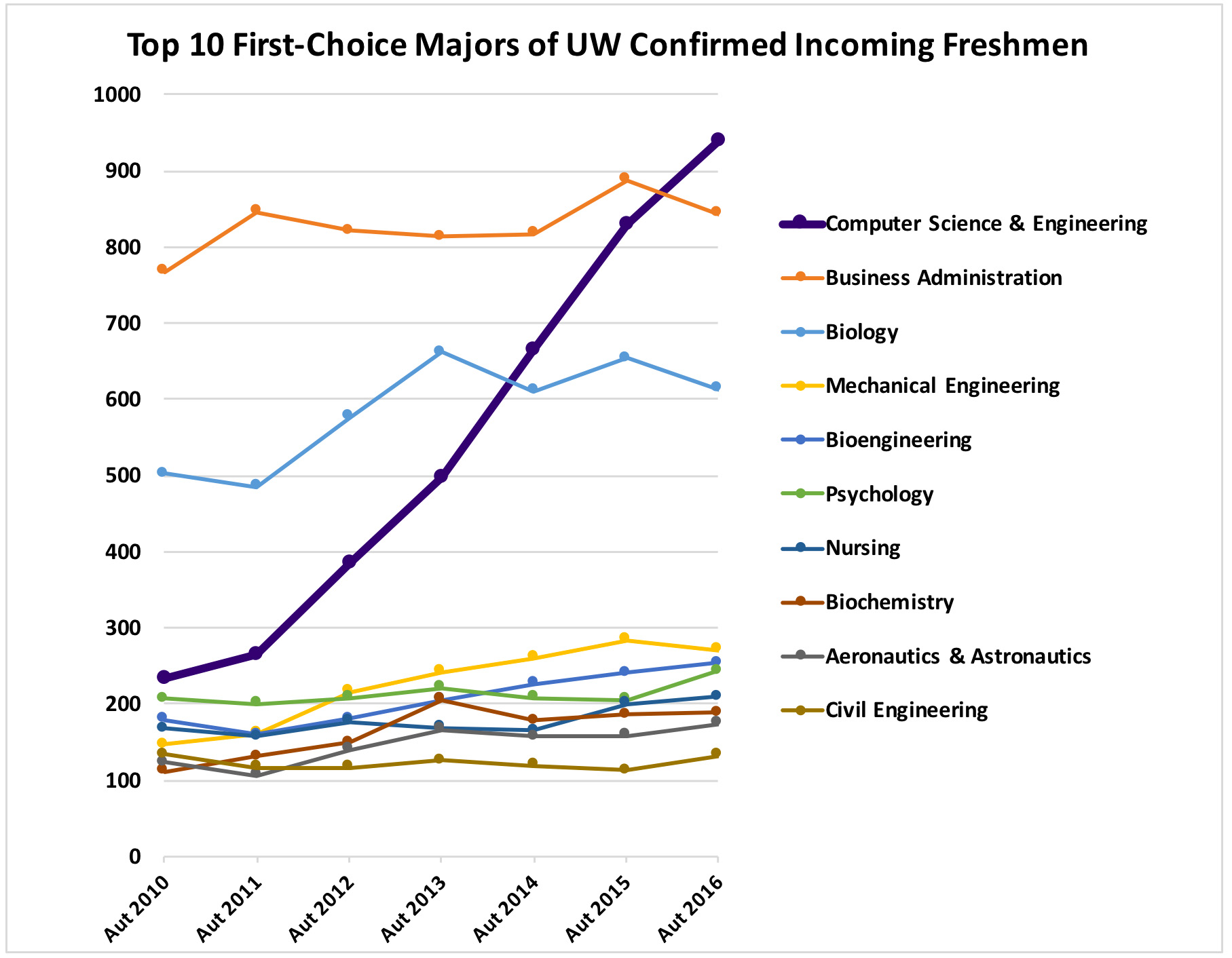
AP Computer Science blows away all other STEM fields! Among 52 fields, its popularity is exceeded only by Dance, Drawing, Graphic Design, Painting, and Choir.

The study, by Change the Equation, the Amgen Foundation, and C+R Research, was unearthed and analyzed by Code.org’s Hadi Partovi.

Hadi3

Hadi Partovi’s aggregated version

Hadi corrected the study for selection bias, and aggregated related fields – the results were just as dramatic!

Read Hadi’s blog post here. Read more →

Oren Etzioni in Wired: “Deep learning isn’t a dangerous magic genie. It’s just math”

GW20160134040-1024x768Oren Etzioni – CEO of Paul G. Allen’s Allen Institute for Artificial Intelligence and long-time UW CSE professor – writes in Wired:

“Deep learning is rapidly ‘eating’ artificial intelligence. But let’s not mistake this ascendant form of artificial intelligence for anything more than it really is. The famous author Arthur C. Clarke wrote, ‘Any sufficiently advanced technology is indistinguishable from magic.’ And deep learning is certainly an advanced technology – it can identify objects and faces in photos, recognize spoken words, translate from one language to another, and even beat the top humans at the ancient game of Go. But it’s far from magic. …

“Machine learning is far from being a ‘genie’ that is ready to spring from a bottle and run amok. Rather, it is a step in a decades-long (or, perhaps, centuries-long) research endeavor to understand intelligence and to construct human-level AI.”

Great essay! Read it here. Read more →

UW CSE’s Anat Caspi, changemaker, at the United States of Women Summit

Anat Caspi Anat Caspi, director of UW CSE’s Taskar Center for Accessible Technology, is attending the United States of Women Summit convened by the White House this week. She was invited to participate in recognition of her efforts to lead change on issues important to women and girls.

The summit is bringing together 5,000 people from all industries and walks of life to celebrate the progress that has been made to advance gender equality and identify the actions needed to move forward. It is organized around six pillars: economic empowerment, health and wellness, educational opportunity, preventing violence against women, entrepreneurship and innovation, and leadership and civic engagement. Caspi checks several of those boxes as an advocate for participatory design and using technology to improve quality of life for people of all abilities in her role at the Taskar Center. The center—which was established in memory of the late UW CSE professor Ben Taskar—taps into UW CSE’s strength in accessibility, sensing and novel interfaces to develop and deploy technologies that will increase independence for individuals with motor and speech impairments.

United States of Women Summit badgeCaspi has been an invaluable resource to students interested in accessible design. She has advised students participating in the City of Seattle’s Hack the Commute competition and in the eScience Institute’s Data Science for the Social Good program. Caspi is also an instructor in our Accessibility Capstone course for undergraduates.

The United States of Women Summit runs today and tomorrow in Washington, D.C. and features First Lady Michelle Obama, Vice President Joe Biden, and a who’s who list of leaders from business, entertainment, academia, non-profits and government. Sessions are being streamed live online. Find out more about the summit and supporting activities by visiting the USOW website here. Read more →

UW CSE awards a record 391 degrees

PhD2016

14 of UW CSE’s 23 2016 Ph.D. graduates

UW CSE awarded a record 391 degrees at our department graduation ceremony on Friday evening. (We are rapidly growing toward a total of 460 degrees per year, and hope to be funded to grow to 600 degrees per year – roughly double the number of just two years ago! An additional building is part of the plan.)

256 Bachelors degrees were awarded in Computer Science and Computer Engineering. Thirty percent of the Computer Science Bachelors recipients were women – not nearly at parity, but double the national average for our peers.

112 Masters degrees were awarded: 49 in our part-time evening/distance Professional Masters Program, and 63 to full-time students.

23 Ph.D.s were awarded.

At the ceremony:

  • Ruth Anderson – a 2006 UW CSE Ph.D. – received the ACM Student Chapter Undergraduate Teaching Award.
  • Bran Amour Hagger received CSE’s Undergraduate Service Award.
  • Darby Losey received CSE’s Undergraduate Honors Thesis Award.
  • Viktor Farkas and Krittika D’Silva received CSE’s Outstanding Computer Science Senior Award and Outstanding Computer Engineering Senior Award, respectively.
  • The Bob Bandes Memorial Excellence in Teaching Award recognized graduate student teaching assistants Adrian Sham and Nick Shahan, and undergraduate student teaching assistants Michael Lee and Melissa Galloway. Honorable mentions went to undergraduate student TAs Megan Hopp and Chloe Lathe.
  • Albert Greenberg (Ph.D. 1983) and Stefan Savage (Ph.D. 2002) received this year’s CSE Alumni Achievement Awards.

Congratulations one and all!

Check out the graduation program here. (Additional photos to come!) Read more →

« Newer PostsOlder Posts »