UW and Microsoft researchers create system to store and retrieve digital images using DNA

MISL-research-team-375x250

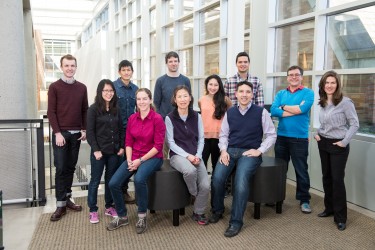
The Molecular Information Systems Lab research team: Front (left to right): Bichlien Nguyen, Lee Organick, Hsing-Yeh Parker, Siena Dumas Ang, Chris Takahashi. Back (left to right): James Bornholt, Yuan-Jyue Chen, Georg Seelig, Randolph Lopez, Luis Ceze, Karin Strauss. Not pictured: Doug Carmean, Rob Carlson, Krittika d’Silva.

Researchers from the UW’s Molecular Information Systems Lab (MISL) have created one of the first systems that uses DNA molecules to store digital images —  and successfully demonstrated the ability to retrieve the encoded images intact.

UW CSE professor Luis Ceze, joint CSE and EE professor Georg Seelig, CSE affiliate faculty members Doug Carmean and Karin Strauss of Microsoft Research, CSE Ph.D. student James Bornholt, and BioE Ph.D. student Randolph Lopez are the authors of an ASPLOS paper describing the effort to advance the state of the art in digital storage. Taking their cues from nature, the researchers aim to create a system that will be able to accommodate the growing volume of data being generated around the world — predicted to reach 44 trillion gigabytes by 2020.

From the UW media release:

“The team of computer scientists and electrical engineers has detailed one of the first complete systems to encode, store and retrieve digital data using DNA molecules, which can store information millions of times more compactly than current archival technologies.

“In one experiment…the team successfully encoded digital data from four image files into the nucleotide sequences of synthetic DNA snippets.
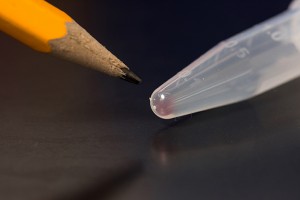
Close-up of DNA

This smear of DNA stores 10,000 gigabytes of data

“More significantly, they were also able to reverse that process — retrieving the correct sequences from a larger pool of DNA and reconstructing the images without losing a single byte of information.”

According to Ceze, “Life has produced this fantastic molecule called DNA that efficiently stores all kinds of information about your genes and how a living system works — it’s very, very compact and very durable…We’re essentially repurposing it to store digital data — pictures, videos, documents — in a manageable way for hundreds or thousands of years.”

The MISL team became one of only two nationwide that have demonstrated the ability to achieve “random access” — that is, to retrieve the correct sequences of data from a large pool of random DNA molecules — by encoding the equivalent of street addresses in the DNA sequences and then employing a technique commonly used in molecular biology, Polymerase Chain Reaction (PCR), to identify and reorder the data. They also applied error correction techniques typically used in computer memory to the DNA to address errors in the encoding process.
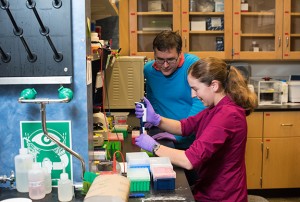
Luis Ceze and Lee Organick

Luis Ceze and research scientist Lee Organick in the lab

“This is an example where we’re borrowing something from nature — DNA — to store information. But we’re using something we know from computers — how to correct memory errors — and applying that back to nature,” Ceze said.

Read the full UW media release here and check out our previous blog post here. The team presented its findings at the ASPLOS 2016 conference earlier this month — read the research paper here. Check out coverage of the project by NewsweekGizmodo, Discover MagazineCNET, Motherboard, Crosscut, Geekwire and the Daily Mail.

Photos: Tara Brown Photography Read more →

Bill Howe explains the technology behind the Panama Papers leak

Bill HoweUW CSE affiliate professor Bill Howe, associate director of the UW’s eScience Institute, was interviewed for a USA Today story on the recent Panama Papers leak. Howe explained the way in which today’s data science tools—from low-cost cloud services to easily available translation and data mining software—made it possible to rapidly untangle and analyze the contents of more than 11 million documents from Panama-based law firm Mossack Fonseca.

From the article:

“Dealing with a data drop like the Panama Papers has gotten much easier in the past decade, with the advent of cheap storage, cloud computing, easy-to-use and often free data mining software and faster computers.

“The first order of business after exfiltrating the files from the law firm’s computer network would be to find somewhere to look at it.

“‘This has gotten much easier with cloud computing. I swipe my credit card and I have as many machines as I need and it’s not expensive, so if I need 500 machines to work on this, I can get them up and running in a weekend,’ said Howe.

“Many of the documents appear to have been images, so the next task is extracting the text, something that’s also become significantly easier with time.

“‘There are off-the-shelf optical character recognition tools you can use. And crucially, if you scale this out over lots of computers, you can do hundreds [of pages] at a time….Every step along the way definitely requires some technical skills, but there’s nothing there that’s requiring a Ph.D. in computer science, quite frankly,’ Howe said.”

Read more about how technology enabled a data dump of global proportions in the full article here. Read more →

Justin Hsia to join UW CSE faculty

Justin HsiaJustin Hsia, currently a postdoc in UC Berkeley’s Electrical Engineering & Computer Sciences department, will join the UW CSE faculty as a lecturer in the fall. Hsia earned his Ph.D. and M.S. degrees in EECS and B.S. degrees in EECS and Mechanical Engineering from UC Berkeley, where his research focuses on synthetic biology and biological systems analysis as a member of the Networked Dynamical Systems Group.

Hsia will arrive at UW CSE with extensive experience in teaching both lower and upper division coursework, including classes in computer architecture, microelectronic circuits, and feedback control systems. He is currently a co-instructor of The Beauty & Joy of Computing, a course that introduces students without programming experience to computer science principles and the field’s impact on society.

Hsia was recognized with UC Berkeley’s Outstanding Graduate Student Instructor Award and was one of only a few graduate students invited to teach a summer course as an instructor. Hsia has demonstrated a strong commitment to mentorship, having worked with visiting high school students and undergraduates—so he will fit right in with UW CSE’s student-centric culture and focus on K-12 outreach.

We are looking forward to welcoming Justin to the UW CSE family! Stay tuned for updates as faculty recruiting season progresses. Read more →

UW CSE’s Su-In Lee wins NSF CAREER Award

Su-In LeeJoint UW CSE and Genome Sciences professor Su-In Lee, whose research focuses on the intersection of computer science and biology, has received an NSF CAREER Award. The award will support her efforts to develop a computational framework for identifying how the human genome interacts with hundreds of regulatory molecules—research that will answer fundamental questions to advance our understanding of how the human genome works.

Lee develops novel statistical and machine learning techniques to solve a variety of thorny problems in biology, from basic science to bedside applications. Her current projects include the development of computational methods to choose the best chemotherapy drug for individual cancer patients, to identify therapeutic targets to halt the progression of Alzheimer’s, and to predict in real time whether a patient under anesthesia during surgery may develop a respiratory crisis. Lee’s group collaborates with various departments at UW Medicine and Fred Hutchinson Cancer Research Center, and she has major research grants from the National Science Foundation, the National Institutes of Health and the American Cancer Society.

In this latest project, Lee will work with chromatin immunoprecipitation-sequencing (ChIP-Seq) data, which measures the location of each of the hundreds of regulators on three billion positions in the human genome. By developing novel computational methods to analyze these big data—involving thousands of available ChIP-Seq data sets—Lee aims to advance the research community’s knowledge of how these regulators interact with each other to control the human genome as well as how those interactions differ across various cell types and across species.

The CAREER Award program is the most prestigious category of awards given by the National Science Foundation in support of junior faculty who exemplify excellence in teaching and research. Lee is the 30th current UW CSE faculty member to be recognized through this program or its predecessors.

Learn more about this project on the NSF award page here, and check out Lee’s research page here.

Congratulations, Su-In! Read more →

Don’t miss the New Tech Seattle meetup at UW CSE!

New Tech NorthwestNew Tech Seattle logo and UW CSE are co-hosting the fourth annual New Tech Seattle UW meetup on Tuesday, April 12th. The event, which features good food, great company and great content from local innovators, will take place from 5:00 to 7:15 pm in the Paul G. Allen Center for Computer Science & Engineering.

UW CSE and EE professor Shwetak Patel will kick off the program, which will also feature presentations by five companies developing solutions in big data, machine learning and health care. Three of the companies will be represented by founders who are also UW CSE alumni: DataBlade by Jeremy Brudvik (B.S., ’08) and Allen Chen (B.S., ’07), Igneous by Jeff Hughes (B.S., ’06), and KRNL Labs by Adam Kirk (B.S., ’01).

Learn more and register on the New Tech Seattle website here.

We hope you can join us! Read more →

UW CSE alum Stefan Savage honored with ACM-Infosys Foundation Award

Stefan SavageUW CSE Ph.D. alum Stefan Savage, currently a professor at UCSD, was named the recipient of the 2015 ACM-Infosys Foundation Award in the Computing Sciences today. He earned the award, which recognizes individuals whose early contributions in their careers have had a fundamental impact on the field of computing, for his “innovative research in network security, privacy, and reliability that has taught us to view attacks and attackers as elements of an integrated technological, societal, and economic system.”

Savage, who completed his Ph.D. at UW CSE working with professors Tom Anderson and Brian Bershad, has applied his holistic view of security research to great effect. Working with collaborators at UCSD and UC Berkeley, he tackled the problem of unsolicited email by constructing a complete model of the spam supply chain to target and remove the financial incentive for perpetrators. He also worked with a team from UCSD and UW CSE to assess the security vulnerabilities of modern automobile systems—that project, which was co-directed by Savage and UW CSE professor Yoshi Kohno, inspired extensive follow-on research and prompted regulators and manufacturers to make cybersecurity a priority.

From the ACM media release:

“Savage’s impact on the field of network security stems from the systematic approach he takes to assessing problems and combating adversaries ranging from malicious software and computer worms to distributed attacks….

“‘Keeping networks secure is an ongoing battle,’ explained ACM President Alexander L. Wolf. ‘Coming up with a technical advancement to block an adversary is important. But, very often, the adversaries soon find new ways in. Stefan Savage has shifted thinking and prompted us to ask ourselves how we might impede the fundamental support structure of an attacker. His frameworks will continue to significantly influence network security initiatives in the coming years.’

“‘Dr. Savage has dedicated his career to analyzing, protecting, and strengthening the systems and networks that make our digital age possible…’ said Vishal Sikka, Chief Executive Officer & Managing Director of Infosys. ‘Dr. Savage is a true innovator, pursuing his curiosity and passion toward new frontiers in cybersecurity, and exemplifying the kind of work that the ACM-Infosys Foundation Award is proud to support.'”

The ACM will present Savage with the award at its annual banquet in San Francisco in June.

Read more about Stefan and his achievements on the ACM website here and in a related Reuters article here.

Congratulations, Stefan! Read more →

UW CSE students shine in 2016 NSF Graduate Research Fellowship competition

NSF Graduate Research Fellowship Program logoThe National Science Foundation announced the recipients of its 2016 Graduate Research Fellowships today and UW boasts the second highest number of fellowship recipients in the nation in the “Computer and Information Science and Engineering” category. A total of eight UW students earned Fellowships in the computing field—including seven from UW CSE—and eight more earned Honorable Mentions.

NSF’s Graduate Research Fellowship Program supports outstanding student researchers pursuing Master’s and doctoral degrees in science, technology, engineering and mathematics who demonstrate the potential to have a significant impact in their fields. Nearly 17,000 students applied for a total of 2,000 fellowships awarded nationwide. Congratulations to the UW students who were recognized by the NSF today for their excellence in computing research:

UW CSE NSF Graduate Research Fellowship winners

Elizabeth Clark: Natural Language Processing

Maxwell Forbes: Natural Language Processing

Lucy Lin: Natural Language Processing

Talia Ringer: Formal Methods, Verification, and Programming Languages

Jessica Schroeder: Human Computer Interaction

Lucy Simko: Computer Security and Privacy

Amanda Swearngin: Human Computer Interaction

UW CSE Honorable Mentions

Kira Goldner: Algorithms and Theoretical Foundations

Daniel Gordon: Robotics and Computer Vision

Ellis Michael: Computer Systems and Embedded Systems

George Mulcaire: Natural Language Processing

Annie Ross: Human Computer Interaction

Zuoming Shi: Human Computer Interaction

In addition to the CSE students named above, UW HCDE student Dawn Sakaguchi-Tang was awarded a 2016 fellowship in Human Computer Interaction, and UW EE student Bora Banjanin and HCDE student Erin Hoffman received honorable mentions in Robotics and Computer Vision and Human Computer Interaction, respectively.

Read the NSF press release here and view the full list of winners here.

Way to go, team! (Last year, UW CSE students earned 8 NSF Graduate Research Fellowships and 3 Honorable Mentions – it’s been a great few years for UW CSE student recognition in the NSF GRFP competition.) Read more →

Crosscut highlights UW CSE’s role in “bringing women back to computer science”

Sonja Khan and Irene ZhangWomen historically have played a significant role in computer science. While the field has gone backward in recent decades when it comes to gender diversity, UW CSE has made a concerted effort to buck that trend and attracted national attention as a result.

Seattle online journal Crosscut recently caught up with UW CSE B.S./M.S. student Sonja Khan and Ph.D. student Irene Zhang to find out what makes this program so special. Their experiences reinforce the notion that, when it comes to increasing diversity in computing, a welcoming and supportive culture is key.

From the article:

“Women’s role in the computer revolution is often glazed over. There’s Ada Lovelace, the mathematician sometimes called the ‘world’s first computer programmer’, who sketched out the possibilities of computers way back in the 1800s. In 1945, one of the world’s first electronic general-purpose computers was built, with six female mathematicians creating its programs. By the early ‘80s, personal digital computers were taking off, and computer science was a major in universities. The number of women earning bachelor’s degrees in computing hovered around 40 percent.

“But around 1985, the number plummeted. Today, only about 18 percent of computer science bachelor’s degrees are earned by women. Women once held a prominent role in shaping the field’s future. In large part, that’s no longer the case….

“What can reverse the trend, and bring more women into the field again? It’s a question that companies and universities across the U.S. are asking. And the University of Washington’s Department of Computer Science and Engineering (UW CSE) may have found a method that works.”

The article charts Khan’s path from undecided freshman to computer science major, inspired by her positive experience in UW CSE’s introductory programming course. Zhang emphasizes the collegial atmosphere and opportunities for younger students to interact with female researchers as vital factors in explaining UW CSE’s success. Professor Ed Lazowska also explains why the entire field should follow UW CSE’s example in promoting diversity to produce the best products and services for users.

Read the full article here.

Photo credit: Dennis Wise Read more →

Where the jobs are – 2016 edition

jobs chartThe 2016 NSF Science & Engineering Indicators have recently been released, including data on the numbers of degrees granted in various fields of science and engineering.

Similarly, the 2016 US Bureau of Labor Statistics job projections have recently been released, covering the decade 2014-2024.

The Tale of the Tape: A chart of “annualized jobs available” (from BLS) vs. “annual degrees granted” (from NSF) for various fields.

Workforce Demand Chart_2013borderThe story in Washington State is the same. Three state educational agencies looked across all fields (not just STEM fields) for those with any appreciable gap between “degrees granted” and “jobs available.” They found only four at the bachelors or graduate level. Computer science was #1, with a gap 2.5X as great as the second-place field – which was all fields of engineering added together (electrical, mechanical, civil, aeronautical, materials, etc.). (Of course, not all of those computer science jobs are in Washington’s vibrant software industry. For example, Washington’s aerospace industry employs roughly 3X as many computer scientists as aeronautical engineers!)

Wowsers! Read more →

Mesosphere raises $73.5 million Series C

O4fX0WytFgMoaT6qIVasMg-Mesosphere_Logo_-_Horizontal_Lockup__RGB__Jumbo_Mesosphere, a “data center operating system” company derived from a course project by UW CSE bachelors alum Ben Hindman when he was a Ph.D. student at UC Berkeley, has raised $73.5 million in Series C funding.

3805afbBen will receive the University of Washington College of Engineering Diamond Award for Early Career Achievement in May.

Check it out in TechCrunch here. Read more →

« Newer PostsOlder Posts »