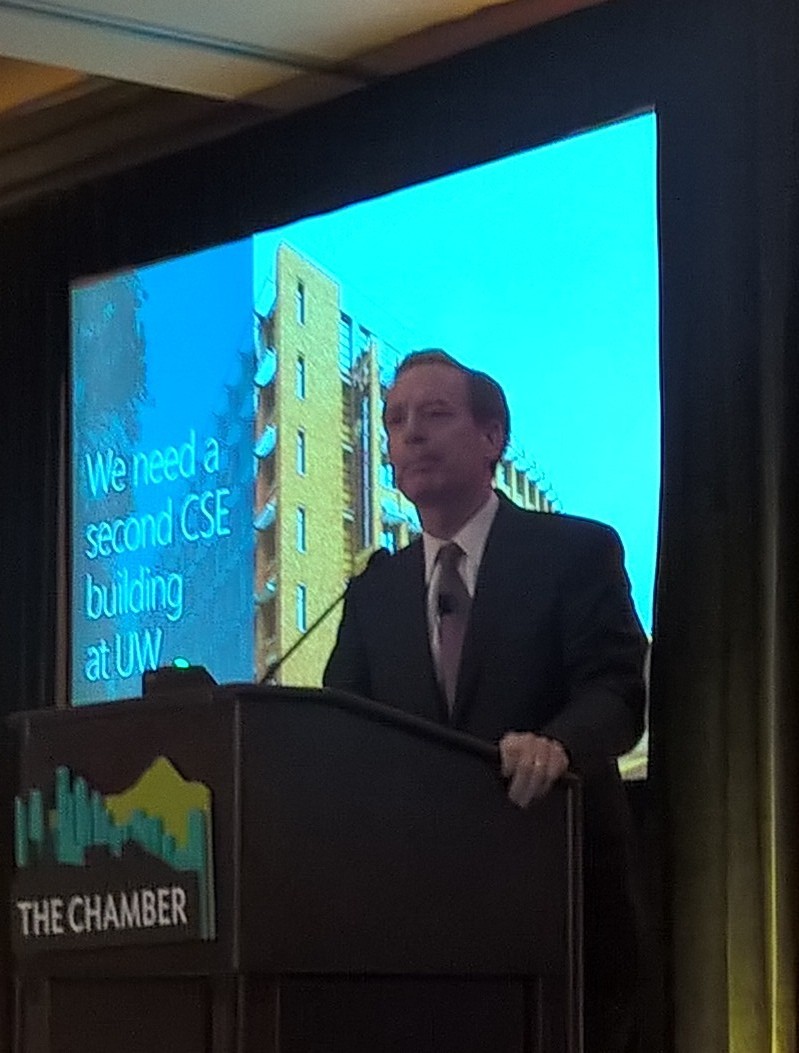
Brad Smith at the Seattle Metro Chamber Leadership Conference: “We need a second CSE building at UW”

WP_20151022_15_56_31_ProMicrosoft President Brad Smith is an extraordinary civic leader in so many ways – including serving as chair of the committee tasked with raising the private funding for a second building that will enable UW CSE to double its enrollment, responding to student demand, employer demand, and intellectual opportunity.

His message at today’s Seattle Metro Chamber Leadership Conference: “We need a second CSE building at UW.”

Thank you Brad! Read more →

Feed your mind with UW CSE’s Ed Lazowska on “Lunch Break”

Ed Lazowska and Brad AndersonLunch Break” is an online video series featuring Brad Anderson, Corporate Vice President for Enterprise Client & Mobility at Microsoft, interviewing tech industry luminaries from the comfort of his car during – what else? – his lunch break. This week’s episode features UW CSE professor Ed Lazowska, who chatted with Brad about topics ranging from Seattle’s contributions to civilization (coffee, grunge, retail), to UW-based efforts to enable data-intensive discovery in a variety of fields.

Along the way, Ed touches upon what inspired him to pursue computer science in the first place and talks about a golden age in which kids are encouraged to build things.

Brad and Ed cover a lot of ground in a short period of time. Watch part one of the two-part interview here, and read more about the episode on Brad’s blog here.

Stay tuned for part two next week! Read more →

UW’s and Microsoft’s HyperCam featured on KING 5 and KOMO 4 news

Mayank Goel demonstrates HyperCam

HyperCam, the new low-cost hyperspectral imaging camera developed by UW’s Ubiquitous Computing Lab and Microsoft Research, recently got some screen time of its own thanks to KING 5 and KOMO 4 news. Crews from our local NBC and ABC stations interviewed UW CSE Ph.D. student Mayank Goel, who demonstrated how HyperCam works and explained its potential commercial applications.

Watch the KING 5 segment here and KOMO 4 segment here.

The HyperCam project has been in the limelight since it was announced last week. In addition to garnering significant media coverage, the project was selected as a runner-up for the Madrona Prize at our annual open house and poster session this past Tuesday.

Congratulations to Mayank and the entire HyperCam team – which includes Mayank’s fellow CSE Ph.D. students, Eric Whitmire and Alex Mariakakis; CSE+EE professor Shwetak Patel; and Microsoft Research contributors Scott Saponas, Neel Joshi, Dan Morris, Brian Guenter and Marcel Gavriliu – for all the well-deserved attention.

Read our previous coverage of HyperCam here and here. Read more →

Recruiting fair for established companies packs ’em into the Allen Center

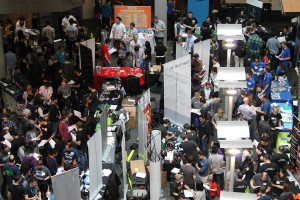
Established company recruitingUW’s Paul G. Allen Center for Computer Science & Engineering was rocking today as recruiters from 60 established companies – and many hundreds of CSE students – descended upon the Allen Center as part of our 2015 Industry Affiliates meeting. Thanks to everyone who showed up – it was especially great to reconnect with so many of our alums who have carved out careers in industry and who return to campus to talk to future graduates about their next step after UW CSE.

We look forward to seeing everyone again at our Winter 2016 recruiting fair on January 27th (startups) and January 28th (established companies).

Thanks to all of our Affiliates, alumni and friends for making this year’s big annual meeting a huge success! Read more about it here, here and here. Read more →

UW CSE and Madrona Venture Group celebrate student innovation

Scott Jacobson and Supasorn Suwajanakorn

Madrona’s Scott Jacobson hands the top prize to Supasorn Suwajanakorn

Each year, the Madrona Prize is awarded to students participating in UW CSE’s Open House whose work shows the greatest potential for commercialization. This year’s crop of one winner and three runners-up earned their awards by doing groundbreaking research in computer vision, systems and networking, health sensing, and ubiquitous computing.

WINNER

What Makes Tom Hanks Look Like Tom Hanks (Total Moving Face Reconstruction): Supasorn Suwajanakorn, Steve Seitz, Ira Kemelmacher-Shlizerman

RUNNERS-UP

Irene Zhang

Student Irene Zhang explains her poster to members of the Madrona team

ApneaApp – Diagnosing Sleep Apnea: Rajalakshmi Nandakumar

Building Consistent Transactions with Inconsistent Replication (TAPIR): Irene Zhang, Naveen Kr. Sharma, Adriana Szekeres, Arvind Krishnamurthy, Dan R. K. Ports

HyperCam – Hyperspectral Imaging and Their Applications: Mayank Goel, Eric Whitmire, Alex Mariakakis, Scott Saponas, Neel Joshi, Shwetak Patel

PEOPLE’S CHOICE AWARD

In addition, the People’s Choice Award, for which attendees vote for their favorite projects, went to EE graduate student Bryce Kellogg working in CSE’s Wireless Lab for Passive WiFi – WiFi at 10000x Lower Power by Vamsi Talla, Bryce Kellogg, Shyam Gollakota and Josh Smith.

Bryce Kellogg on stage

Bryce Kellogg accepts the People’s Choice Award from CSE’s Ed Lazowska and Hank Levy

Read more over on Madrona’s website here and an excellent GeekWire article here.

Congratulations to our winners – and thanks to Madrona Venture Group and all of the participants in last night’s event for supporting UW CSE! Read more →

The Seattle Times visits UW CSE’s Industry Affiliates meeting

“Ricardo Martin-Brualla has created a time-lapse video that shows a massive glacier in Norway receding over the course of 10 years from a giant block of ice to a smaller frozen patch.

“But Martin-Brualla didn’t set up a camera to take photos for a decade. Instead, the University of Washington computer science Ph.D. student used computer-vision technology to find photos online of the popular landmark, warp them so they all appear to be taken from the same angle and stitch them together so it looked as if time flowed continuously.

“Martin-Brualla presented his project to a packed room Tuesday at the University of Washington Department of Computer Science & Engineering’s Industry Affiliates Meeting, part of a three-day event to showcase the department’s work. Tuesday was all about showing off student research for local companies who support the department. On Monday, more than 40 startups packed the Paul G. Allen Center for Computer Science & Engineering on UW’s campus to meet with students. A second recruiting event will take place Wednesday, this time with more than 60 larger companies showing off their swag to recruit new workers.”

Read more – and find a link to a video of Ricardo’s amazing work – here. Read more →

Don’t miss UW CSE’s Dieter Fox talking about our robotic future

Dieter FoxUW CSE professor Dieter Fox, head of the UW Robotics and State Estimation Lab, is headlining the next installment of the 2015 Engineering Lecture Series this Wednesday, October 21st. Dieter will talk about the latest advances in robotics, including the development of robots that can do 3D mapping, track human movement and manipulate objects. The lecture will begin at 7:30 pm in Kane Hall on the UW’s Seattle campus. Attendance is free, but advance registration is required. Learn more and register here.

Dieter is the second of three CSE faculty members featured in the series, Robots to Web Trackers: Privacy in the Age of Smart Technology, sponsored by the UW Alumni Association. Earlier this month, Franzi Roesner delivered a talk on pervasive tracking in a connected age; on November 3rd, Yoshi Kohno will participate in a panel examining privacy and security challenges.

Don’t miss it! Read more →

Center for Game Science and Allen Institute for Brain Science team up to unlock mysteries of the human brain

Brain powerUW CSE’s Center for Game Science, led by professor Zoran Popović, and Paul Allen’s Institute for Brain Science are teaming up with a growing community of citizen scientists to develop a new game aimed at creating a “periodic table of the neurons.” The project, which is made possible in part with support from the National Science Foundation, is one of several new initiatives announced by the White House yesterday that are designed to engage more students and adults in scientific discovery.

The Center for Game Science has a track record of uniting the power of gaming and the wisdom of the crowd to advance scientific research through games like Foldit (protein folding) and Nanocrafter (synthetic biology). This latest effort with the Allen Institute will engage citizen scientists in an exciting new challenge: unlocking mysteries of the human brain.

Learn more at the Center for Game Science blog here, and read the White House press release here.

Congratulations to Zoran and the entire CGS team on the launch of this new partnership – game on! Read more →

It’s nuts at the UW CSE startup recruiting fair

Startup Recruiting Fair Crowd(1)Today’s the first day of the 2015 UW CSE Industry Affiliates meeting – an afternoon of recruiting by startups and small companies, followed by a “startup pitch gong show.” And it’s nuts!

Tomorrow: research interactions and our annual evening Open House, concluding with the awarding of the Madrona Prize.

Wednesday: recruiting by established companies.

A million thanks to all of our supporters in the tech community! You play a big role in making what we do possible, and in making it worthwhile! Read more →

Tom Alberg, Amazon, and Seattle’s tech scene

On the 20th anniversary of Madrona Venture Group, and the day before the annual awarding of the Madrona Prize at our Industry Affiliates meeting, a lovely Seattle Times profile of its co-founder and our friend Tom Alberg.

“As one of the first investors in Amazon.com, Tom Alberg has been an active participant in the Seattle area’s tech industry for decades. He talks about those years, Amazon and investing in risky startups.”

Related: A post by Amazon’s Jay Carney, “What The New York Times Didn’t Tell You,” presenting a number of un-reported facts related to the recent New York Times article on Amazon’s workplace practices.

“The next time you see a sensationalistic quote in the Times like “nearly every person I worked with, I saw cry at their desk,” you might wonder whether there’s a crucial piece of context or backstory missing — like admission of fraud — and whether the Times somehow decided it just wasn’t important to check.” Read more →

« Newer PostsOlder Posts »