UW CSE celebrates scholarship and fellowship donors

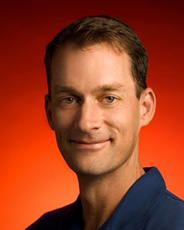
Karanbir Singh

Karanbir Singh thanks donors for supporting UW CSE undergraduates

UW CSE’s Scholarship and Fellowship Donor Recognition Luncheon is an annual tradition and one of our favorite events of the year. On Thursday, we held our 2016 luncheon to honor the individuals, families and organizations whose generosity keeps a CSE education within reach for undergraduate students regardless of means, and also enables us to recruit the most talented graduate students to our research program. With their support, UW CSE’s 29 endowed scholarship funds and 19 endowed fellowship funds are assisting 98 UW CSE undergraduate and graduate students this year to obtain a first-rate education and research experience.

Each year, we invite two recipients—one undergraduate and one graduate—to share their personal stories of how they came to UW CSE and what their scholarship or fellowship has meant to them. At the 2016 luncheon, Karan Singh and Annie Ross shared their stories and offered thanks on behalf of all of the students who have benefited from our donors’ support.

Singh is a third-year undergraduate student and recipient of the Burkhardt Family Endowed Scholarship. He serves as a teaching assistant for CSE’s introductory programming courses and has been accepted into the combined B.S./M.S. program. Singh told of his path from pre-med to computer science, when he was inspired to trade pipettes for programming. He looks forward to putting his computer science education to good use in order to improve education and health care.
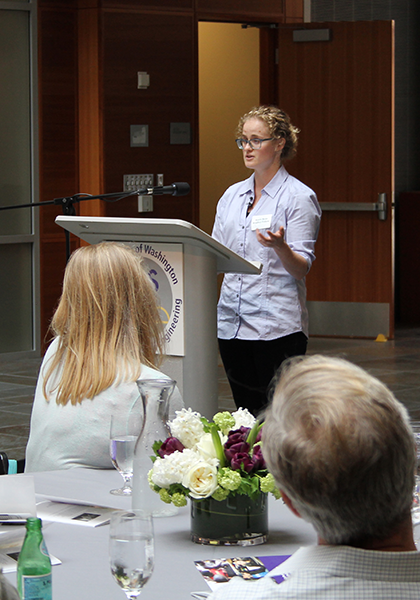
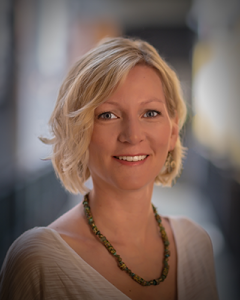
Annie Ross

Annie Ross thanks donors for giving student researchers the gift of time

Ross is a first-year Ph.D. student and the holder of the Wilma Bradley Endowed Fellowship. She works with CSE professor James Fogarty and CSE adjunct faculty member Jacob Wobbrock of the iSchool in the area of human-computer interaction. Ross discovered computer science after taking a CS course for the sake of a technical challenge while majoring in film production. She decided to pursue her Ph.D. in human-computer interaction as it gives her an opportunity to combine the creativity and human connection she found in film with her love of math and science.

Ross cited the supportive atmosphere as one of the reasons she chose UW CSE. But it was her fellowship that gave her the freedom to explore research areas that personally interest her which has defined her graduate school experience. Ross closed her remarks by recalling a conversation she had with her benefactor that perfectly illustrates the lasting impact of our donors’ generosity on our students.

“I had the absolute pleasure of having lunch with Ms. Bradley, the donor for my scholarship, earlier this year. Something she said really rang true with me: ‘One of the greatest gifts we can give to one another is time,’” said Ross.

“I’d like to take a moment to thank all of the generous donors who, through your fellowships and scholarships, have given us time to explore our interests and focus on our passions.”

Read about our terrific donors and the students they support in the luncheon program here.

Watch a video here of the remarks by Karan Singh and Annie Ross.

Our heartfelt thanks to all who support UW CSE and our students! Read more →

UW researchers shine at CHI

CHI 2016 logoUW faculty and students are gearing up for the Association of Computing Machinery’s CHI 2016 conference that begins this weekend in San Jose, California. As the top conference for human-computer interaction research, CHI offers a terrific opportunity to showcase the breadth and depth of the University of Washington’s expertise in HCI and design as well as the strength of our interdisciplinary collaborations. UW CSE professor James Fogarty put together a terrific overview of UW-authored papers featured at this year’s conference for the DUB website—including three Best Paper Awards representing the top one percent of submissions.

Katharina Reinecke

Katharina Reinecke

UW CSE professor Katharina Reinecke co-authored one of the winning papers, Enabling Designers to Foresee Which Colors Users Cannot See, with professors David Flatla of University of Dundee and Christopher Brooks of the University of Michigan. For that project, Reinecke and her fellow researchers collected data through LabintheWild to examine the effect of real-world lighting conditions on people’s ability to differentiate colors in websites and infographics. The team then developed an image-processing tool, ColorCheck, that enables designers to identify color pairings that may pose a problem for some users of digital content.

Of the nine UW-authored papers that earned Honorable Mentions—given to the top five percent of submissions to CHI—five were co-authored by CSE faculty and/or students. The projects deal with an array of HCI-related topics, including accessibility, health sensing, gesture tracking, and virtual reality:

Finexus: Tracking Precise Motions of Multiple Fingertips Using Magnetic Sensing, by UW Electrical Engineering Ph.D. alum Ke-Yu Chen, CSE and EE professor Shwetak Patel, and Sean Keller of Oculus Research, is a system that uses magnets to precisely track finger movements for a more elegant and immersive virtual reality experience (more on Finexus here).

FingerIO: Using Active Sonar for Fine-Grained Finger Tracking, by UW CSE Ph.D. student Rajalakshmi Nandakumar, EE Ph.D. student Vikram Iyer, CSE affiliate faculty member Desney Tan of Microsoft Research, and CSE professor Shyam Gollakota, enables users to interact with smartphones and smartwatches by writing or gesturing on any surface or in mid-air using sonar (more on FingerIO here).

Incloodle: Evaluating an Interactive Application for Young Children with Mixed Abilities, by UW Human Centered Design & Engineering Ph.D. student Kiley Sobel, CSE Ph.D. student Kyle Rector, HCDE graduate student Susan Evans, and HCDE professor and CSE adjunct faculty member Julie Kientz, presents a picture-taking app that advances our understanding of how interactive technology can facilitate inclusive play among children with diverse abilities.

Researcher-Centered Design of Statistics: Why Bayesian Statistics Better Fit the Culture and Incentives of HCI, by UW CSE Ph.D. students Matthew Kay and Greg Nelson, and professor Erik Hekler of Arizona State University, demonstrates how Bayesian methods will lead to a more user-centered approach to statistical analysis in HCI research.

SpiroCall: Measuring Lung Function over a Phone Call, by UW CSE Ph.D. students Mayank Goel and Eric Whitmire, EE Ph.D. students Elliot Saba and Josh Fromm, former high school intern Maia Stiber, UW EE Ph.D. alum Eric Larson (now a professor at Southern Methodist University), CSE and EE professor Shwetak Patel, and the late CSE professor Gaetano Borriello, is a tool for measuring lung function using any phone, anywhere in the world (more on SpiroCall here).

And that’s just the tip of the iceberg! Several more papers authored by CSE adjunct faculty and friends were designated among the best of CHI—all told, UW authors contributed a total of 39 papers to this year’s conference, representing 10 UW departments or programs and more than two dozen external university and industry partners. See the complete list of UW CHI papers here.

Way to go, team! Read more →

PECASE ceremony: Shwetak Patel and Luke Zettlemoyer go to (the other) Washington

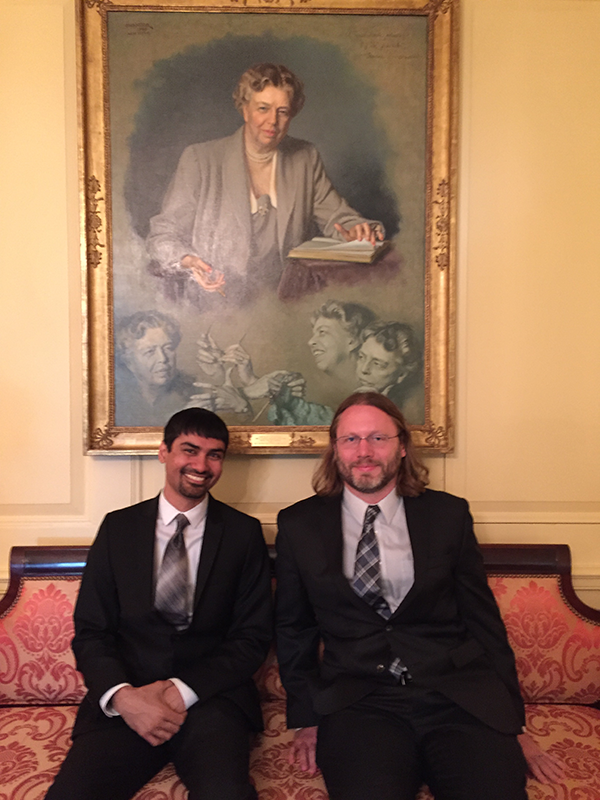
Front row: Shwetak and Luke. Back row: Eleanor.

UW CSE and Electrical Engineering professor Shwetak Patel and CSE professor Luke Zettlemoyer traveled to our nation’s capital to collect their Presidential Early Career Award for Scientists & Engineers (PECASE). The PECASE Award is the highest honor bestowed by our nation’s government on early career researchers in science and engineering fields.

The 106 winners named in February gathered yesterday to be recognized at ceremonies hosted by the National Science Foundation and the White House Office of Science & Technology Policy. Today, awardees joined President Barack Obama at the White House, where Amazon CEO Jeff Bezos also spoke.

Patel was nominated for the PECASE by the National Science Foundation for his work on home sensing systems to monitor electricity and water consumption. Zettlemoyer was nominated by the Department of Defense for developing new approaches to natural language processing. UW Chemistry professor David Masiello also received a PECASE through NSF for his work in the emerging field of theoretical molecular nanophotonics.

Read our earlier post on the PECASE announcement here.

Congratulations to Shwetak, Luke and David on this terrific achievement! Read more →

UW CSE’s Alvin Cheung receives U.S. Department of Energy Early Career Research Award

Alvin CheungProfessor Alvin Cheung, who works with UW CSE’s PLSE and database research groups, has received an Early Career Research Award from the U.S. Department of Energy’s Office of Science. Cheung’s winning proposal, “Using Verified Lifting to Optimize Legacy Stencil Codes,” was one of 49 projects selected for funding by DOE out of 720 proposals submitted.

Cheung’s proposal describes how verified lifting can enable legacy stencil computations to leverage domain-specific languages (DSLs) and frameworks to improve performance. Stencil computations are used in many image processing, physical simulation and machine learning applications. Verified lifting is a new technique that utilizes program analysis and program synthesis to automatically infer a high-level, provably correct summary from the input code. This technique has been previously applied to database applications and programmable switches. For stencil computations, his proposal offers an alternative to the rewriting of existing applications or developing custom compilers to transform such code—practices which are both tedious and prone to bugs—while leveraging the latest developments in high-performance DSLs and domain-specific compilers to improve speed, maintainability, and portability.

Cheung, along with collaborators Shoaib Kamil, senior research scientist in the Adobe Creative Technologies Lab led by CSE affiliate faculty member David Salesin, and postdoc Shachar Itzhaky and professor Armando Solar-Lezama of MIT, will present a related paper at the PLDI 2016 conference in June. In that paper, the team describes STNG, a system that translates stencil computations from low-level Fortran code into the high-performance DSL Halide to produce median performance improvements as high as 24x.

Congratulations, Alvin! Read more →

Researchers in UW’s UbiComp Lab turn any phone into a health sensing tool

Shwetak Patel, Mayank Goel, Elliot Saba

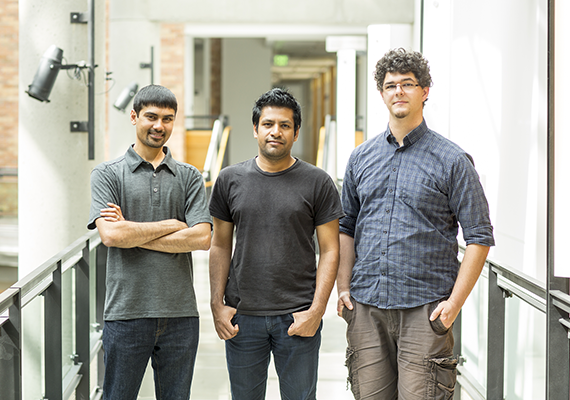
SpiroCall team members, from left: Shwetak Patel, Mayank Goel and Elliot Saba

Researchers in the UbiComp Lab led by UW CSE and EE professor Shwetak Patel have come up with a way to measure lung function using any phone, anywhere in the world. SpiroCall accurately measures lung function over a telephone call, enabling patients and doctors to monitor chronic lung diseases such as asthma and cystic fibrosis without requiring frequent visits to a clinic. The project extends the benefits of SpiroSmart, the smartphone app developed by the same team of researchers as an alternative to the traditional spirometry test, to people who only have access to older style mobile phones or landlines.

From the UW News release:

“‘We wanted to be able to measure lung function on any type of phone you might encounter around the world — smartphones, dumb phones, landlines, pay phones,’ said Shwetak Patel…’With SpiroCall, you can call a 1-800 number, blow into the phone and use the telephone network to test your lung function’….

“‘People have to manage chronic lung diseases for their entire lives,’ said lead author Mayank Goel, a UW CSE doctoral student. ‘So there’s a real need to have a device that allows patients to accurately monitor their condition at home without having to constantly visit a medical clinic, which in some places requires hours or days of travel.'”

Co-authors include UW EE Ph.D. students Elliot Saba and Josh Fromm, UW CSE Ph.D. student Eric Whitmire, former high school intern and California Institute of Technology freshman Maia Stiber, UW EE Ph.D. alum Eric Larson (now on the faculty of Southern Methodist University), and the late UW CSE professor Gaetano Borriello.

The researchers will present SpiroCall at the CHI 2016 conference that begins later this week in San Jose, California.

Read the full news release here, and check out the project web page here. Read the research paper here, and watch the YouTube video here.

Photo credit: Dennis Wise/University of Washington Read more →

UW CSE students in the Husky 100

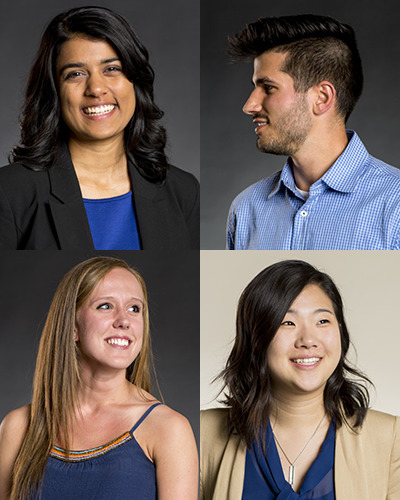
Krittika D'Silva, Viktor Farkas, Karolina Pyszkiewicz, Sarah YuFour UW CSE students—Krittika D’Silva, Victor Farkas, Karolina Pyszkiewicz and Sarah Yu—have been selected as members of the inaugural class of the Husky 100. This new award recognizes 100 undergraduate and graduate students from across the three UW campuses who are making the most of their time as members of the UW community—and making a difference inside and outside of the classroom.

Krittika D’Silva is a senior majoring in computer engineering and bioengineering. She works with UW CSE professor Luis Ceze in the Molecular Information Systems Lab (MISL) on a groundbreaking project that uses DNA molecules for long-term data storage. Previously, D’Silva worked with the late UW CSE professor Gaetano Borriello and Ph.D. alum Nicki Dell on the development of smartphone apps to improve health care for low-income people in remote regions. She also spent more than two years as a research assistant in the Department of Bioengineering on improving the design of prosthetic devices to increase patient comfort. D’Silva plans to pursue a Ph.D. in computer science at Cambridge University as a Gates Cambridge Scholar.

Victor Farkas is a senior computer science major who arrived at the UW four years ago from Slovakia after accepting an athletic scholarship to join the UW men’s tennis team. In his freshman year, Farkas successfully managed his academic and athletic responsibilities and overcame the language barrier to earn the highest grade point average among UW student-athletes. He has exhibited leadership on and off the court as co-captain of the tennis team, a research assistant in the Robotics & State Estimation Lab, and a teaching assistant for CSE’s Computer Security course. Farkas has completed internships at Amazon, Google and International Software, and he plans to extend his time at the UW to complete CSE’s fifth-year master’s program.

Karolina Pyszkiewicz is a junior who earned direct admission into the computer science major from Seattle’s Holy Names high school. She is generous in volunteering her time to various CSE outreach activities and particularly effective at engaging young women in computer science, having served as a counselor for UW CSE’s DawgBytes summer day camps, an officer of the UW chapter of the Association for Computing Machinery (ACM), and a Google Student Ambassador. Pyszkiewicz completed an internship at Microsoft while still in high school, and has completed internships at Facebook and Google since her arrival at UW CSE. In addition to being a UW CSE endowed scholarship recipient, she was named a Washington State Opportunity Scholar and a NASA Space Grant Scholar.

Sarah Yu is a senior majoring in computer science, economics and international studies. She spent last spring as a Cybersecurity Research Fellow in Microsoft’s Trustworthy Computing Group in partnership with the UW’s Jackson School of International Studies. Previously, Yu worked with the Seattle Red Cross as a Jackson-Munro Public Service Fellow, an award that aims to develop undergraduate students’ potential as leaders while working on a public service project. She has completed internships at Amazon and Lagoon Conservation, and for the past six years she has served in various capacities as a volunteer with the American Red Cross.

We are very proud to have Krittika, Victor, Karolina and Sarah as members of the UW CSE family. Learn more about the Husky 100 program here, and read profiles of the 2016 class here.

Congratulations to all! Read more →

UW CSE affiliate professor Eric Horvitz of Microsoft Research receives ACM-AAAI Allen Newell Award

Eric HorvitzUW CSE affiliate professor Eric Horvitz, technical fellow and managing director of Microsoft Research in Redmond, has been recognized with the ACM-AAAI Allen Newell Award for his groundbreaking contributions in artificial intelligence and human-computer interaction.

The Newell Award recognizes career contributions that have breadth within computer science and/or that bridge computer science and other disciplines. Horvitz’s work does both, combining the theoretical with the practical and leveraging human and machine intelligence to deliver technologies that improve people’s lives. He has made countless, lasting contributions to Microsoft and to the field of computing through his work in the areas of time-critical decisions, information retrieval, health care, urban infrastructure, sustainability and development. His trailblazing research has produced computational models for assisting physicians in minimizing patient readmissions; predictive analytics for traffic flow and routing; and techniques for prioritizing and interpreting email.

Microsoft Corporate Vice President Jeannette Wing says of Horvitz, “He asks big questions: How do our minds work? What computational principles and architectures underlie thinking and intelligent behavior? How can computational models perform amidst real-world complexities such as sustainability and development? How can we deploy computation systems that deliver value to people and society?”

The Newell Award is a fitting acknowledgment of the scale and importance of Horvitz’s work. Read more about his many accomplishments on the Microsoft blog here and in the ACM press release here.

Congratulations, Eric! Read more →

UW CSE and Intel Labs win inaugural SIGMOBILE Test of Time Award

Gaetano Borriello, Anthony LaMarca, Jeff Hightower“Test of Time” awards recognize research papers that, with the benefit of a decade’s hindsight, are viewed as having had particularly great impact.

SIGMOBILE, the Association for Computing Machinery’s special interest group focused on mobile computing and communications, has just introduced a Test of Time award and has selected Place Lab: Device Positioning Using Radio Beacons in the Wild as one of the inaugural winners.

Place Lab was a collaboration between researchers at UW CSE, Intel Research Seattle, Intel Research Cambridge, UC San Diego and the UW iSchool. The project ushered in a new era of location-aware computing and laid the foundation for many of the mobile apps that people take for granted today, from checking the weather forecast, to choosing a restaurant, to navigating their commute. The work of the Place Lab team helped to revolutionize mobile computing—and many other industries along with it.

In its award citation, SIGMOBILE hailed Place Lab as “a seminal effort to achieve accurate localization of mobile devices using existing infrastructure. It showed through painstaking experiments that leveraging a combination of Wi-Fi and GSM beacons enabled positioning with 20-30 meter median accuracy and close to 100% coverage throughout a major metropolitan area. The work directly informed localization techniques that have come to be used in billions of mobile devices.”

The Place Lab team included the late UW CSE professor Gaetano Borriello; Ph.D. alum and affiliate faculty member Anthony LaMarca, then a member of Intel Labs and now Intel Principal Engineer at the Intel Science & Technology Center at the UW; Ph.D. alum Jeff Hightower, now an engineering manager at Google; and then-bachelor’s students James Howard, Jeff Hughes and Fred Potter.

This is the second such award for Place Lab—a paper describing other aspects of the work captured the 10-year Impact Award at UbiComp 2015. Read the original research paper here, and learn more about the SIGMOBILE Test of Time Award here.

Congratulations to the entire team! Read more →

UW CSE’s Hanchuan Li and Alex Mariakakis win Qualcomm Innovation Fellowship

Hanchuan Li and Alex Mariakakis outside Qualcomm headquarters

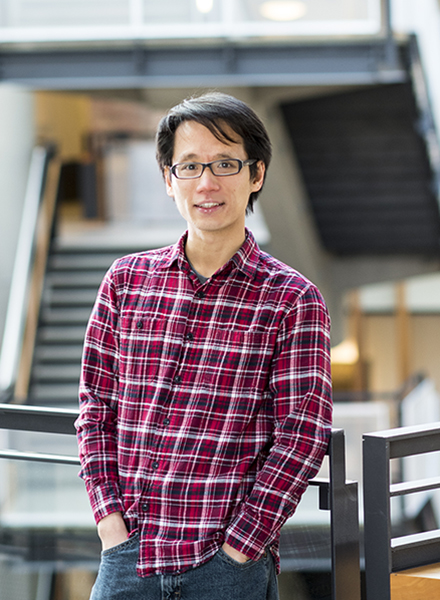
UW CSE Ph.D. students Hanchuan Li and Alex Mariakakis are one of eight teams selected to receive a 2016 Qualcomm Innovation Fellowship. They won one of these coveted awards with their proposal for IDCam, a hybrid RFID-computer vision system that enables simultaneous localization and identification for individuals and objects that will increase our understanding of how people interact with the physical world.

IDCam observes how RFID tags instrumented on everyday objects are disturbed by their motion, and then correlates that information with visual motion information. The team envisions a variety of potential applications for the system. For example, retailers could use IDCam to observe the identity and location of merchandise with which their customers interact in their stores in order to gain a deeper understanding of people’s preferences and behaviors.

The Qualcomm Innovation Fellowship program recognizes and supports graduate students engaged in research that advances futuristic ideas and embodies the company’s values of innovation, execution and partnership. Each winning team receives a $100,000 fellowship and mentoring by Qualcomm engineers, and the competition is fierce: this year, 129 teams submitted proposals, of which 34 were selected as finalists and invited to present their ideas at Qualcomm’s headquarters in San Diego.

Li and Mariakakis were nominated by CSE and Electrical Engineering professor Shwetak Patel, who leads the UbiComp Lab, and former CSE postdoc Alanson Sample at Disney Research.

UW CSE students have done very well in this competition in recent years, including past winners Carlo del Mundo and Vincent Lee (2015), Vincent Liu (2014, with EE student Vamsi Talla), and Thierry Moreau and Adrian Sampson (2013).

Way to go, Alex and Hanchuan! Read more →

UW CSE’s Anna Karlin and Jeff Dean elected to the American Academy of Arts & Sciences

UW CSE professor Anna Karlin and Ph.D. alum Jeff Dean have been elected to the American Academy of Arts & Sciences. The American Academy, established in 1780, is one of the nation’s oldest and most revered learned societies whose members are among the most accomplished individuals in their disciplines—disciplines that span mathematics, the biological and physical sciences, medicine, the social sciences, business, government, humanities and the arts. Karlin and Dean are among only six computer scientists who were elected to the Academy this year out of 212 new members.

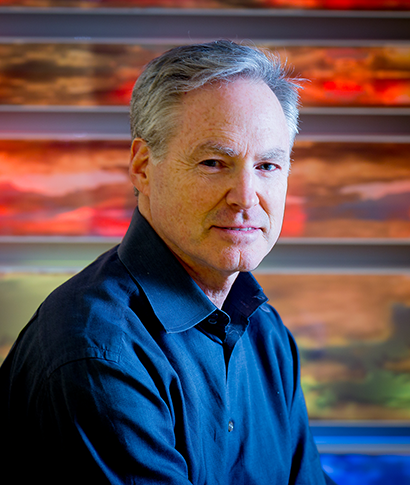
Anna KarlinKarlin is the Microsoft Professor of Computer Science & Engineering and a member of UW CSE’s Theory group. Her research primarily focuses on the design and analysis of algorithms, particularly probabilistic and online algorithms. She also works at the interface between theory and other areas, such as economics and game theory, data mining, operating systems, networks and distributed systems. In addition to her research and teaching within CSE, Karlin designed and taught a course for non-majors that examined the intellectual underpinnings and societal impacts of computer science. Before her arrival at UW CSE, Karlin spent five years as a researcher at Digital Equipment Corporation’s Systems Research Center. As one of the founding members of rock band Severe Tire Damage, she has the distinction of having participated in the first-ever live music broadcast on the internet in 1993. Karlin earned her Ph.D. from Stanford in 1987 and is a fellow of the Association for Computing Machinery. She joins CSE faculty members Susan Eggers and Ed Lazowska as fellows of the Academy.

Jeff DeanDean is a Google Senior Fellow, where he leads the Google Brain project. Since he joined Google in 1999, Dean has contributed to a number of significant developments at the company, including five generations of crawling, indexing and query serving systems; the initial development of the company’s AdSense for Content product; MapReduce, which simplifies the development of large-scale data processing applications; BigTable, a large-scale, semi-structured storage system that underpins a number of Google products; the system design for Google Translate; and the design of DistBelief and TensorFlow for large-scale training and deployment of deep learning models—among many others. Dean earned his Ph.D. from UW CSE in 1996 working with Craig Chambers on whole-program optimization techniques for object oriented languages. He was elected to the National Academy of Engineering in 2009 and is a fellow of the ACM and the American Association for the Advancement of Science.

Karlin, Dean and their fellow new members will be inducted at a ceremony in October in Cambridge, Massachusetts. Read the Academy press release here.

Congratulations to Anna and Jeff on this outstanding recognition! Read more →

« Newer PostsOlder Posts »