UW CSE’s Dan Weld on “the real AI threat”

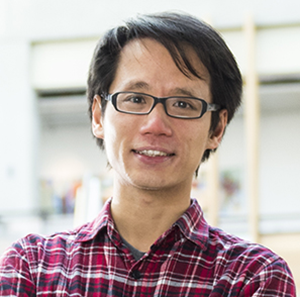
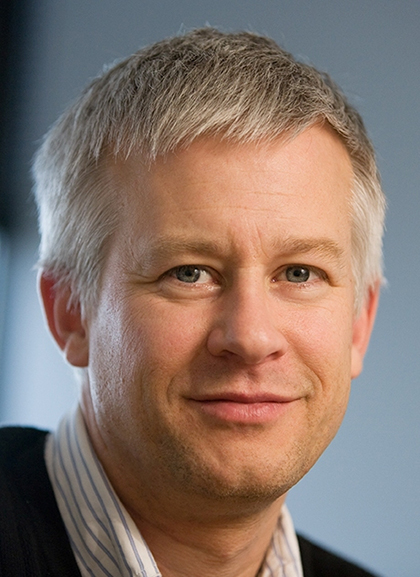
Dan WeldUW CSE professor Dan Weld wrote a thought-provoking column for GeekWire on “the real AI threat,” just in time for the White House-sponsored workshop on AI law and policy taking place on the University of Washington campus today.

Casting aside the sensational imaginings of Hollywood directors, Weld insists that we need not fear the day that AI systems willfully turn against humanity, as “computers have no hidden goals or secret motivations.” Instead, it is the action of human beings in control of the AI that we have to worry about.

But some bad actor at a keyboard is not what keeps Weld up at night. The greatest threat, he asserts, stems not from humans’ actions, but rather from our inaction. According to Weld, we ignore at our peril the potential for significant social upheaval stemming from mass job displacement, as computers perform more and more tasks that used to be the preserve of people.

From the article:

“The real AI threat stems not from nefarious actions, but rather from the opposite direction. As AI systems become more capable and more common, they will displace innumerable workers. Robots and intelligent software are outperforming humans at an increasing number of jobs. Mid-career education and retraining may slow this displacement, but digital innovation accelerates exponentially, virtually guaranteeing that social disruption will be faster and more extensive than ever before in history.

“We are already living the contradiction of automation increasing prosperity and economic output, on the one hand, and inequality, on the other. Political conservatives lament the laziness of today’s welfare recipients, but what should a population do when jobs disappear en mass? How will society respond when jobs disappear en mass? Is capitalism sustainable when labor becomes unnecessary?”

It’s a fascinating piece, which you can read in full here. Find out more about today’s AI workshop here, part of a series of workshops announced by the White House earlier this month to assess the benefits and risks of artificial intelligence. Read more →
UW CSE team wins Best Robotic Manipulation Paper Award at ICRA 2016

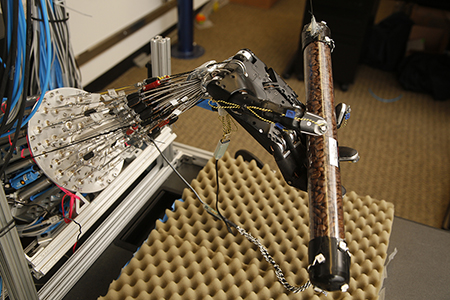
UW CSE's dexterous robot handUW CSE Ph.D. student Vikash Kumar and professors Emo Todorov and Sergey Levine captured the Best Robotic Manipulation Paper Award at the International Conference on Robotics and Automation (ICRA 2016) in Stockholm, Sweden this week. Their submission, “Optimal Control with Learned Local Models: Application to Dexterous Manipulation,” presents the results of their work on a dexterous robot hand that learns from experience. The paper details how the researchers achieved local learning, demonstrating the ability of the robot hand to improve its performance of a specific manipulation task through repetition—and without any human intervention.

This is the second year in a row that Levine has won a Best Paper Award in the robotic manipulation category at ICRA. He won last year for a paper he co-authored as a postdoc at UC Berkeley titled “Learning Contact-Rich Manipulation Skills with Guided Policy Search.”

Read more about UW CSE’s robot hand project in our previous blog post here and the UW News release here.

Go team! Read more →

UW CSE’s Paris Koutris, Alvin Cheung recognized by ACM SIGMOD

Paris KoutrisThe Association for Computing Machinery’s Special Interest Group on the Management of Data (SIGMOD) announced that UW CSE Ph.D. alum Paris Koutris is the recipient of this year’s Jim Gray Doctoral Dissertation Award. UW CSE professor Alvin Cheung’s MIT Ph.D. dissertation was recognized with an Honorable Mention. The award recognizes outstanding Ph.D. dissertations in the data management field.

Koutris, who completed his Ph.D. working with professor Dan Suciu in the UW Database Group before joining the faculty of University of Wisconsin-Madison last fall, received the award for his dissertation titled “Query Processing for Massively Parallel Systems.” In the dissertation, Koutris explores the fundamental problem of query processing for modern massively parallel architectures—a critical issue in the age of big data—and proposes a theoretical framework, the Massively Parallel Computation model or MPC, to analyze the performance of parallel algorithms for query processing. Using the MPC model, Koutris illustrates a method for designing novel algorithms and techniques for query processing and for proving their optimality.

Alvin CheungAs SIGMOD noted in its award citation, “The work stands out by the elegance of its models, applicable to numerous contemporary large-scale data processing platforms, and for its fundamental results related to the complexity of parallel processing in this setting. It will help advance our community’s understanding of the challenges and opportunities raised by large-scale distributed data management.”

Cheung earned an Honorable Mention for his MIT dissertation “Rethinking the Application-Database Interface,” in which he demonstrated how to improve the performance of database applications by multiple orders of magnitude by considering the programming system and database management system in tandem and by applying a combination of declarative database optimization and modern program analysis and synthesis techniques. MIT previously recognized Cheung’s work with its George M. Sprowls Award for the outstanding dissertation in computer science.

We can’t resist noting that Dan Suciu’s student Chris Re (now on the faculty at Stanford, and formerly on the faculty at the University of Wisconsin) received the 2010 Jim Gray Award, and that his student Gerome Miklau (now on the faculty at the University of Massachusetts Amherst) received the 2006 Jim Gray Award. Oh – and his student Nilesh Dalvi (founder of Troo.ly, previously Facebook and Yahoo! Research) received an Honorable Mention in 2008.

Way to go, Paris and Alvin – and Dan! Read more →

UW CSE’s Supasorn Suwajanakorn collects GeekWire Innovation of the Year Award

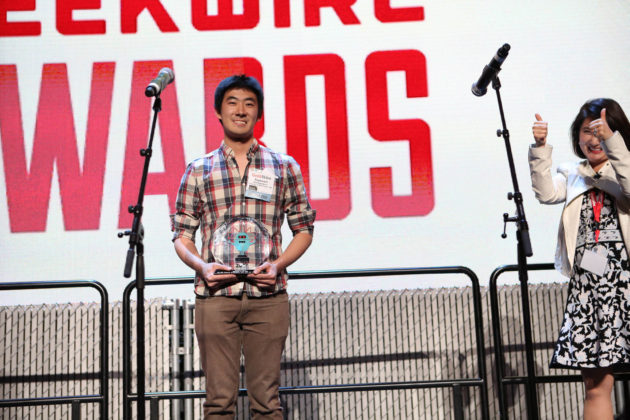
Supasorn Suwajanakorn onstagePh.D. student Supasorn Suwajanakorn of UW CSE’s GRAIL group took home the coveted Innovation of the Year Award at GeekWire’s annual awards bash—a.k.a. “the Oscars of Northwest tech.” He collected the award, which was voted on by members of the local tech community, for his work with with professors Ira Kemelmacher-Shlizerman and Steve Seitz on What Makes Tom Hanks Look Like Tom Hanks?, which combines 3-D face reconstruction, tracking, alignment, and multi-texture modeling to create a digital persona from photos mined from the internet.

Suwajanakorn took home the Madrona Prize at UW CSE’s annual Industry Affiliates meeting last October. Learn more about the project, and its potential applications in augmented and virtual reality, in a previous blog post here.

Way to go, Supasorn, Ira and Steve! And thanks to all those who voted for UW CSE! Check out the complete list of GeekWire Award winners here. Read more →

UW CSE/HCDE student Kaitlyn Zhou elected to ASUW

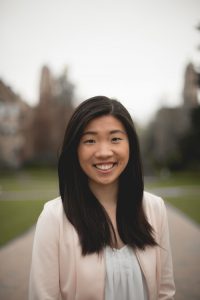
Kaitlyn ZhouKaitlyn Zhou, a sophomore majoring in computer science and human-centered design and engineering, has been elected to the board of directors of the Associated Student of the University of Washington (ASUW). The ASUW represents UW Seattle undergraduates and their interests through programming, services and advocacy and has a budget of roughly $1 million.

Zhou, who was elected the new director of university affairs, ran on a student-centered platform focused on accessibility, affordability and translating student priorities into administrative action. She is particularly interested in addressing rising student debt; expanding representation of commuter, transfer and non-traditional students in ASUW; and ensuring students’ voices are heard on critical issues such as campus safety and mental health.

This is the latest in a string of service and leadership roles for Zhou. She has served in the ASUW student senate for the past two years. She is also a member of the Provost Advisory Committee, which advocates for student priorities in budgeting, as well as the speaker selection manager for TEDxUofW.

Zhou is also active in research, co-authoring a paper examining rumor and uncertainty on social media that was featured at the recent CHI 2016 conference.

Read about the ASUW election results in the UW Daily article, and learn more about Zhou and her platform here.

Congratulations, Kaitlyn! Read more →

UW CSE’s Rajalakshmi Nandakumar wins CoMotion Graduate Innovator Award

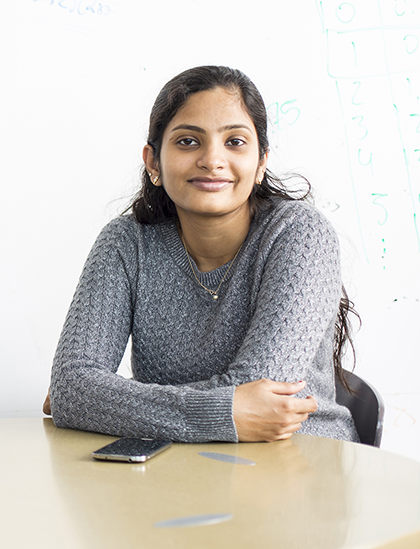
Rajalakshmi NandakumarUW CSE Ph.D. student Rajalakshmi Nandakumar has been recognized with the 2016 CoMotion Graduate Innovator Award. The award, which was announced during the College of Engineering Awards ceremony yesterday, honors a graduate student or postdoctoral researcher “who best demonstrates creative problem-solving on the road to moving innovative ideas to real-world impact.”

Nandakumar works with CSE professor Shyam Gollakota in the Networks & Mobile Systems Lab on the development of applications in mobile health and human-computer interaction. According to Gollakota, “Rajalakshmi is amazing—she is single-handedly leading our efforts in acoustic-based sensing.”

Those efforts include ApneaApp, which turns a smartphone into an active sonar system for contactless diagnosis of sleep apnea, and FingerIO, a novel finger-tracking system that enables users to interact with smartphones and smartwatches by gesturing on any nearby surface.

“Rajalakshmi is a driving force behind getting ApneaApp out of the lab and into the hands of consumers,” said Deborah Alterman, the CoMotion technology manager who nominated Nandakumar for the award. “After completing the initial research and publications, she wrote a complex real-time data viewer so that industry partners could see the full promise of this technology and spent countless hours working on industry evaluation and testing.

“Rajalakshmi excels at both technical creativity and dedication to maximizing the societal impact of her work.”

Congratulations, Rajalakshmi! Read more →

UW CSE’s Aleesha Wiest recognized with College of Engineering Staff Award

Aleesha WiestAleesha Wiest, a program operations specialist with UW CSE, was recognized today with a UW College of Engineering Professional Staff Award. Each year, the College honors faculty, students and staff who go above and beyond—be it through teaching, research, or, in Wiest’s case, their vital work behind the scenes that makes faculty, students and fellow staff members look good.

When Wiest joined UW CSE in 2013, she managed administrative projects and budgets for the UW-hosted Intel Science and Technology Center for Pervasive Computing (ISTC-PC) and five UW CSE faculty. One of those faculty members, Ed Lazowska, was in the process of expanding the eScience Institute—at the time, a relatively modest operation with a $600K budget. During Wiest’s tenure, the Institute expanded into a $24M+ operation, with 10 research scientists and an Executive Committee of nine faculty members representing eight UW departments. Eventually, it had no choice but to hire its own grants manager, which enabled Wiest to focus her energies on providing top-notch administrative and grants support to no fewer than nine individual CSE faculty members, plus continuing to support the ISTC-PC with its 10 UW faculty members from various departments and nearly two dozen postdocs, students and staff.

The College’s criteria for nominees includes excellent customer service, resourcefulness, innovation and creativity, and promoting positive morale. Wiest ticks all of those boxes and more. The College asks for two or three letters in support; six faculty and staff wrote in favor of Wiest’s nomination.

As one professor put it: “Aleesha manages to create the illusion that each of these individuals and organizations is her entire focus. No matter what I ask her to do—no matter how little or how big, no matter how straightforward or how complex and ill-defined, no matter how many times I change my mind about what I need on short notice for a site visit or an annual report—she produces it in record time with total accuracy.”

Another wrote, “Aleesha is handling duties typically assigned to multiple people, and she’s doing a wonderful job on each of them. What makes Aleesha so special is that she makes every person feel like there’s nobody else she is supporting, and we continue to wonder how she manages all of these jobs with enthusiasm and a continuous smile on her face.”

Congratulations, Aleesha, on this well-deserved recognition—and thank you for all that you do for us! Read more →

UW researchers transform a piece of paper into a smart interface with PaperID

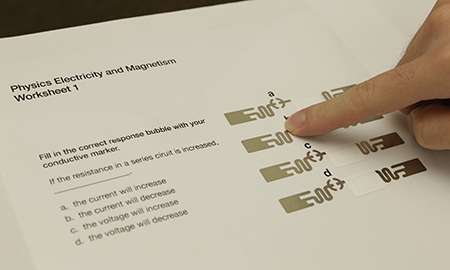
A multiple-choice poll using PaperIDResearchers in the University of Washington’s UbiComp Lab have devised a way to turn a piece of paper into an interactive interface. PaperID—which was developed by UW CSE Ph.D. student Hanchuan Li, EE Ph.D. student Josh Fromm, and CSE and EE professor Shwetak Patel in collaboration with colleagues at Disney Research and Carnegie Mellon University—leverages inexpensive RFID sensors to integrate real-world items into the Internet of Things.

From the UW News release:

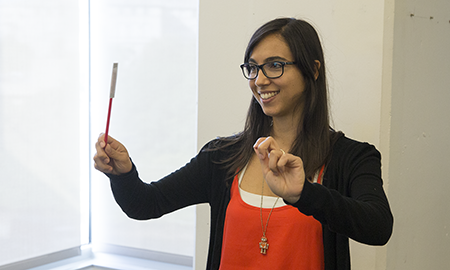
“Researchers from the University of Washington, Disney Research and Carnegie Mellon University have created ways to give a piece of paper sensing capabilities that allows it to respond to gesture commands and connect to the digital world. The method relies on small radio frequency (RFID) tags that are stuck on, printed or drawn onto the paper to create interactive, lightweight interfaces that can do anything from controlling music using a paper baton, to live polling in a classroom.

“‘Paper is our inspiration for this technology,’ said lead author Hanchuan Li…’A piece of paper is still by far one of the most ubiquitous mediums. If RFID tags can make interfaces as simple, flexible and cheap as paper, it makes good sense to deploy those tags anywhere.'”

A woman conducts music with a PaperID wandEach RFID tag has a unique identification that can be picked out by a reader device. With PaperID, a person disrupts the signal between tag and reader by touching, swiping or another interaction. Algorithms capable of recognizing specific movements then interpret the resulting signal interruption as a command, such as switching on a light or selecting the answer to a multiple-choice question.  The system can also track a tagged object’s velocity to enable gesture-based sensing and control, like waving a wand in mid-air.

“‘These little tags, by applying our signal processing and machine learning algorithms, can be turned into a multi-gesture sensor,’ Li said. ‘Our research is pushing the boundaries of using commodity hardware to do something it wasn’t able to do before.'”

The team—which also includes Eric Brockmeyer, Liz Carter and former UW CSE postdoc and EE Ph.D. alum Alanson Sample of Disney Research, and professor Scott Hudson of CMU—will present PaperID tomorrow at the CHI 2016 conference in San Jose, California.

Read the complete UW News release here, and the research paper here. Watch a video demonstration here.

Photo credits: Eric Brockmeyer/Disney Research Read more →

K-12 Math and Science teachers! Join UW CSE at our CS4HS summer workshop!

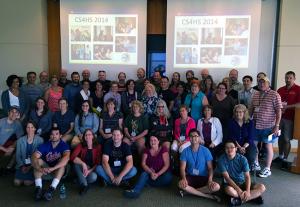
CS4HS participants

Teachers who attend our summer CS4HS workshop give it high marks

Registration is now open for UW CSE’s popular CS4HS professional development workshop for educators to be held July 6-8 on the University of Washington’s Seattle campus.

CS4HS is designed for teachers who have no previous computer science knowledge or programming experience. Aimed at middle and high school math and science teachers, CS4HS offers three action-packed days of insights and best practices that empower educators to incorporate computational thinking into their teaching and inspire their students’ curiosity about this rapidly expanding field.

Workshop participants learn computational problem solving and acquire the vocabulary to share these concepts in the classroom. They also gain an understanding of the relationship between computer science and other disciplines and how to convey the field’s impact on people and communities in a way that engages and excites students.

Don’t take our word for it, though—check out the testimonials from past CS4HS participants:

“I was super impressed with the caliber of speakers and information…This was a ‘class act’ in every way. Even the food was impressive!”

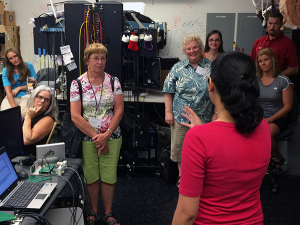
CS4HS participants in one of CSE's labs

CS4HS participants visit one of UW CSE’s research labs

“As a high school Math teacher I was curious and excited to learn how this workshop on Computer Science might prove useful in my class. In the end, I can say absolutely that this workshop changed my teaching.”

“This was the most fun I’ve had in a professional development, EVER!”

Educators earn 20 clock hours from the Washington Science Teachers Association for attending the workshop. That, plus a continental breakfast and lunch each day, a welcome reception on the evening of the opening day, parking or transit reimbursement, and dorm accommodation for out-of-town participants, is included in the $50 registration fee.

CS4HS is a joint undertaking between UW CSE, Carnegie Mellon University, and Tim Bell’s CS Unplugged. Since 2007, nearly 500 Washington educators have completed the workshop in order to incorporate computer science into their classrooms. Teachers interested in attending CS4HS this summer can learn more and register here. Read more →

UW CSE robot hand teaches itself to manipulate objects

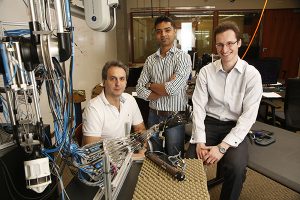
Emo Todorov, Vikash Kumar, Sergey Levine

Left to right: Emo Todorov, Vikash Kumar, and Sergey Levine

Researchers in UW’s Movement Control Laboratory have built a dexterous robot hand that learns from experience, enabling it not only to perform tasks that are typically challenging for robots, but also improve its performance without human intervention. In contrast to a typical robotics application in which each individual movement must be programmed, the autonomous learning system developed by CSE Ph.D. student Vikash Kumar, CSE and Applied Mathematics professor Emo Todorov, and CSE professor Sergey Levine enables the robot to refine its movements as it practices a task.

From the UW News release:

“‘Hand manipulation is one of the hardest problems that roboticists have to solve,’ said lead author Vikash Kumar…’A lot of robots today have pretty capable arms but the hand is as simple as a suction cup or maybe a claw or a gripper.’

“By contrast, the UW research team spent years custom building one of the most highly capable five-fingered robot hands in the world. Then they developed an accurate simulation model that enables a computer to analyze movements in real time. In their latest demonstration, they apply the model to the hardware and real-world tasks like rotating an elongated object.

“With each attempt, the robot hand gets progressively more adept at spinning the tube, thanks to machine learning algorithms that help it model both the basic physics involved and plan which actions it should take to achieve the desired result.”

The robot hand used to demonstrate the team’s autonomous learning system was developed in by Kumar, Todorov and UW CSE Ph.D. alum Zhe Xu (now a postdoc at Yale). Levine, a pioneer in the use of deep learning to create neural network controllers for robots, worked on the project while completing his postdoc at the University of California, Berkeley prior to joining the UW CSE faculty this year.

“‘Usually people look at a motion and try to determine what exactly needs to happen —the pinky needs to move that way, so we’ll put some rules in and try it and if something doesn’t work, oh the middle finger moved too much and the pen tilted, so we’ll try another rule,’ said senior author and lab director Emo Todorov…

“‘It’s almost like making an animated film — it looks real but there was an army of animators tweaking it. What we are using is a universal approach that enables the robot to learn from its own movements and requires no tweaking from us.'”

The team will present its findings at the IEEE International Conference on Robotics and Automation (ICRA 2016) later this month in Stockholm, Sweden. Read the research paper here, and the news release here. Watch a video demonstration here, and check out coverage by Wired, CNN MoneyGizmagGeekWire, Fox News, Business Insider, and ZDNet.

A robot hand that learns by doing? That deserves a high-five! Read more →

« Newer PostsOlder Posts »