UW’s “PoWiFi” could power the Internet of Things, says MIT Technology Review

PoWiFi examplesA UW research project that seeks to power the Internet of Things using Wi-Fi signals – dubbed “power over Wi-Fi” or “PoWiFi” for short – is the topic of a recent paper and an article in MIT Technology Review. The project was developed by a team that includes CSE professor Shyam Gollakota, CSE and EE professor Josh Smith, EE Ph.D. student Vamsi Talla, CSE alum (and current EE Ph.D. student) Bryce Kellogg, former CSE postdoc Ben Ransford, and EE Ph.D. student Saman Naderiparizi.

From the article:

“The idea is simple in concept. Wi-Fi radio broadcasts are a form of energy that a simple antenna can pick up. Until now, Wi-Fi receivers have all been designed to harvest the information that these broadcasts carry. But Talla and co point out that there is no reason why the energy shouldn’t be harvested as well. The question is how much can be gathered in this way. And therein lies the challenge …

“The problem is that Wi-Fi broadcasts are not continuous. Routers tend to broadcast on a single channel in bursts. This provides enough power for the sensor but as soon as the broadcast stops, the voltages drop … That gave Talla and pals an idea. Why not program the router to broadcast noise when it is not broadcasting information and employ adjacent Wi-Fi channels to carry it so that it doesn’t interfere with data rates.”

Calling the results “impressive,” the article explains how the researchers used their new PoWiFi system to wirelessly power a battery-free temperature sensor and a camera without compromising network performance, in real-world conditions. They also were able to recharge coin-cell batteries using PoWiFi from distances of up to 28 feet.

The article concludes:

“The ability to deliver power wirelessly to a wide range of autonomous devices and sensors is hugely significant. But the real icing on the cake here is the ability to do this with ordinary technology that is commonly available all over the developed world and beyond. As such, PoWi-Fi could be the enabling technology that finally brings the Internet of Things to life.”

Read the complete article here.

Read a PDF of the team’s paper, “Powering the Next Billion Devices with WiFi,” here. Read more →
TUNE and Seattle Women in Tech team up in support of UW CSE’s DawgBytes program

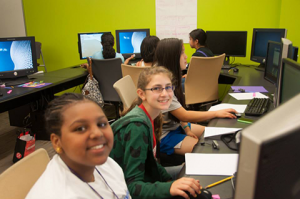
DawgBytes middle school campersUW CSE’s DawgBytes is one of three programs recently selected by mobile marketing company TUNE (formerly HasOffers) and Seattle Women in Technology as beneficiaries of a new partnership that aims to cultivate more women leaders in technology fields. DawgBytes, which hosts girls-only and co-ed summer day camps in computing, in addition to engaging in teacher support, community partnerships and other outreach activities, is part of a long tradition at UW CSE of encouraging women to pursue computer science education and careers.

Each summer, DawgBytes engages 88 middle and high school girls in computer science through our girls-only camps and reaches many more through its co-ed camps, including a session for elementary school students. This is part of a multi-pronged approach aimed at increasing the diversity of our student body and of our industry. We outperform our peers when it comes to cultivating the next generation of women computer scientists, awarding 30 percent of our CS bachelor’s degrees to women (roughly twice the national average). We also have made it a priority to recruit women who are rising stars in the field to the UW CSE faculty, including recent hires Maya Cakmak (robotics), Yejin Choi (natural language processing), Ira Kemelmacher-Shlizerman (computer vision), Franzi Roesner (security and privacy), and Emina Torlak (programming languages and software engineering).

While UW CSE is a recognized leader in advancing women in computer science education and careers, there is more work to be done. To support our efforts and those of other like-minded organizations, TUNE, in partnership with Seattle WiT, is encouraging donations to DawgBytes, Tech Trek and Ada Developers Academy in the run-up to its big annual event, Postback, which will be held July 23-24 in Seattle.

Read more about the partnership on the TUNE company blog here and check out the details on Postback 2015 here.

Check out our DawgBytes 2015 summer camp lineup here.

Read earlier coverage of UW CSE’s nationally recognized efforts to engage more women in computer science here, here and here.

Many thanks to our friends at TUNE and Seattle Women in Technology for their support! Read more →

UW CSE’s Brian Ferris brings real-time transit data to Google Maps

Brian FerrisUW CSE Ph.D. alum Brian Ferris is the patron saint of transit riders. Not only did he create the wildly popular app OneBusAway while a Ph.D. student here, but now he has gone one better: he and his team at Google have added enhanced real-time transit data to Google Maps for a handful of cities, including Seattle. The new feature will enable transit riders to make judgments about which mode or route to use based on actual traffic conditions and transit performance, using data from King County Metro and Sound Transit.

Brian is quoted by GeekWire on the new functionality:

“With traffic congestion in Seattle getting worse every year, real-time information is essential for making our transit system usable … I might not be able to build a new light-rail line through Seattle or add new bus service myself, but I can help build tools to make everyone’s commute a little more pleasant.”

Read more on GeekWire here and on VentureBeat here.

Thanks, Brian, for helping to keep Seattle commuters – including many of us here at UW CSE – rolling! Read more →

UW CSE accepting applications for summer K-12 teacher workshop, CS4HS

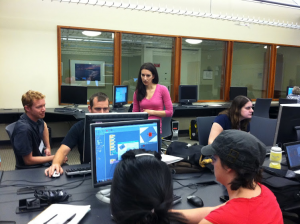
CS4HS participants in a computer labEach summer, UW CSE welcomes middle school and high school teachers from around the state at our computer science education workshop, CS4HS. Math and science teachers are invited to participate in an action-packed, three-day program designed to give them the knowledge and resources to integrate computer science into their classrooms and to build student interest in our exciting and rapidly growing field.

The 2015 workshop will take place July 15th – 17th at UW’s Paul G. Allen Center for Computer Science & Engineering. Thanks to the generous donors who support CSE’s K-12 outreach programs, the registration fee for teachers is just $50. CS4HS participants will enjoy breakfast and lunch each day, an evening networking reception, parking or transit reimbursement, dorm accommodations for out-of-town participants, and 20 clock hours from the Washington Science Teachers Association – not to mention fantastic demos, faculty and guest presentations, hands-on learning, and idea sharing among peers.

Teachers who have no computer science background or programming experience are welcome and encouraged to attend. CS4HS is a joint undertaking between UW CSE, Carnegie Mellon University and Tim Bell’s CS Unplugged.

Interested educators are invited to apply for a slot at the 2015 workshop here. Read more →

UW CSE’s Krittika D’Silva: “I signed up for an intro CS class, and couldn’t stop taking classes after that”

Krittika D'SilvaUW’s Undergraduate Academic Affairs office recently published a great article on CSE undergrad Krittika D’Silva, who decided to double-major in computer science and bioengineering after taking one of our introductory courses. The article, “Undergrad sees change in the palm of her hand,” describes how Krittika arrived at the intersection of the two fields, which earned her a 2014-2015 Levinson Emerging Scholars Award.

After being accepted to CSE, Krittika worked with the late professor Gaetano Borriello on the development of hands-free smart phone technology for use by health care providers in low-resource environments to aid diagnosis and prevent the spread of infection. She currently works in bioengineering professor Paul Yager‘s lab on the development of portable kits that diagnose the bacterial infection MRSA at the point of care with the help of an Android app – an approach that could be used to improve diagnosis and care of patients with other diseases.

Read more about Krittika and her research here.

Check out previous coverage of Krittika’s work on the CSE blog here. Read more →

UW CSE’s time-lapse video project featured on PBS NewsHour

PBS time-lapse video imageThe new method for creating time-lapse videos developed by UW CSE’s GRAIL Group and Google was featured on a recent segment of the PBS NewsHour. As part of “NewsHour Shares,” its series of eye-catching stories from around the Web, PBS highlighted the videos created by graduate student Ricardo Martin Brualla, professor Steve Seitz and Google’s David Gallup of famous locations such as the Vatican and the Las Vegas strip – all from photos posted online.

As PBS anchor Judy Woodruff noted, “Where it once took months or years to create these videos, they can now do it almost instantly in an effort to help document our ever-changing world.”

Watch the video and read the transcript here.

Read our earlier blog post and media coverage featuring the time-lapse video project here. Read more →

UW CSE wins NCWIT Grand Prize for supporting women in computer science

IMG_5026

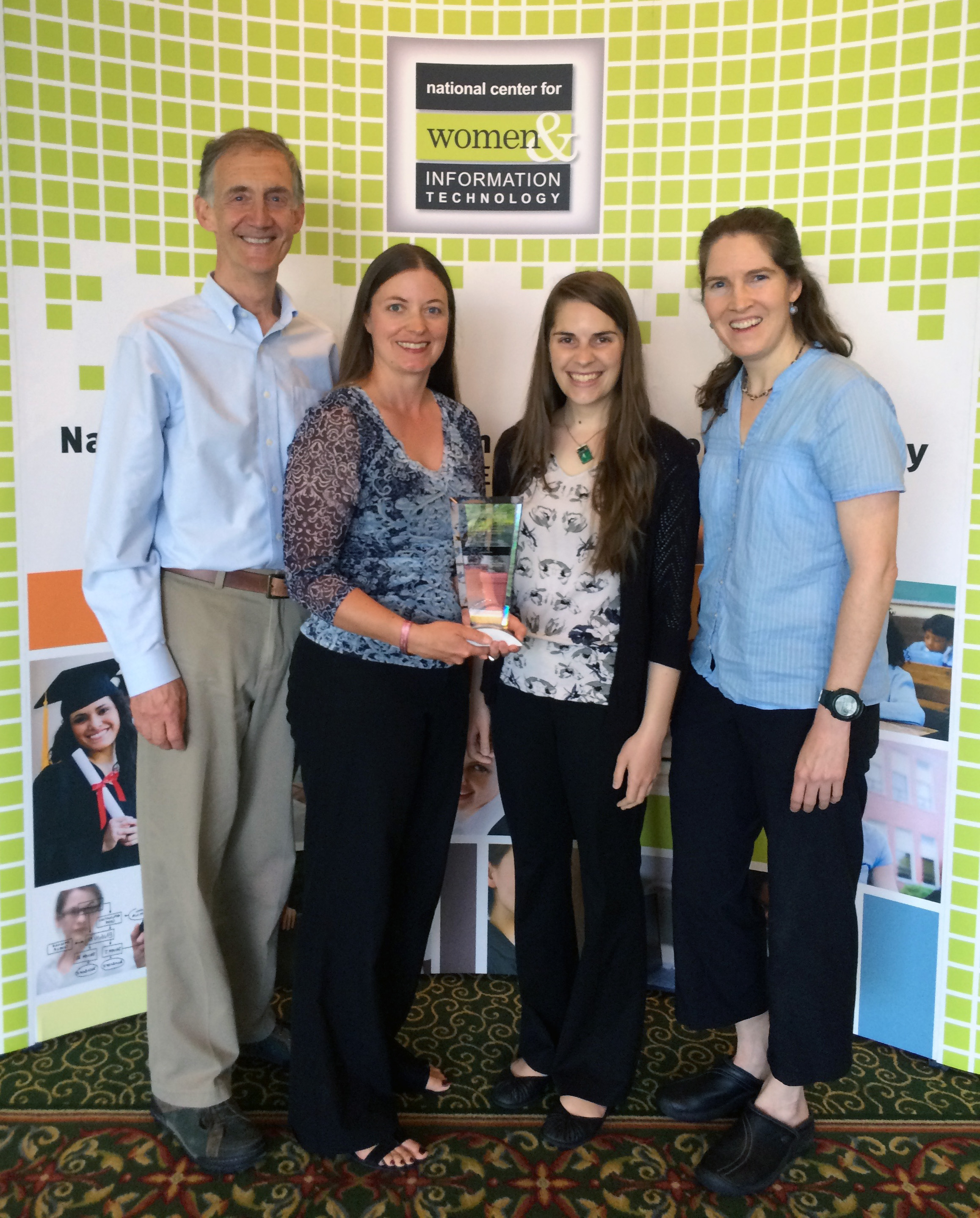
UW CSE’s Ed Lazowska, Crystal Eney, Allison Obourn, and Ruth Anderson with the NCWIT NEXT Award Grand Prize trophy

The National Center for Women & Information Technology (NCWIT) has recognized UW CSE with its Excellence in Promoting Women in Undergraduate Computing Award – the Grand Prize in the organization’s inaugural NEXT Awards. NCWIT selected UW CSE for this honor based on our strong commitment and demonstrated success in encouraging women to pursue computer science education and careers.

From the NCWIT Award website:

“These accomplishments are the result of strategic, well-planned recruiting and retention efforts. They conduct multi-pronged outreach to K-12 schools in their region, including providing professional development, networking opportunities, and other support to high school teachers. K-12 students benefit from camps, campus visits, computing open houses and coding competitions. These programs serve all students interested in computing but are implemented and designed with girls and other underrepresented students in mind.

“The UW program does an excellent job of retaining its majors, including women. There appears to be a strong sense of community and inclusion in the department. One way this has been built is by redesigning the introductory courses so that they are accessible to a range of students by hiring strong, engaging faculty to teach these courses and using well-trained undergraduate teaching assistants, including many women… The University of Washington has grown an inclusive, welcoming community that spans beyond the walls of the university and has demonstrably advanced women’s meaningful participation in computing.”

NCWIT logoUW CSE director of student services Crystal Eney and faculty members Allison Obourn (who also coordinates CSE’s K-12 outreach program, DawgBytes), Ruth Anderson, and Ed Lazowska (a member of NCWIT’s Executive Advisory Council, and also of the National Academies’ Committee on Women in Science, Engineering, and Medicine) attended this week’s 2015 NCWIT Summit on Women and IT, and accepted the award.

Congratulations to the members of our hardworking student advising team, the DawgBytes team, and the entire CSE faculty (and especially our introductory course team, led by Stuart Reges) for walking the talk when it comes to supporting gender diversity in our department and in our field! We have a long way still to go, but we’re extremely proud of this recognition for what we have accomplished thus far.

Read NCWIT’s award commendation for UW CSE here.

And see coverage in the New York Times, the Seattle Times, Xconomy, GeekWire, UW Today, and KIRO Radio. Read more →

Taskar Center for Accessible Technology joins eScience Institute “Data Science for Social Good” summer program

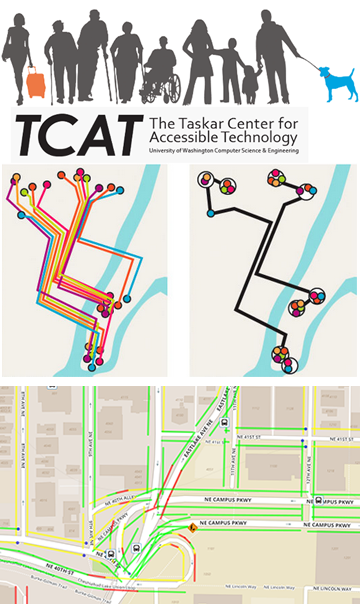
TCAT traveler image and mapsUW CSE’s Taskar Center for Accessible Technology (TCAT) announced today that two of its projects were selected to participate in the eScience Institute‘s Data Science Incubation Program this summer focusing on Data Science for Social Good. Both TCAT projects address commuting and transportation needs in King County, with an emphasis on enhancing access for individuals with mobility impairments.

The first project, ParaTransit To Go, is a collaboration between TCAT and King County Metro Transit’s Accessible Services group to improve and optimize paratransit services, a demand-responsive mode of public transportation in which passengers are picked up at or near their doorstep and delivered to their specified destination. The second project, Access Map, was created by a team of students as part of the City of Seattle’s Hack the Commute competition under the guidance of TCAT director Anat Caspi and CSE professor Alan Borning. After Access Map captured first place in the civic competition, TCAT continued to support the effort and solicited the help of the eScience Institute to advance the data science end of development.

“Part of TCAT’s mission is to provide longevity to worthy student projects that might otherwise be abandoned upon the developers’ graduation or upon completion of their thesis,” said Caspi. “With Access Map, TCAT was involved from start, but that is not necessarily the case with other projects that we foster.”

“It is great to partner with eScience to provide continuity for projects with high social value and enable more students to contribute to large scale civic data projects like these,” she continued. “Engaging a diversity of stakeholders is critical to building strong and sustainable access technology efforts.”

The UW eScience Institute receives major support from the Gordon and Betty Moore Foundation, the Alfred P. Sloan Foundation, the Washington Research Foundation, and the University of Washington. This summer’s Data Science for Social Good incubator session is sponsored in part by a grant from the MacArthur Foundation and an emerging campus-wide initiative called Urban@UW. Read more →

CSE’s GRAIL Group and Google turn online photos into time-lapse videos

Time-lapse skyscraper imagesCSE graduate student Ricardo Martin Brualla and professor Steve Seitz, in collaboration with David Gallup of Google, have pioneered a new method for creating time-lapse videos of popular or historically significant landmarks from the millions of photos posted online.

Using a process they call “time-lapse mining,” the researchers sorted photos of a particular location by date and devised a method of compensating for differences in camera position and lighting quality. By warping the photos to a common viewpoint and stabilizing their appearance, they were able to create high-quality videos of the world’s most photographed sites. From skyscrapers rising to glaciers receding, the team provides dramatic examples of how the vast collection of photos uploaded to the internet can be used to understand how our surroundings have changed over time.

The team will present its findings at SIGGRAPH 2015 in August. Visit the project page to view a video demonstration here, and read a PDF of the research paper here.

Read more about time-lapse mining and view videos in the Washington Post, CNET, Gizmodo, Engadget, The Verge, and Quartz. Read more →

CSE’s Richard Ladner and Tactile Graphics Project featured in Eyes on Success audio show

Richard LadnerLast week, Eyes on Success interviewed UW CSE professor Richard Ladner about his long-running Tactile Graphics Project, a tool for creating universally accessible graphs and charts. During the half-hour audio show, Ladner talked about the importance of tactile graphics in providing blind students with access to figures and diagrams in textbooks, and how computer vision and machine learning techniques enable more rapid translation of graphical images for this purpose. He also talked about Tactile Graphics with a Voice, which is a way to access the textual information in tactile graphics using QR-codes instead of Braille.

The Eyes on Success audio show, which was created by Pete and Nancy Torpey in 2011, has more than 200 entertaining and informative interviews with people who are blind or who work on projects that serve the blind and low-vision population. Former graduate student Jeff Bigham was featured in August 2011 sharing details on WebAnywhere, the web-based screen reader that he developed as part of his UW dissertation.

Listen to Richard’s Eyes on Success interview here.

Learn more about the Tactile Graphics Project here. Read more →

« Newer PostsOlder Posts »