UW CSE’s Emily Fox, Shyam Gollakota, Thomas Rothvoss win Sloan Research Fellowships

estAlfred P. Sloan Research Fellowships are among the nation’s most prestigious awards for young scientists.

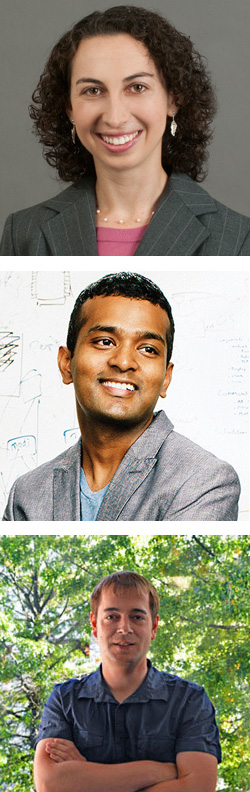
Today, UW CSE’s Shyam Gollakota and Thomas Rothvoss were named recipients of 2015 Sloan Research Fellowships. Shyam and Thomas join 24 previous UW CSE faculty members (plus 3 adjunct faculty members) as recipients of Sloan Research Fellowships – an unprecedented number that speaks to the extraordinary caliber of our young (or, in some cases, formerly young …) faculty members.

Emily Fox, Amazon Professor of Machine Learning in UW Statistics and adjunct professor in CSE, also received a Sloan Research Fellowship.

Shyam is an expert in wireless technology. Thomas, jointly appointed with UW’s Department of Mathematics, is a leader in approximation algorithms, linear and integer programming, combinatorics, network design, and scheduling. Emily is an emerging star in machine learning.

Congratulations to Emily, Shyam and Thomas!

(Our Ph.D. grandchild Alex Halderman at the University of Michigan – a student of UW CSE Ph.D. alum and Princeton professor Ed Felten – also is a recipient!)

Full page New York Times ad from the Sloan Foundation celebrating all of this year’s recipients here. Read more →

American millennials lag the developed world in literacy, numeracy, and problem solving

branding-globeNot directly related to UW CSE, but important to all who care about education and about the future of our society:

A sobering analysis by the Educational Testing Service of results from the latest Programme for the International Assessment of Adult Competencies (PIAAC) survey of adult skills carried out by the Organisation for Economic Co-operation and Development (OECD).

Among the 22 participating nations, American millenials (the cohort born after 1980) had:

  • Among the lowest average scores in each skill area
  • Among the lowest scores for students at the 90th percentile nationally
  • The lowest scores for those at the 10th percentile nationally
  • Among the lowest scores in numeracy among those with four-year bachelors degrees (we beat only Poland and Spain)

Read the short scary summary here. Read more →

Remembering Ira Kalet, 1944-2015

iraRetired CSE adjunct professor Ira Kalet passed away last night after a long battle with cancer.

Ira joined the University of Washington in 1978 in the then newly formed Department of Radiation Oncology. Subsequently he held adjunct appointments in Computer Science & Engineering, Bioengineering, and Biological Structure, and a joint appointment in Medical Education (now the Department of Biomedical Informatics and Medical Education).

From 2005 until his retirement, Ira also served as Director of Security and Networking for UW Medicine IT Services, where he led the establishment of a strong security program for UW Medicine clinical and research data and systems.

Ira was closely engaged as a CSE adjunct professor, advising a number of CSE Masters and Doctoral students.

We extend our best wishes to his wife Terry, and to all of his many friends. Read more →

Google Faculty Research Awards to UW CSE’s Tom Anderson, Alvin Cheung, Richard Ladner, Ph.D.alums Ethan Katz-Bassett and Steve Swanson, iSchool professor Karen Fisher

sixUW CSE’s Tom Anderson, Alvin Cheung, and Richard Ladner are among 122 recipients (from among 808 applicants) of Winter 2015 Google Faculty Research Awards. UW CSE Ph.D. alums Ethan Katz-Bassett (now on the faculty at USC) and Steve Swanson (now on the faculty at UCSD) also were recipients, as was UW iSchool professor Karen Fisher.

Congratulations to Tom, Alvin, Richard, Ethan, Steve, and Karen! Read more here.

  Read more →

UW CSE’s Nanocrafter in PLOS

Nanocrafter-image“On its surface, it looks like just another science puzzle game. In reality, the game is part of a broader goal to enable non-scientists to contribute to synthetic biology research.

“‘It’ is Nanocrafter, a project created by researchers and game developers at the Center for Game Science at the University of Washington. They are the same team behind the citizen science project FoldIt.”

Read more here. Read more →

Forbes: “We Need to Innovate the Science Business Model”

indexAn article by Greg Satell in Forbes concludes:

“Most of all, we need to accept that we all have a stake in the public funding of science.  It is, after all, government funding that made the iPhone possible, has led to miracle cures and blockbuster drugs and decoded the human genome.  We’d all be poorer without it.”

The article quotes UW CSE’s Ed Lazowska extensively:

“When [Vannevar] Bush wrote his famous proposal for public financing of scientific research, we had just defeated Hitler and his allies with help from scientific miracles like radar and the atomic bomb. That created enormous support for the public funding of science to enhance the private sector as well as national defense.  Times, unfortunately, have clearly changed.

“Today, there is a veritable war on science, with politicians quick to score cheap political points by accusing researchers of waste or merely declaring that science is irrelevant to everyday concerns.  Ed Lazowska, who co-chaired President Bush’s Information Technology Advisory Committee, sees this as a fundamental misunderstanding of how innovation takes place.

“There’s a big misunderstanding of today’s industry R&D. Most of it is ‘D’ rather than ‘R,” he told me and points to Google X as an example. Although Google has taken on major business risks with things like autonomous cars, the basic research was funded by the federal government through places like NSF and DARPA, so there is little technological risk.

“He also points to the principle of appropriability as a foundation for thinking about scientific funding. Enterprises understandably have a bias for investments from which they will benefit directly. That’s why public funding is the most viable source of support for basic research, which leads to applications that are not only broad, but often unforeseeable.

“Lazowska notes further that market leaders may have an interest in investing in scientific inquiry that benefits their industry broadly and highlights Microsoft and IBM as two firms that invest in basic research and publish openly. Yet they are the exception, not the rule.”

Read more in Forbes here. Read more →

NSF CAREER Award to UW CSE postdoc alum Yuriy Brun

yuriyCongratulations to Yuriy Brun – 2008 USC Ph.D., Computing Innovation Fellow postdoc in UW CSE from 2009-12, and now an Assistant Professor at UMass-Amherst – on receipt of an NSF CAREER Award.

Yuriy’s research interests are in software system modeling, design, and development, focusing on understanding how local component behavior impacts global system behavior.

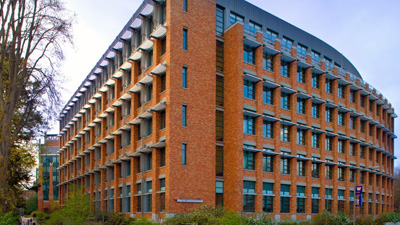
(That’s the Allen Center’s cool LED public artwall in the background of Yuriy’s photograph!) Read more →

UW CSE hosts Code for Seattle’s “Seattle Open Data Day”

logo-300x300Today UW CSE hosted Code for Seattle’s “Seattle Open Data Day” – a one day unconference on open data and civic technology where we ask: how might we …

  • Make data easy to find and use?
  • Use data to make and improve decisions?
  • Make it easy for everyone to participate in open data and civic technology?

UW CSE Ph.D. student Will Scott was the organizer. Socrata, Microsoft, and the City of Seattle were among the sponsors.

Putting public data to work for the public good is something we can all get behind! Let’s make Seattle a leader in this!

IMG_4722


  Read more →

UW’s Aaron Parks, Kyle Rector are 2015 North American Google PhD Fellows

anp-181x300Among the 15 2015 North American Google PhD Fellows announced to day are UW’s Aaron Parks and Kyle Rector.

Aaron, a Ph.D. student in Electrical Engineering, works with CSE and EE professor Josh Smith on the design of ultra-low-power hardware and software systems, and RF energy harvesting for ubiquitous computing applications.

Kyle, a Ph.D. student in CSE, works with HCDE professor (and CSE affiliate professor) Julie Kientz and CSE professor Richard Ladner on research at the intersection of human-computer interaction and accessibility, such as designing accessible exergames for people who are blind or low-vision.

Congratulations to Aaron and Kyle, and thanks to Google! Read the Google announcement here.


kyle
Read more →

Live outside of your comfort zone: UW CSE alum Mohamed El-Zohairy shares lessons learned as a student, an entrepreneur and an activist

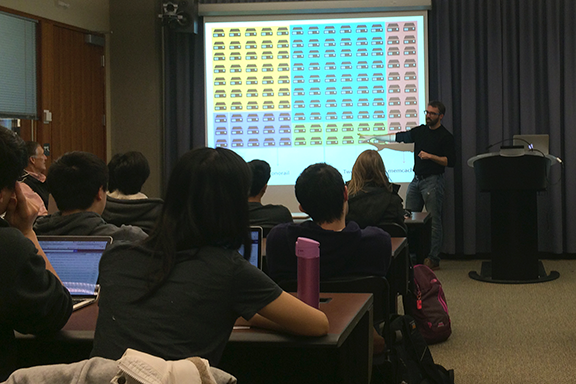
Mohamed El-Zohairy at UW CSEUW CSE alumni may be revolutionary in technology terms, but Mohamed El-Zohairy (BS, ’07) took it to a new level when he joined the political revolution in his home nation of Egypt. Yesterday, Mohamed returned to the Allen Center to share his experiences with a group of undergraduates as part of CSE’s Leadership Seminar Series.

Mohamed opened his talk by urging students to “live outside of your comfort zone” – words he certainly lived by during his unconventional journey from high school student in Egypt captivated by UW CSE’s robotic soccer dogs, to UW CSE graduate, startup founder, and director of product engineering at News Corp.

Mohamed was in graduate school at the University of British Columbia when the protests against the government of President Hosni Mubarak began in early 2011. He took a leave of absence from his studies to join his compatriots in Tahrir Square – but not before reaching out to TechCrunch to alert the Western media about the Internet blackout instigated by Egypt’s government in response to the protests.

After the revolution, Mohamed remained in Egypt, where he was joined by fellow UW CSE alums Allen Chen and Bobby Mathews in building the content creation platform CloudPress. One year later, News Corp. acquired CloudPress – and with it, the team. Mohamed then departed Egypt for New York to join News Corp. to help build the company’s mobile publishing platform.

Even with all he has experienced after CSE, Mohamed made sure to share practical advice to help students make the most of their time in the department. Among his pearls of wisdom: “If you procrastinate, do it right!” and, “Know your most productive time of day.” And, drawing from his entrepreneurial heritage, he urged them to not be afraid of failing, because “failing doesn’t make you a failure.”

Read the TechCrunch article on the Egyptian revolution and Mohamed’s role in bringing the government’s Internet shutdown to the attention of the media here.

Read about News Corp.’s acquisition of CloudPress on TechCrunch here and on GeekWire here.

See Mohamed’s presentation slides – great advice for students – here. Read more →

« Newer PostsOlder Posts »