Microsoft JobsBlog features CSE undergrad TA alum Kasey Champion

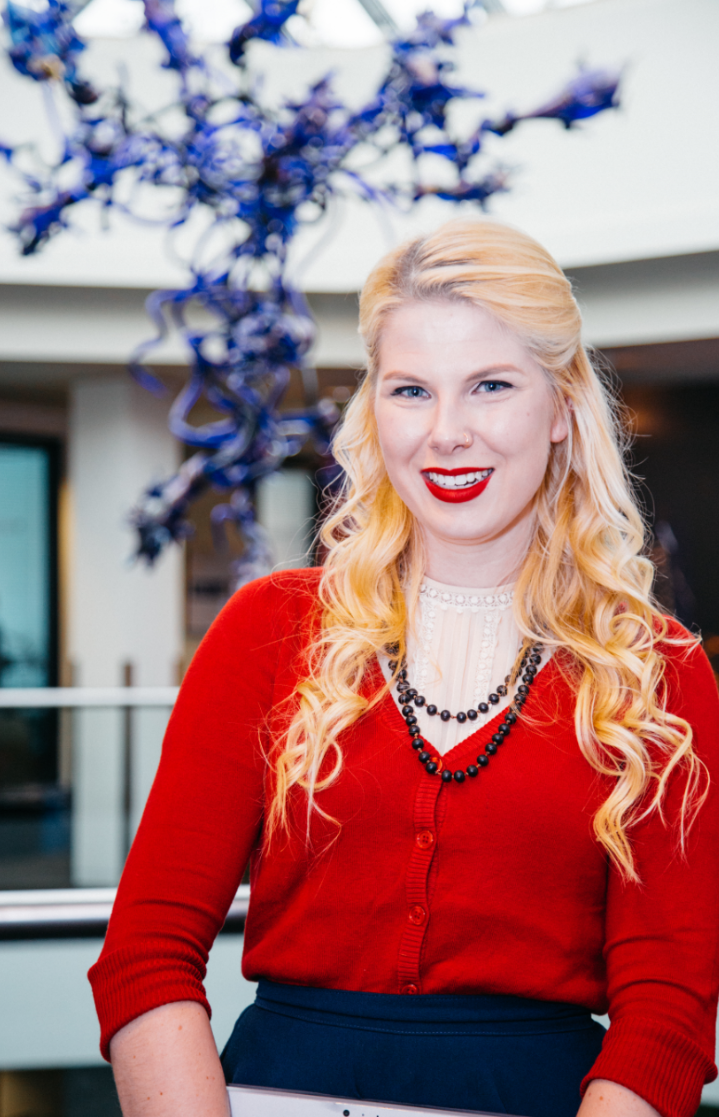
kasey-2“In his 25 years at Microsoft, Bjorn Rettig has never felt compelled to offer someone a job during an informational interview. But that all changed after he met Kasey Champion …

“For Champion, who just celebrated her fourth anniversary with the company, joining Rettig’s team has been the fulfillment of everything she’s worked toward at Microsoft. She’s able to combine her passion for teaching and her enthusiasm for computer science. In fact, Champion’s talk at this year’s Grace Hopper conference was entitled ‘Technology and Education: Combining Your Two Passions into One Career.'”

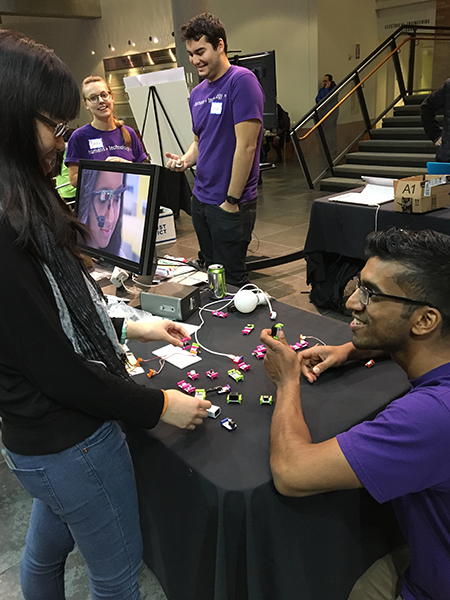
(Kasey was recently back at UW CSE participating in a reunion of undergraduate teaching assistants.)

Read more here. Read more →

UW researchers hit the right note with new machine learning tool for music

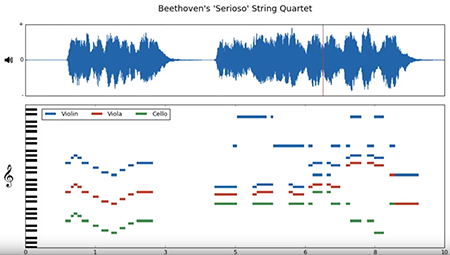
MusicNet demoA team of UW CSE and UW Statistics researchers have released MusicNet, a collection of 330 classical music recordings accompanied by more than one million annotated labels indicating the precise timing, instrument and position of every note. As the first large-scale public dataset of its kind, MusicNet could be music to the ears of machine learning researchers and composers alike.

From the UW News release:

“The composer Johann Sebastian Bach left behind an incomplete fugue upon his death, either as an unfinished work or perhaps as a puzzle for future composers to solve.

“A classical music dataset released Wednesday by University of Washington researchers — which enables machine learning algorithms to learn the features of classical music from scratch — raises the likelihood that a computer could expertly finish the job.

“MusicNet is…designed to allow machine learning researchers and algorithms to tackle a wide range of open challenges — from note prediction to automated music transcription to offering listening recommendations based on the structure of a song a person likes, instead of relying on generic tags or what other customers have purchased.”

The researchers who orchestrated this novel tool — CSE Ph.D. student Jonathan Thickstun, CSE and Statistics professor Sham Kakade, and Statistics professor Zaid Harchaoui — hope that MusicNet will do for music-related machine learning what ImageNet did for computer vision.

“An enormous amount of the excitement around artificial intelligence in the last five years has been driven by supervised learning with really big datasets, but it hasn’t been obvious how to label music,” Thickstun said.

To create MusicNet, the researchers had to be able to track what instruments were playing what notes down to the millisecond. They employed a technique called dynamic time warping, which enabled them to synch real performances to synthesized files containing musical notations and digital scoring of the same pieces of music. They then mapped the digital scoring onto the original performances — turning 34 hours of chamber music into a tool for supervising and evaluating machine learning methods.

“At a high level, we’re interested in what makes music appealing to the ears, how we can better understand composition, or the essence of what makes Bach sound like Bach,” said Kakade. “No one’s really been able to extract the properties of music in this way…We hope MusicNet can spur creativity and practical advances in the fields of machine learning and music composition in many ways.”

Read the full news release here, and visit the MusicNet project page to learn more.

Read more →

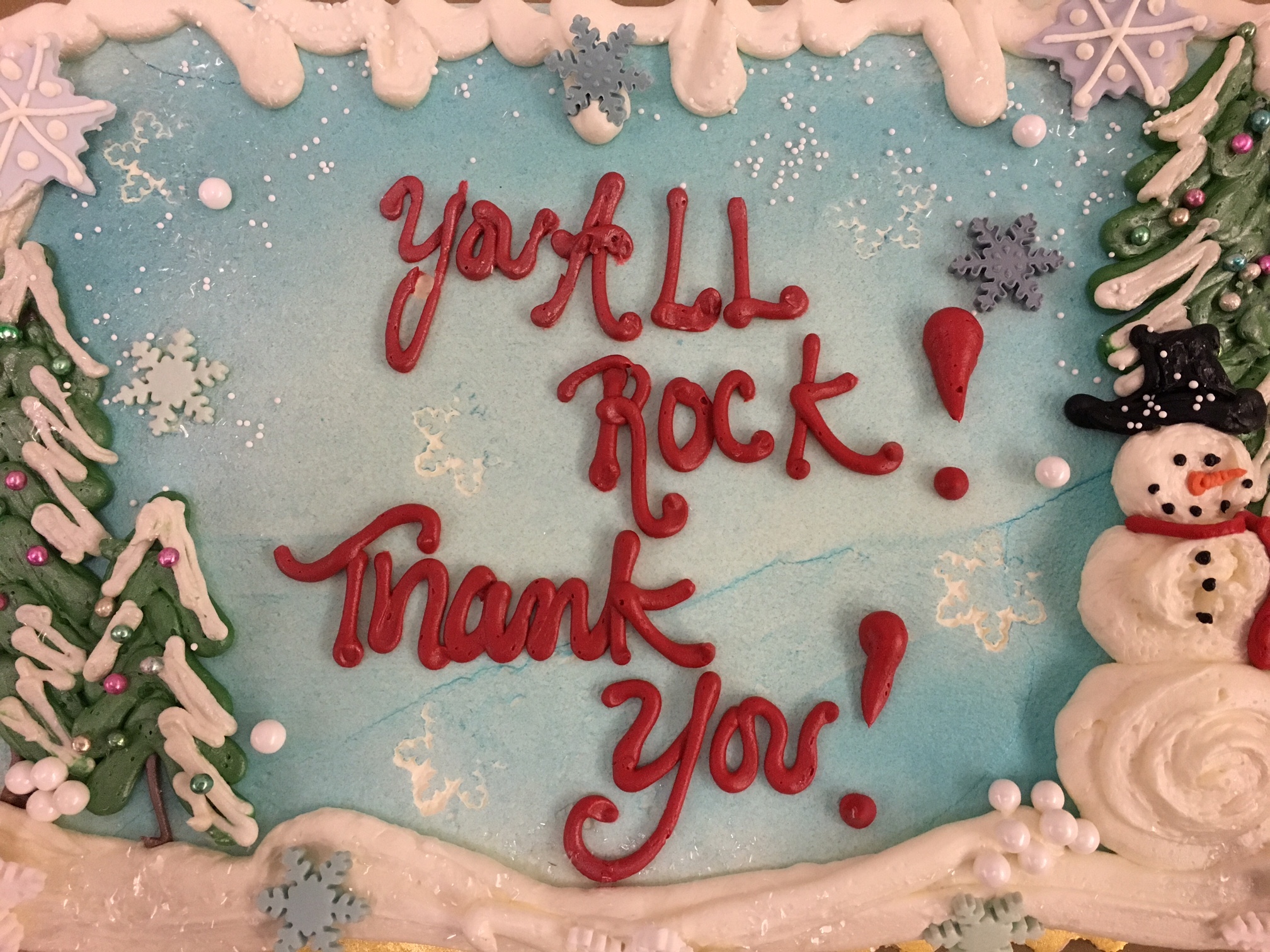
UW CSE undergraduate TA’s reunite and celebrate!

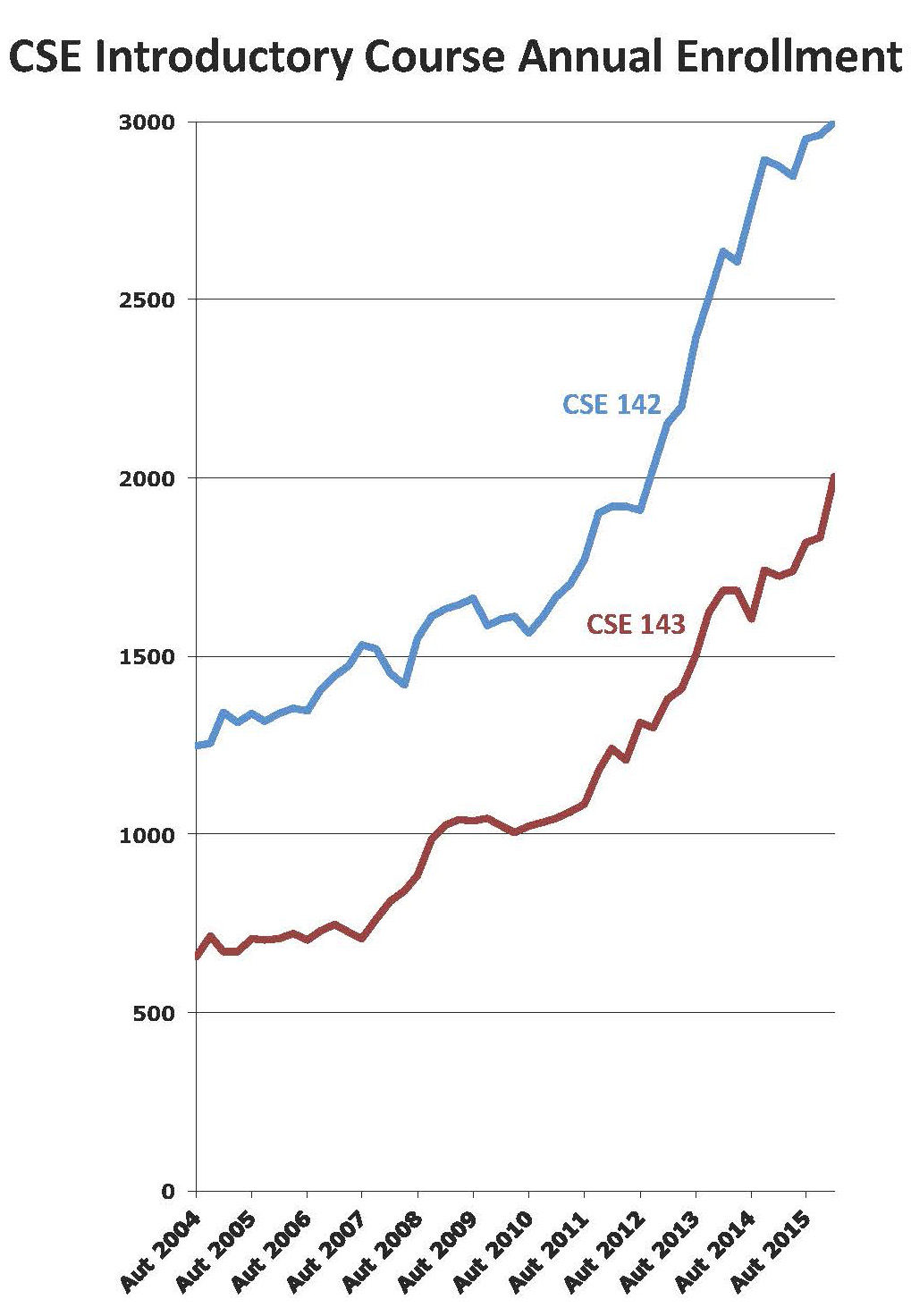
14x_enrollmentUW CSE’s introductory courses have seen extraordinary growth in size and in quality – growth that’s powered by an amazing corps of undergraduate teaching assistants.

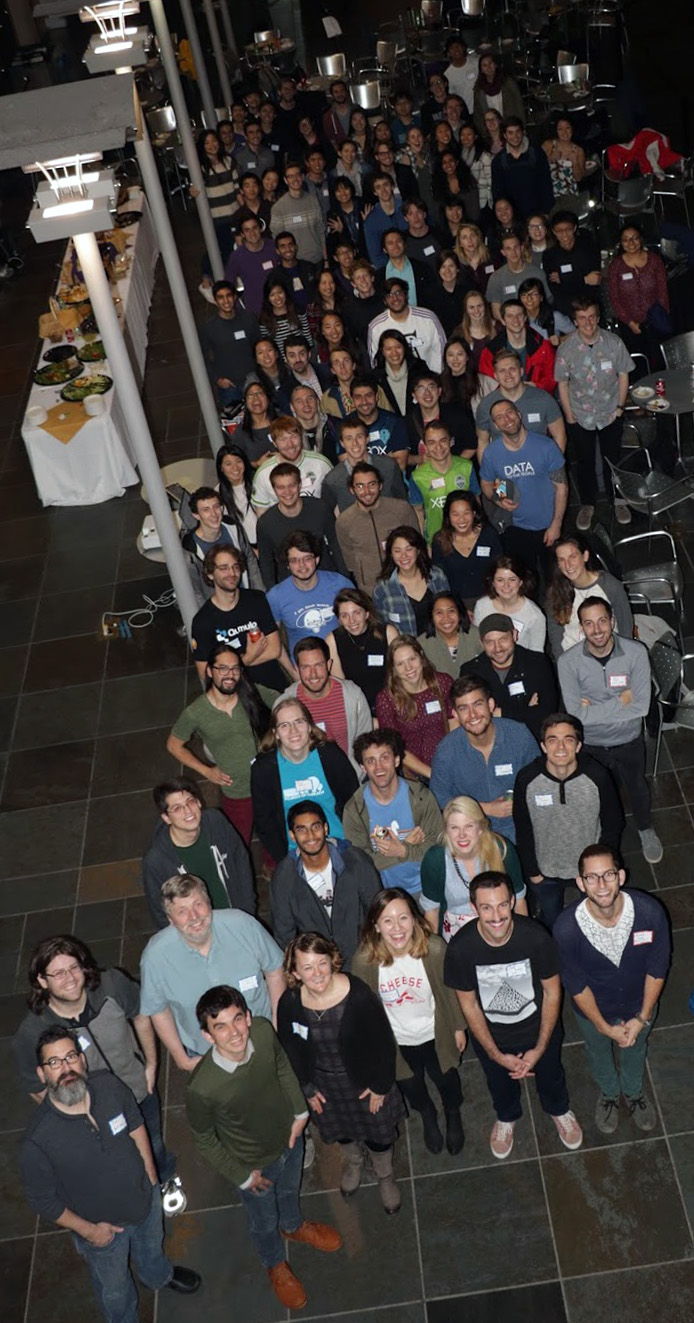
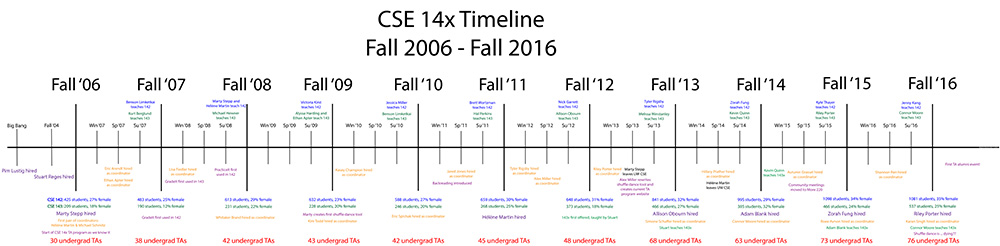
More than 150 current and former CSE142 and CSE143 undergraduate TAs participated in a reunion event in the Paul G. Allen Center on November 22nd. A timeline created for the event highlighted how much the program has changed in the last ten years.

In the fall of 2006, CSE142 had 425 students and CSE143 had 209 students, supported by 30 undergraduate TAs. For the current fall quarter, CSE142 has 1,081 students and CSE143 has 537 students supported by 76 undergraduate TAs. The growth in enrollment by women has been even more impressive: in fall 2006, 27% of the students in CSE142 and 18% in CSE143 were women, versus 35% in CSE142 and 25% in CSE143 today.

Speakers at the reunion event included Stuart Reges, who created the undergraduate TA program at UW, Victoria Kirst, who was a TA and student instructor at UW and is now teaching at Stanford, and current 14X TA coordinators Shannon Ren and Karanbir Singh, who put in incredible effort to create a fun activity for members of the community – both past and present – to come together. Former 14X TA coordinators Alex Miller, Hillary Prather, Kasey Champion, Michael Schmitz, Riley Porter, Tyler Rigsby, and Whitaker Brand also joined the event.

utasReges highlighted how special the UW undergrad TA program is because most universities do not offer such a rich opportunity for undergraduates to become partners in the teaching of introductory computer science. Singh reminded attendees of how attractive the undergraduate TA program has become with over 200 applicants for fewer than 30 new spots in the most recent round of hiring.

Reges also pointed out the impressive list of former undergraduate 14X TAs who have gone on to be hired as college faculty including:

  • Kurtis Heimerl – assistant professor in UW CSE
  • Peter Michael Osera – assistant professor at Grinnell College
  • Helene Martin – former lecturer in UW CSE
  • Victoria Kirst – lecturer at Stanford
  • Allison Obourn – former lecturer in UW CSE, now at the University of Arizona
  • Whitaker Brand – teacher of multiple UW CSE courses
  • Zorah Fung – lecturer in UW CSE
  • Riley Porter- lecturer in UW CSE
  • Ryan Parsons – faculty at Whatcom Community College

One of the main reasons the program has produced so many college level instructors is that UW encourages undergraduates who have been TAs to complete the fifth year Masters program and teach one of the courses in the summer. Few major computer science programs have pathways like this that encourage students to prepare for and consider a career in teaching.

Former UW CSE lecturer Marty Stepp was unable to attend the program, but several speakers mentioned his many contributions. Stepp came out of a similar undergraduate TA program at the University of Arizona and helped Reges create the program at UW. He also put in substantial effort to shape the 14X courses, creating tools known as GradeIt and PracticeIt. Stepp now teaches at Stanford University.

The timeline for the program appropriately lists course administrator Pim Lustig as appearing at the beginning of time as he has been a crucial source of support before anyone else on the list even came to UW.

Timeline

  Read more →

UW CSE alum Peter Brook and Snap Spectacles

snapglassesta

Not UW CSE alum Peter Brook …

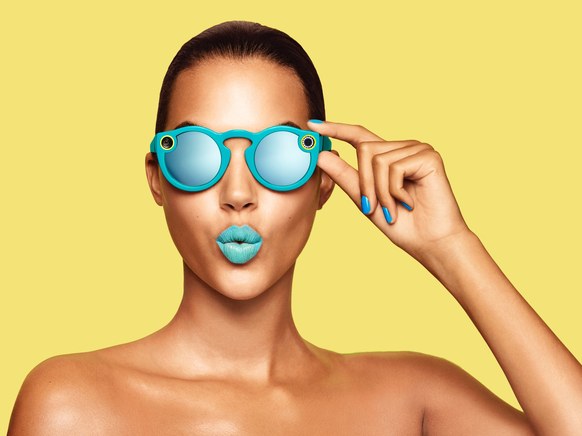
Peter Brook spent his undergraduate days in Joshua Smith’s Sensor Systems Laboratory and at Facebook. In 2013 he took his newly-minted Computer Engineering bachelors degree to Vergence Labs, where he was lead software engineer on Epiphany Eyewear – fashion-conscious eyewear that captures video snippets with the touch of a button. Vergence was acquired by Snapchat, where Peter has led the software side of Snap Spectacles from early prototypes through mass production.

Snap Spectacles have now hit the big time – sold through popup vending machines in Southern California, and soon near you! Read a Wired article here.

Congratulations Peter! Read more →

UW startup WiBotic among GeekWire’s 2016 “Seattle 10” hot startups

WiBotic CEO Ben Waters

“From the brick walkways of Pioneer Square to the funky facades of Fremont, there’s a lot of startup action in Seattle.

“So trying to identify the 10 hottest entrepreneurial ventures in the region is no easy task. But that’s what we’ve set out to do with this year’s class of The Seattle 10, which we’re hosting again in partnership with the Museum of History & Industry

“We’re putting our entrepreneurs to work, asking each of The Seattle 10 winners to reproduce their business ideas on giant six-foot by six-foot cocktail napkins that will be unveiled for the first time at the GeekWire Gala on Dec. 7th at MOHAI.”

In 2013, CSE startup SNUPI was among The Seattle 10. In 2014, CSE startup GraphLab was among The Seattle 10. This year, it’s CSE+EE startup WiBotic, out of the Sensor Systems Laboratory of UW CSE+EE professor Joshua Smith. WiBotic provides reliable wireless power to charge aerial, mobile and aquatic robot systems.

Read about all of The Seattle 10 in GeekWire here. Read more →

Cybercrime-fighters of Batman’s Kitchen cook up a 3rd place finish at CSAW ’16

CSAW '16 Capture the Flag badgeLast week, a team of UW undergraduates known as Batman’s Kitchen became cybersecurity superheroes when they earned third place at the U.S. finals of Capture the Flag at Cyber Security Awareness Week (CSAW ’16). The CSAW CTF competition, which was hosted by New York University’s Tanton School of Engineering, featured 15 teams battling it out in response to a series of computer security challenges inspired by real-world scenarios that tested their cybercrime-fighting mettle. The New York competition was one of three held simultaneously around the world in what is billed as the largest student-run cybersecurity contest.

The competition, which spanned 36 hours, began Thursday night and ran uninterrupted until late afternoon on Saturday. The grueling schedule meant team members had to take turns sleeping in shifts.

Was it worth it? UW CSE student Alex Kirchhoff, who traveled to Brooklyn to compete as a member of Batman’s Kitchen, says yes.

“CSAW gives us the opportunity to practice computer security skills, meet students from other universities with similar interests, and connect with companies in the field,” he said.

That sentiment was echoed by Kirchhoff’s team mates, including fellow CSE major Bo Wang, Physics major Stanley Hsieh, and Atmospheric Sciences major Dan Arens.

“Competing with the best undergraduate teams around the U.S. and Canada is really fun and rewarding,” said Hsieh. Arens was similarly enthusiastic, complimenting the “great teams, challenges, and sponsors” involved in the competition.

After an action-packed weekend of battling cyber-villains, the students are back in classes this week. Three members of the team that went to New York barely have time to reflect on their success before gearing up for their next competition in just a few short days — this time, traveling to Japan.

“I was surprised by how well we did,” said Wang. “Now, I’m hoping for the best for Trend Micro finals this week.”

Wang, Kirchhoff and Hsieh will be joined by pre-engineering student Grayson Sinclair at the Trend Micro CTF competition in Tokyo. The talented members of Batman’s Kitchen are making a habit out of not only representing the UW, but the entire country in these elite cybersecurity competitions.

“This year, Batman’s Kitchen is going global,” said Melody Kadenko, CSE research program director and adviser to Batman’s Kitchen. “We were the only team from a U.S. university to compete at the VolgaCTF finals in Russia earlier this fall, and we will be the only U.S.-based team competing in Japan.”

Batman’s Kitchen is growing in size as well as international visibility. Around 700 current and former students, drawn from the three UW campuses, are involved in meetings and activities. Kadenko selects members to represent Batman’s Kitchen in various competitions from a pool of core CTF enthusiasts who have developed skills in cryptography, forensics, web security and reverse engineering. Going into CSAW, the team ranked 34th out of nearly 11,000 CTF teams worldwide.

Read more about the results of the CSAW CTF here.

Way to go, team — and good luck in Japan! Read more →

UW CSE earns yet another Best Paper Award at OSDI

osdi-16-logoUW CSE continued our winning ways this week with a Best Paper Award at the 12th USENIX Symposium on Operating Systems Design and Implementation (OSDI ’16). The winning paper, Push-Button Verification of File Systems via Crash Refinement, was co-authored by a team of researchers from UW CSE’s Computer Systems Lab and Programming Languages & Software Engineering (PLSE) group that includes Ph.D. students Helgi Sigurbjarnarson and James Bornholt, and professors Emina Torlak and Xi Wang.

The paper presents Yggdrasil, an efficient and practical new toolkit that will enable programmers to build reliable storage applications using push-button verification. The toolkit requires no manual annotations or proofs about the implementation code. To define file system correctness, Yggdrasil uses crash refinement, which is amenable to fully automated reasoning with satisfiability modulo theories (SMT) solvers. Yggdrasil offers several techniques to scale up automated verification, including a stack of abstractions and separation of data representations, so that developers can implement file systems in a modular way for verification. Yggdrasil also generates a concrete test case (a counterexample) in instances where it finds a bug in the file system implementation or its consistency invariants.

The team’s Best Paper Award is one of three given out at this year’s conference, which is taking place this week in Savannah, Georgia. It is not the only one with a UW CSE connection: former postdoc Simon Peter, now on the faculty of the University of Texas at Austin, co-authored one of the other winning papers, Ryoan: A Distributed Sandbox for Untrusted Computation on Secret Data.

With this latest win, UW CSE has completed the trifecta of top systems and networking conferences this year, having also earned Best Paper accolades at NSDI and SIGCOMM.

Go team! Read more →

Seattle Business explores the region’s – and UW CSE’s – emergence as a high-tech magnet

November 2016 cover of Seattle Business magazineFor its November cover article, Seattle Business magazine examines the factors that contribute to our region’s growing attractiveness to tech companies looking to expand or open new engineering operations outside of their hometowns. The list of firms who have put down roots in and around the Emerald City is a who’s who of fast-growing firms, multi-national powerhouses, and household names, including Airbnb, Alibaba, Facebook, Google, Magic Leap, Pinterest, Snapchat, and Uber. In some cases, the newcomers’ local workforce has grown to hundreds or even thousands of employees — with space for even more.

From the article:

“Eighty satellite offices may not seem like many, given that there are some 12,000 tech firms in Washington state. But the number of branches has grown dramatically in recent years, and they tend to include the world’s most successful companies with astonishingly rapid growth trajectories. More than half of the engineering centers have been established since 2014, according to GeekWire…While they typically start small, many have grown quickly and now play strategic roles for such global giants as Google and Facebook.

“The Seattle tech community, once described as Snow White and the Seven Dwarfs because of the overwhelming presence of Microsoft, has gradually become more diversified with the emergence of Amazon and numerous midsize companies like Tableau Software and F5 Networks. The new engineering centers add yet another important source of growth and variety.”

How to explain this astonishing growth? The magazine surveyed economic development, research and industry leaders on what makes our region so enticing. Quality of life (particularly if you like the great outdoors), inexpensive office space, a lower cost of living than the Bay Area — all of these may factor into a company’s decision to open an outpost here.

But the key ingredient in Seattle’s secret sauce, which comes up again and again, is talent — lots of it, according to the article:

“‘We have more software engineers than any city per capita in the nation,’ says Suzanne Dale Estey, CEO of the Economic Development Council of Seattle & King County.

“And even though Silicon Valley is by far the leader in venture capital funding, WTIA CEO Michael Schutzler says, ‘For actual engineering talent, for software development, this is the center of the universe.’

“Yet it’s not just about quantity. University of Washington Computer Science & Engineering Professor Ed Lazowska points out that Seattle area engineers are in the vanguard in a broad range of sectors, from cloud computing and e-commerce to online gaming and virtual reality.

“‘We are, honestly, in a different league,’ says Lazowska. ‘It’s Silicon Valley and Seattle. New York has an extremely vibrant startup culture, but it is much less of a magnet for engineering offices.'”

The article notes that UW CSE has played its part in drawing companies from outside of the region. For example, the magazine recalls the story of then-UW CSE professor Brian Bershad opening Google’s first Seattle office. It also cites the influence of CSE and Electrical Engineering professor Shwetak Patel, whose work on low-power sensing for water and energy monitoring led Belkin International to establish WeMo Labs.

Read the full article here. Read more →

UW CSE’s Ed Lazowska named to Seattle magazine’s 50th anniversary Hall of Fame

Norm Rice, Patricia Kuhl, Ed Lazowska, Jeff Brotman

UW CSE’s Ed Lazowska (center) with fellow hall of famers (left to right) former Seattle mayor Norm Rice, UW I-LABS co-director Patricia Kuhl, and Costco founder Jeff Brotman. Credit: Hayley Young

“Every city possesses its own, unique spirit — its zeitgeist. It’s what makes a metropolis move, defines its identity and propels it forward. We owe much of ours to our city’s shapers — those leaders, trendsetters and trailblazers who, over the past 50 years, have transformed the town in extraordinary ways…

“The people on these pages — living legends who have made a major contribution during the past five decades — are influential in their own right, but are also just a representative cross section of the many talented visionaries, big thinkers and risk-takers who have shaped our city into the remarkable place it is.”

With that, Seattle magazine introduced its list of the most influential Seattleites of the past 50 years in art, philanthropy, social justice, technology, and more. On that list of movers and shakers who have helped to define our city, which the magazine compiled to mark its 5oth anniversary, is UW CSE’s very own Ed Lazowska. He earns his place in the magazine’s Hall of Fame in the Technology and Business category based on his many contributions as an educator, researcher, volunteer, and advocate.

“His research and teaching of high-performance computing and communications systems, and his service on countless advisory councils and boards helped shape Seattle’s high-tech economy and influence the future of information technology,” noted the magazine.

Lazowska joins Paul Allen, Jeff Bezos, the Gates Family, Madrona Venture Group’s Tom Alberg, personalized medicine pioneer Lee Hood, and others credited with helping to transform Seattle into the vibrant center of innovation and economic dynamism that it is today. The magazine is planning a celebration of these luminaries and the city’s past, present and future on November 17 — find event information here.

Lazowska’s inclusion in Seattle magazine’s Hall of Fame is only the latest accolade inspired by his tireless commitment to our department, our university and our region. Last month, Seattle Business magazine named him its 2016 Tech Impact Champion for his achievements and advocacy on behalf of the local tech community.

Congratulations, Ed! Read more →

UW’s Ira Kemelmacher-Shlizerman and Eli Shlizerman to timeshare with Facebook

Eli ShlizermanIra Kemelmacher-ShlizermanIra Kemelmacher-Shlizerman, a professor in UW CSE’s GRAIL group, and Eli Shlizerman, a professor of Electrical Engineering and Applied Mathematics, have joined the Research at Facebook team. Facebook’s gain is not UW’s loss, however, as the duo will be splitting their time between the company and campus.

In a welcome post, Joaquin Quiñonero Candela, Facebook’s director of applied machine learning, expressed excitement at what Kemelmacher-Shlizerman, an expert in computer vision and graphics, and Shlizerman, an expert in dynamical networks, will bring to the team.

“Their knowledge will provide new and fun ways for everyone to express themselves,” he said. “We’re excited for them to come onboard.”

One of the projects that caught the company’s eye was Dreambit, a personalized image search engine developed by Kemelmacher-Shlizerman that enables people to explore what they would look like in a variety of styles and situations. The Dreambit system automatically synthesizes the user’s face from an input photo with online search results based on hair style, hair color, age, historical period, country, and more. Given the importance of images to Facebook’s 1.7 billion users, it is not hard to see why the company was eager to tap into the expertise of the program’s creator.

Kemelmacher-Shlizerman said in a post, “We will both continue moving forward [with] our research programs, advise students at UW, and do absolutely awesome projects at Facebook!” At Facebook they will work closely with UW CSE Affiliate Professors Michael Cohen and Rick Szeliski, long-time GRAIL collaborators and founding members of Facebook’s Computational Photography group.

UW CSE’s GRAIL faculty are in high demand these days. Kemelmacher-Shlizerman joins fellow CSE professor Steve Seitz, who splits his time between UW and Google, in bridging academia and industry. Meanwhile, their colleague Ali Farhadi divides his time between UW and the Allen Institute for Artificial Intelligence.

We are excited to see what this new partnership with Facebook produces. Congratulations, Ira and Eli! Read more →

« Newer PostsOlder Posts »