UW CSE helps launch new professional master’s degree program in data science

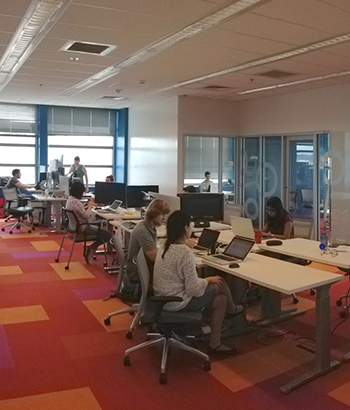
WRF Data Science Studio at UW

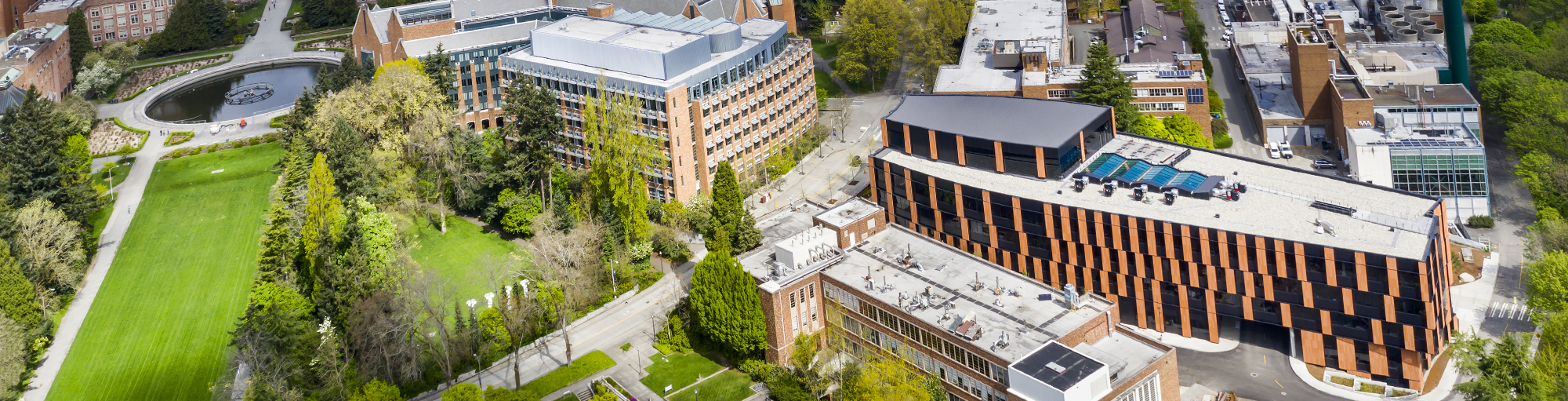
The WRF Data Science Studio on the UW Seattle campus

UW CSE has partnered with the iSchool and the departments of Applied Mathematics, Biostatistics, Human Centered Design & Engineering, and Statistics – under the auspices of the eScience Institute – on the creation of a master’s degree program in the growing field of data science. The new program, which will begin in fall 2016, was developed with input from industry leaders and will combine statistical modeling, machine learning, software engineering, data management and visualization, and user interface design.

From the UW news release:

“‘This new master’s program was designed not only by six leading UW departments, but also with direct input from top data science hiring managers in Seattle and nationwide,’ said Bill Howe, associate director and senior data science fellow at the UW eScience Institute and chair of the UW Data Science Master’s Development Committee. ‘The level of technical expertise from both industry and academia that went into designing this program makes it unique in the country….’

“‘UW has elite programs — among the best in the nation — in the core fields on which data science relies,’ said Ed Lazowska, Bill & Melinda Gates chair for the UW Department of Computer Science & Engineering and founding director and senior data science fellow at the UW eScience Institute. ‘This new professional master’s program builds on the UW’s leadership in data science research and education and solidifies the position of Seattle and the Pacific Northwest as a national hub for professional data scientists.'”

The Master of Science in Data Science is designed for working professionals, who will have the option to study full-or part-time. Classes will be held in the evenings on the UW Seattle campus.

Read the full media release here, and learn more about the program here. Read more →
UW CSE faculty star in typically brilliant holiday party skit …

IMG_6036

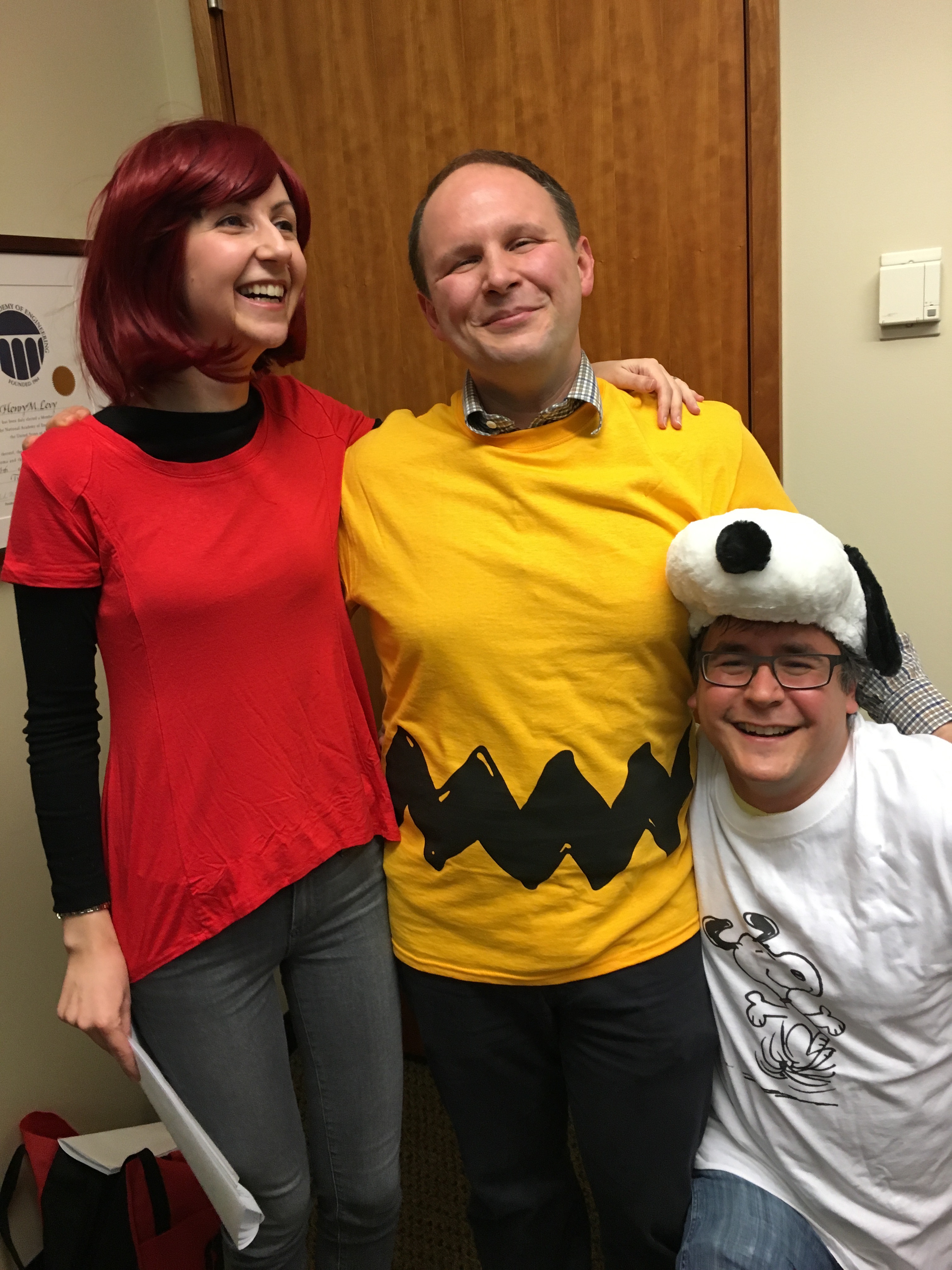
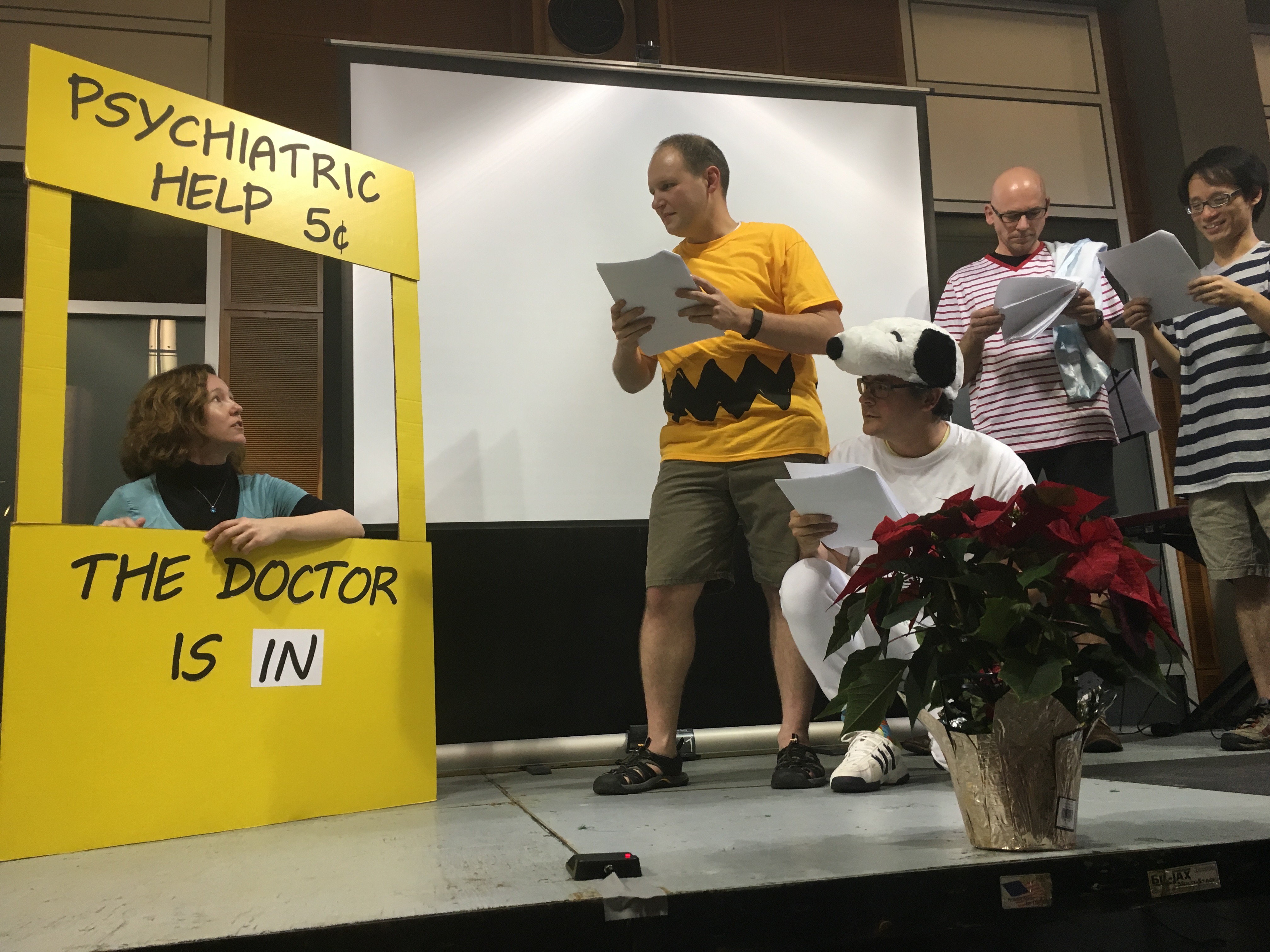
Magda “Lucy” Balazinska counsels Zack “Charlie Brown” Tatlock, as Luis “Snoopy” Ceze, Ras “Linus” Bodik, and Alvin “Schroeder” Cheung look on

IMG_6003

The VAX – all dressed up with no place to go

IMG_6029

Emina “Little Red-Haired Girl” Torlak, Zach “Charlie Brown” Tatlock, and Luis “Snoopy” Ceze during 5 minute “Rehearsal” in Hank “Pig-Pen” Levy’s office

Video here!

(The faculty skits weren’t always “family entertainment” – see, for example, here, in Hank Levy’s basement in the early 1980s.) Read more →

UW CSE’s Franzi Roesner guides business and civic leaders along “the invisible trail” of online tracking

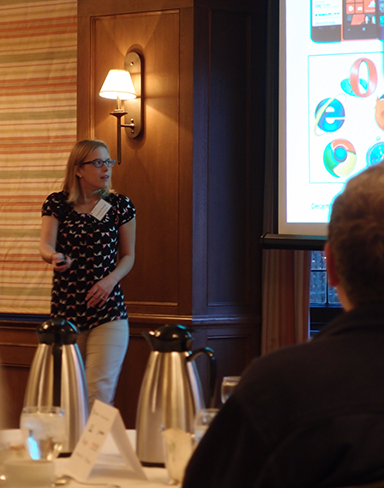
Franzi Roesner at the Discovery SeriesUW CSE professor Franzi Roesner, co-director of the Security and Privacy Research Lab, delivered a presentation today on the topic of online tracking and smartphone security to an audience of local business and civic leaders as part of the Technology Alliance’s Science & Technology Discovery Series in downtown Seattle.

Roesner’s work is based on the premise that security and privacy issues arise when there is a mismatch between user expectations as to how systems operate and actual systems behavior. Nowhere is this more evident than in the case of browser tracking – a legitimate function that can enhance web users’ convenience, but one that users do not fully understand and therefore are unable to control. Roesner talked about her quest to build better systems that improve privacy protections without overburdening users, giving the audience a crash course in how cookies work, the role of third-party websites, and the difference between anonymous trackers – for example, personalized advertising generators – and personal trackers tied to popular social media widgets.

Roesner and her fellow researchers built an automated detection tool, TrackingObserver, to measure tracker behavior and pervasiveness “in the wild.” The team’s work yielded some startling results: in visiting the top 500 websites, researchers encountered 524 unique trackers, and roughly half of the domains studied embed four or five different trackers. One website that the researchers visited contained 43 distinct trackers. They also found that the top three trackers – Doubleclick, Facebook and Google – were able to collect between 21 percent and 39 percent of users’ browser history. As a result of their research, Roesner and her colleagues developed a tool called ShareMeNot to empower users to counteract unwanted third-party tracking. The tool has since been integrated into the Electronic Frontier Foundation’s Privacy Badger offering.

Roesner also discussed her work in smartphone security, another area in which systems behave in ways that are not necessarily transparent or beneficial to users. As with browser tracking, there are legitimate reasons why smartphone applications would need access to users’ information – for example, location information when a user requests directions – or device features such as the camera. The problem, Roesner explained, is that users do not necessarily expect an app to have ongoing access to such information once a specific task is completed.

When Roesner began researching smartphone security, the state of the art consisted of prompts that asked the users to confirm permission for an app to access information or features, which can cause users to develop “prompt fatigue,” or install-time manifests – an all-or-nothing approach to permissions at the time of an app’s installation. Both, she noted, are overly permissive. To address these shortcomings, UW and Microsoft Research teamed up in an effort to advance user-driven access control – which, interestingly enough, more than half of users surveyed by the team thought was the norm already – by changing the underlying operating system instead of attempting to change user behavior.

Roesner concluded by highlighting emerging challenges associated with new augmented reality systems, the increasing popularity of wearable technology and the growing prevalence of sensors. The key will be to anticipate and address challenges before new systems become widely deployed, relying upon a combination of technology and good policy.

Keep up with UW’s work in this area by visiting the Security and Privacy Research Lab and the interdisciplinary Tech Policy Lab. Read more →

UW CSE alum Skarpi Hedinsson named CTO of Disney|ABC Television Group

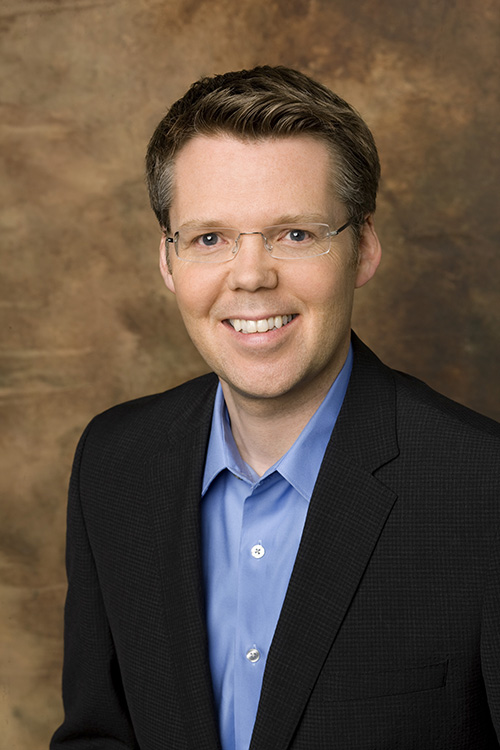
1994 UW CSE bachelors alum Skarpi Hedinsson has been named Chief Technology Officer of Disney|ABC Television Group.

Skarpi’s career path took him from Geoworks to Starwave to ESPN to Disney.

Congratulations Skarpi!

Read more here. Read more →

Think bolder, aim higher: Microsoft Research leader Jeannette Wing at UW CSE

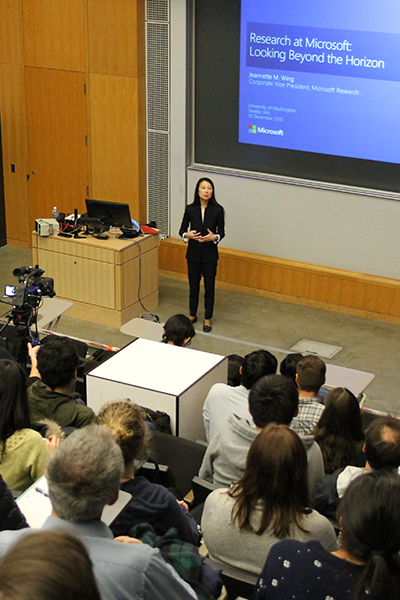
Jeannette Wing“Think bolder, aim higher.” That’s the message that Jeannette Wing delivered to the world-class scientists and technologists in Microsoft Research, and the message she delivered to a packed lecture hall during the latest installment of UW CSE’s Distinguished Lecturer Series.

With more than 1,000 researchers around the globe, Wing likes to describe Microsoft Research as “the largest computer science department in the universe.” During her presentation, Wing talked about MSR’s impact on science, on technology and on society, and described a handful of projects that are sure to affect all three in the coming years.

The first deals with integrative intelligence in the areas of vision and language. A team at MSR has developed a system for captioning images that goes beyond object segmentation and classification to reasoning and inference, and that exhibits evidence of “transfer learning” – that is, a model trained on one task shows itself to be good at another task. The second project is focused on developing safe cyber-physical systems (specifically drones). But the research team has more than the safety of drones in mind: its work could impact the safety of broad communities, using drones to fight the spread of infectious diseases. Finally, Wing talked about the large biological computation group at MSR. By applying computer science to biology, Wing noted, researchers are able to “discover new biology.” Researchers are taking this approach to better understand and program biological systems.

There is one more Distinguished Lecture left in 2015! Join us next Thursday, December 17th, when John Markoff of The New York Times joins us to talk about his new book, Machines of Loving Grace: The Quest for Common Ground Between Humans and Robots. More details here.

Thanks to Jeannette for her leadership in the field of computer science and for sharing MSR’s great work with our faculty and students! Read more →

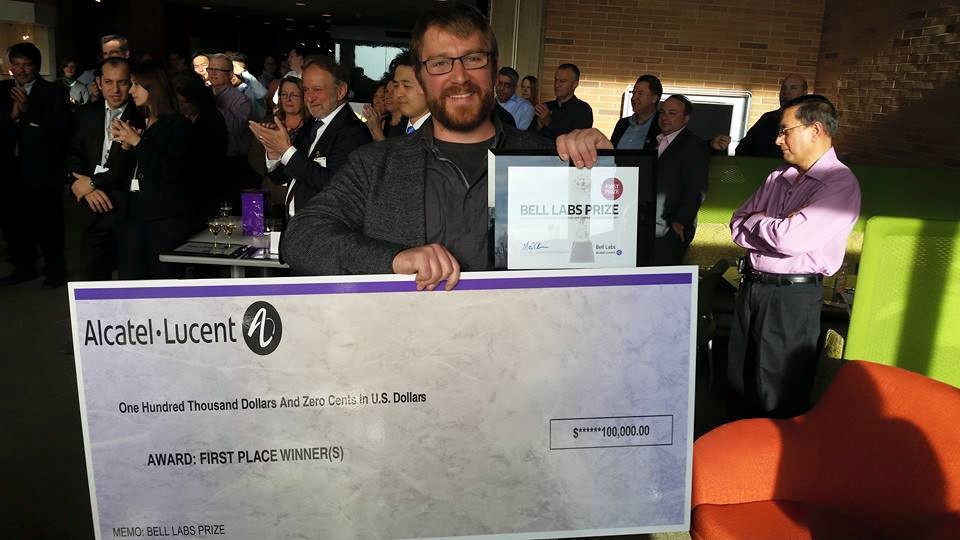
UW CSE Ph.D. alum Brandon Lucia wins 2015 Bell Labs Prize

12360275_10100743598095268_5082318562899768385_nThe Bell Labs Prize is a competition for innovators from around the globe that seeks to recognize proposals that “change the game” in the field of information and communications technologies by a factor of 10.

In the 2015 Bell Labs Prize competition, more than 250 applicants from 33 different contries submitted proposals for consideration. Of those applicants, 17 were selected to move on to the next stage of the competition and were given the chance to collaborate with Bell Labs research partners to strengthen their proposals. Following this, 7 were selected as finalists, and presented their ideas to a panel of judges, including Emmanuel Abbe, 2014 Bell Labs Prize winner and Assistant Professor at Princeton University; Al Aho, Lawrence Gussman professor at Columbia University; David Freeman, managing editor of The Huffington Post; Philippe Keryer, Chief Strategy and Innovation Office of Alcatel-Lucent; Marcus Weldon, president of Bell Labs and CTO of Alcatel-Lucent; and Robert Wilson, senior scientist at the Smithsonian Astrophysical Observatory of the Harvard Smithsonian Center for Astrophysics.

And the winner (first prize and $100,000): 2013 UW CSE Ph.D. alum – now CMU ECE assistant professor – Brandon Lucia!

Read more here.

Congratulations Brandon! Read more →

Scuba diving in the stratosphere: Record-setting space jumper Alan Eustace at UW CSE

Alan Eustace at UW CSEStudents, faculty and guests packed the Allen Center atrium today to hear former Google executive Alan Eustace tell the exciting story of his world record-setting space jump and the technical challenges he had to overcome to, in his words, “scuba dive in the stratosphere,” as part of UW CSE’s Distinguished Lecturer Series.

Eustace broke the altitude record and traveled faster than the speed of sound, reaching 822 miles per hour at one stage of his jump from a balloon launched from Roswell, New Mexico. During his presentation at UW CSE, Eustace described how he and his team emphasized “technology over ability,” developing a nearly indestructible, 400+ pound space suit with novel life support and parachute systems built mostly with off-the-shelf components. He also discussed the challenges associated with safely launching a helium balloon roughly the size of a football stadium into space and bringing it back down to earth without incident.

If you missed the lecture, checked out GeekWire’s excellent write-up here, and read more about Eustace’s incredible feat in the New York Times here.

Next up in the Distinguished Lecturer Series: join us this Thursday for a presentation by Jeannette Wing, Corporate Vice President at Microsoft, for “Research at Microsoft: Looking Beyond the Horizon.” Find more details here.

And next Thursday, December 17th, don’t miss New York Times science reporter John Markoff exploring artificial intelligence in “Machines of Loving Grace: Terminator Anxiety, or Will the Robots Arrive Just in Time?” More details available here.

Many thanks to Alan for sharing his amazing story with us! Read more →

Join UW CSE, UW President Ana Mari Cauce and 400+ novice programmers in doing the Hour of Code!

Code.org logoUW CSE has organized a series of events on campus this week to engage UW students and their friends and family members in the Hour of Code, an annual event organized by Code.org to engage people in computer programming. More than 190,000 Hour of Code events are being held around the world to celebrate Computer Science Education Week.

As UW CSE professor Ed Lazowska noted in a column published today in Xconomy:

“CS Ed Week was kind of a snoozer until Hadi Partovi founded Code.org, hatched the idea of Hour of Code, and built tools to support it. In the two years since then, nearly 150,000,000 ‘Hours of Code’ have been completed.

“Kids of all ages—from elementary school to grandparents—can participate in the hour of code.”

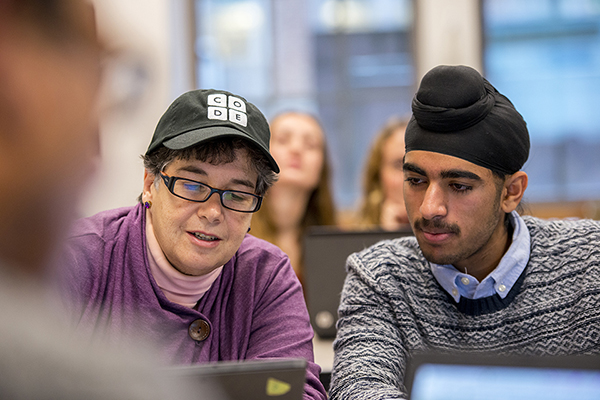
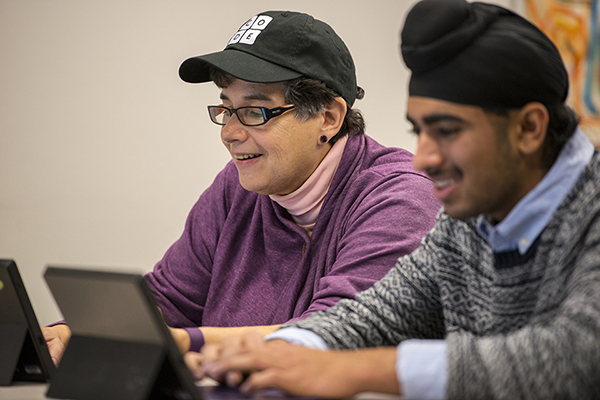
Yesterday, UW President Ana Mari Cauce joined in the fun, teaming up with freshman Sukhdeep Singh and a group of students to do the Hour of Code:

Ana Mari Cauce and Sukhdeep Singh

This was not the first time President Cauce had tried her hand at programming, as she took a COBOL class back in the day.

Ana Mari Cauce and Sukhdeep Singh

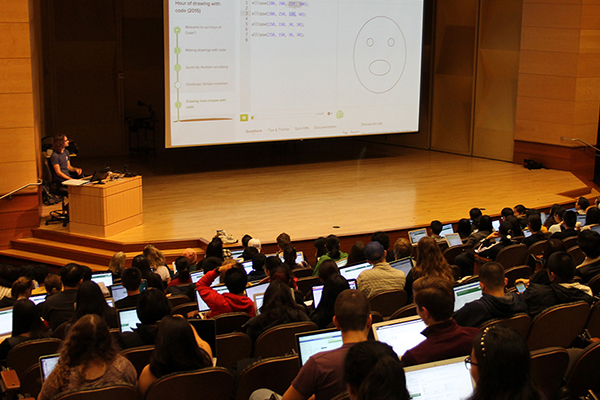
Later the same morning, 100 students in CSE Principal Lecturer Stuart Reges’ introductory Java programming course invited friends and family members to Kane Hall to try their hands at the Hour of Code:

UW CSE Hour of Code

Eric Keenan, a junior who is majoring in atmospheric sciences, brought along his mother, Gayle:

Eric and Gayle Keenan

Altogether, we expect more than 400 people from the extended UW family to take part in CSE’s Hour of Code activities throughout the week. It’s not too late to join in! If you can’t make it to an event, try the Hour of Code from wherever you are with one of Code.org’s online tutorials.

Read more about the UW Hour of Code and other local events in GeekWire here, and Lazowska’s Xconomy column here. Watch a KING 5 News video about the Hour of Code, including an interview with Stuart Reges, here. More photos from President Cauce’s Hour of Code can be viewed here.

Go Huskies! Read more →

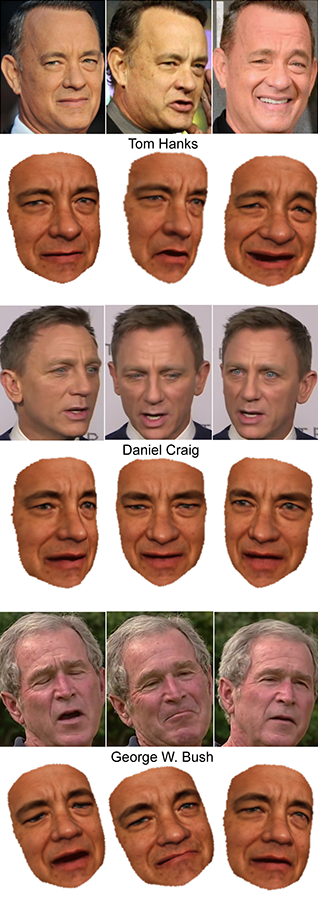
What makes Tom Hanks look like Tom Hanks? UW CSE researchers can show you!

This week, UW CSTom Hanks digital puppetry with Daniel Craig and George W BushE’s GRAIL Group demonstrated the ability to construct digital models of celebrities such as Tom Hanks by applying a novel combination of 3-D face reconstruction, tracking, alignment and multi-texture modeling to photos and videos mined from the Internet. The research team, which includes graduate student Supasorn Suwajanakorn and professors Ira Kemelmacher-Shlizerman and Steve Seitz, also engaged in some high-tech puppeteering, using footage of one person to control another’s expressions while preserving the latter’s own character.

From the UW media release:

“University of Washington researchers have demonstrated that it’s possible for machine learning algorithms to capture the ‘persona’ and create a digital model of a well-photographed person like Tom Hanks from the vast number of images of them available on the Internet.

“With enough visual data to mine, the algorithms can also animate the digital model of Tom Hanks to deliver speeches that the real actor never performed.

“‘One answer to what makes Tom Hanks look like Tom Hanks can be demonstrated with a computer system that imitates what Tom Hanks will do,’ said lead author Supasorn Suwajanakorn….

“It’s one step toward a grand goal shared by the UW computer vision researchers: creating fully interactive, three-dimensional digital personas from family photo albums and videos, historic collections or other existing visuals.”

The technology could be a game-changer for animation and virtual reality applications. The team will present its findings next week at the International Conference on Computer Vision (ICCV) in Chile.

Read the full media release and watch a video demonstration of the technology here, and check out coverage of the project by The Atlantic, Mashable, Gizmodo and GeekWire. Read the team’s research paper here. Read more →

UW CSE Ph.D. alums Geoff Voelker and Stefan Savage immortalized

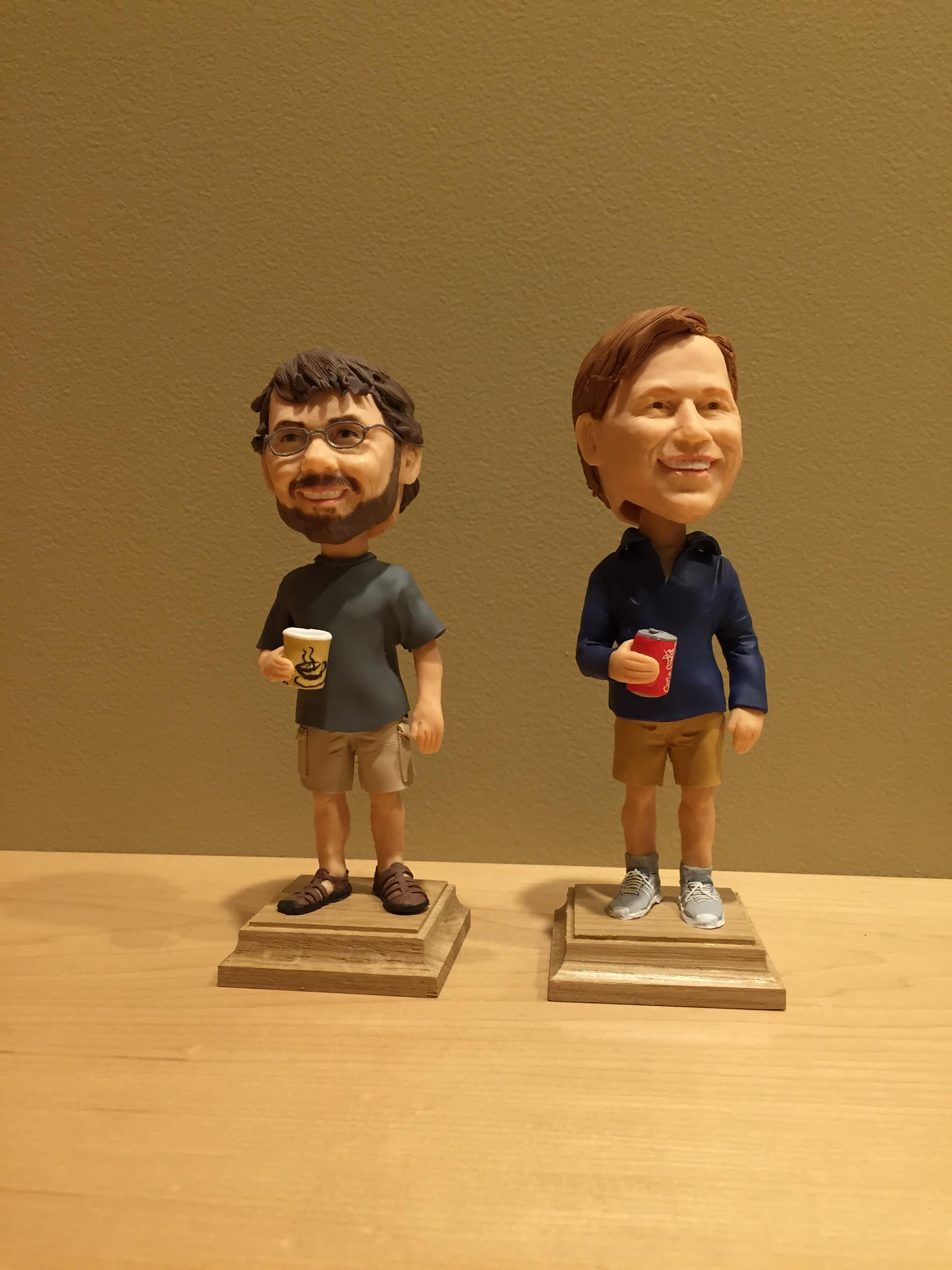
GeoffStefanUC San Diego Computer Science & Engineering Ph.D. student Neha Chachra defended her thesis today. In an effort to divert the attention of her thesis advisors – UW CSE star Ph.D. alums and long-time UCSD CSE star faculty members Geoff Voelker and Stefan Savage – she presented each with a hand-crafted bobblehead as a parting gift.

Stunning likenesses! (And Geoff and Stefan are probably easier to take in plastic form … at the very least, they can be made to nod “yes” …)

(Congratulations to Neha for sailing through her defense – based on terrific research, not bobbleheads. And thanks to Alex Snoeren for the photo.) Read more →

« Newer PostsOlder Posts »