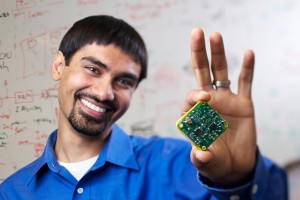
New “intelligent water” venture launches with technology from UW’s UbiComp Lab

Shwetak Patel

Shwetak Patel

Electronics company Belkin International and plumbing and HVAC supplier Uponor Corp. recently announced the formation Phyn, a $40 million joint venture to further scale their intelligent water innovations based on technology that was developed by CSE and EE professor Shwetak Patel working with students in the UW’s UbiComp Lab.

The Belkin technology is based on HydroSense—a pressure-based sensor for monitoring home water usage developed by Patel, CSE Ph.D. alum Jon Froehlich, and EE Ph.D. alum Eric Larson—and ElectriSense, a plug-in sensor that monitors home energy consumption at the device level that was developed by Patel and CSE Ph.D. alum Sidhant Gupta. Froehlich and Larson are now faculty members at University of Maryland, College Park and Southern Methodist University, respectively, and Gupta is a researcher at Microsoft Research.

Belkin licensed the technology when it acquired Patel’s home sensing startup, Zensi, six years ago. As part of that deal, Belkin opened its Wemo Labs in Seattle under Patel’s leadership. The new venture, Phyn, will operate a research facility in Seattle as part of its efforts to bring projects such as Belkin’s Wemo Water system, which is built on the UW-licensed technology, to market.
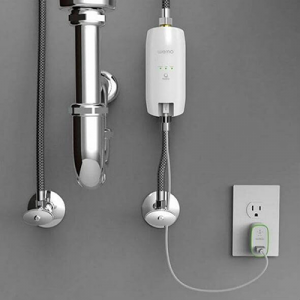
Wemo Water system

Wemo Water system

From the GeekWire article:

“Phyn’s R&D lab, in Seattle’s Belltown neighborhood, is starting with 10 engineers, and the company plans to continue expanding the team, said Ryan Kim, the newly named Phyn CEO, who was previously Belkin’s vice president of engineering. Kim said in an email to GeekWire that the company ‘continues to be committed to and invested in both our relationship with UW and our R&D office in Seattle.’

“‘We’ve found the quality of thinking as well as the quality of execution by the team at the lab, under Shwetak’s guidance, to be excellent, cooperative, and highly productive,’ Kim said. ‘Phyn will absolutely continue to work closely with Shwetak and the lab as we move forward.'”

Read the full GeekWire article here and a related Seattle Times article here.

UW CSE and EE professor Matt Reynolds collaborated on the ElectriSense project. Collaborators on the HydroSense project include former Mechanical Engineering undergraduate Tim Campbell, EE Ph.D. alum Gabe Cohn, EE Ph.D. students Tien-jui Lee and Elliot Saba, EE Master’s alum Eric Swanson, CSE professor James Fogarty, and EE professor Les Atlas. Read more →
DNA data storage project by UW and Microsoft researchers featured in Scientific American

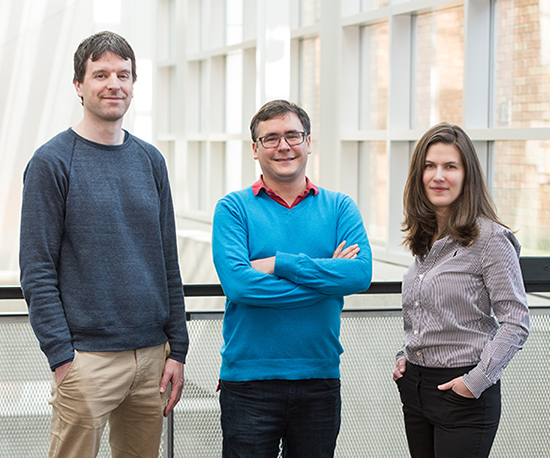
Georg Seelig, Luis Ceze, Karin Strauss

MISL researchers Georg Seelig, Luis Ceze, and Karin Strauss

Scientific American published a terrific article this week highlighting the work of UW and Microsoft researchers in the Molecular Information Systems Lab (MISL) as part of a broader examination of efforts to re-purpose DNA as a digital data storage medium. The magazine spoke with UW CSE and Electrical Engineering professor Georg Seelig and Microsoft researcher and CSE affiliate professor Karin Strauss about the project, which is generating a lot of buzz for its potential to revolutionize digital storage—offering massive expansion in both density and durability—in the age of big data.

From the article:

“Humans will generate more than 16 trillion gigabytes of digital data by 2017, and much of it will need to be archived: Think: legal, financial and medical records as well as multimedia files. Data is stored today on hard drives, optical disks or tapes in energy-hogging, warehouse-size data centers. These media last anywhere from a few years to three decades at most. Plus, says Microsoft Research computer architect Karin Strauss, ‘we’re producing a lot more data than the storage industry is producing devices for, and projections show that this gap is expected to widen….’

“In April Microsoft’s Strauss and computer scientists Georg Seelig and Luis Ceze at the University of Washington reported being able to write three image files, each a few tens of kilobytes, in 40,000 strands of DNA using their own encoding scheme—and then reading them individually with no errors. They presented this work in April at an Association for Computing Machinery conference. With the 10 million strands Microsoft is buying from Twist Bioscience, the team plans to prove that DNA data storage can work on a much larger scale. ‘Our goal is to demonstrate an end-to-end system where we encode files to DNA, have the molecules synthesized, store them for a long time and then recover them by taking DNA out and sequencing it,’ Strauss says. ‘Start with bits and go back to bits.’

Seelig and Strauss co-authored the paper referenced in the article with CSE Ph.D. student James Bornholt, Bioengineering Ph.D. student Randolph Lopez, Microsoft researcher and CSE affiliate professor Douglas Carmean, and CSE professor Luis Ceze. The team presented its work at ASPLOS 2016 earlier this year.

Read the full article here, visit the MISL website here, and check out our past blog coverage here.

Photo credit: Tara Brown Photography Read more →

eScience Institute’s VizioMetrix search engine featured in MIT Technology Review

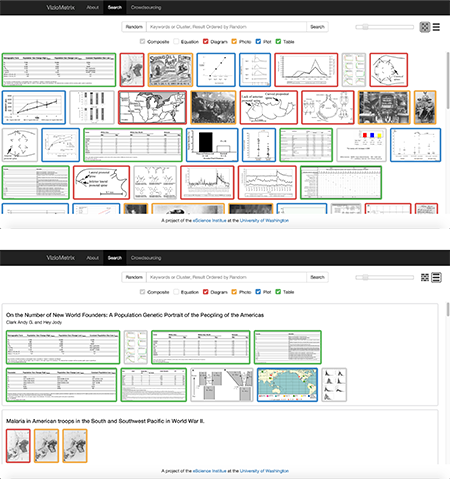
VizioMetrix screenshotVizioMetrix—the world’s first visual search engine for scientific diagrams, developed by a team at the UW’s eScience Institute—was the subject of a great article that appeared in MIT Technology Review over the weekend. The article reports on researchers’ efforts to understand the presentation of visual information in scientific literature, or viziometrics, based on a paper co-authored by Electrical Engineering Ph.D. student Po-Shen Lee, iSchool professor and Data Science Fellow Jevin West, and Associate Director, Senior Data Science Fellow and CSE affiliate professor Bill Howe.

From the article:

“Most scientists recognize the importance of good graphics for communicating complex ideas. It’s hard to describe the structure of DNA, for example, without a diagram.

“And yet, there is little if any evidence showing that good graphics are an important part of the scientific endeavor. The significance of good graphics may seem self-evident, but without evidence, it is merely a hypothesis.

“Today, that changes thanks to the work of Po-shen Lee [and] pals at the University of Washington in Seattle who have used a machine-vision algorithm to search for graphics in scientific papers and then analyze and classify them. This work reveals for the first time that graphics play an important role in the scientific process.”

The article goes on to explain how the team assembled a searchable database of 10 million scientific visuals by training a machine vision algorithm to separate multi-chart figures into their component parts and classify different types of figures. In analyzing the resulting data, the team found a significant correlation between the most successful scientific papers and the amount of information conveyed visually within the publication—information that has been largely ignored by current bibliometrics and scientometrics. This work will almost certainly influence how we present and access scientific information in the future.

Additional contributors to the VizioMetrix project include EE Ph.D. student Sean Yang, CSE Ph.D. student Maxim Grechkin, and CSE Ph.D. alum Hoifung Poon of Microsoft Research.

Read the full article here, and try VizioMetrix here. Read the research paper here. UPDATE: Check out a terrific article on VizioMetrics that appeared in the print and online edition of The Economist here. Read more →

Lazowska featured on @techvitamin podcast

AAEAAQAAAAAAAAkbAAAAJDk5MDJmYTljLTFlYWYtNDYzYy1hYjU2LTdmMDM1NWFjYjk5OA“Are our Tesla’s going to band together in the Costco lot and attack us? Find out. In this episode Ed Lazowska (@lazowska), the eminent and long-time member of UW’s Computer Science faculty, joins Facebook’s Michael Cohen and me to discuss everything from big data, deep learning, to how Universities are responding to the massive demand for computer savvy graduates.”

Listen here. Read more →

UW CSE faculty, staff, alums and friends @ Paul Allen’s Living Computer Museum

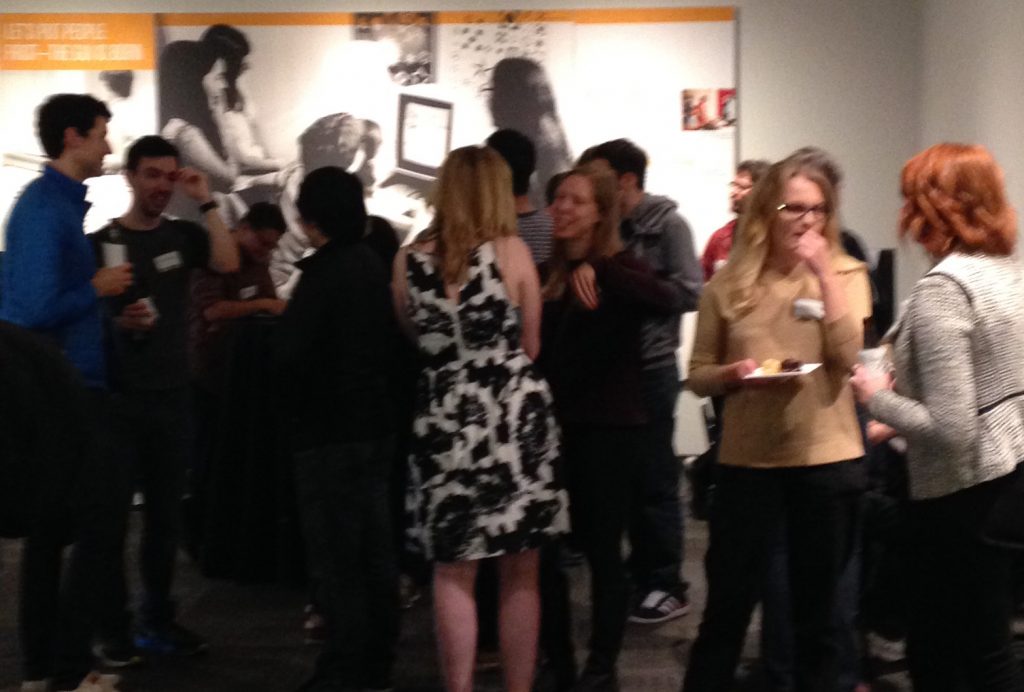
IMG_0497(1)More than 200 UW CSE faculty, staff, alums, and friends gathered at Paul Allen’s Living Computer Museum on Wednesday for a meetup.

If you haven’t been to the LCM … it’s phenomenal.

Bay Area alums and friends: See you at the Computer History Museum at the end of June! Read more →

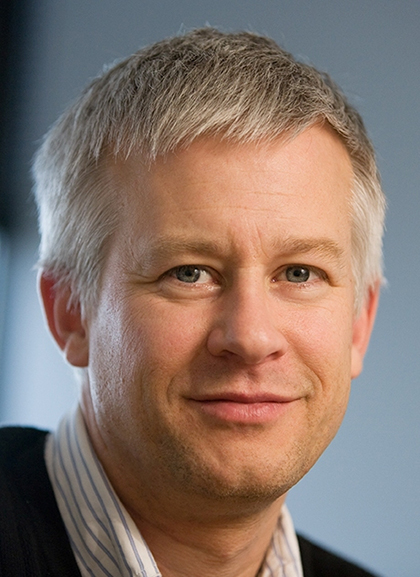
Yin Tat Lee to join the UW CSE faculty

Yin Tat LeeWe are thrilled to announce that Yin Tat Lee, who works in algorithms and optimization, will join the UW CSE faculty.

Lee’s research focuses on the design of fast algorithms for fundamental optimization problems. Leaders in convex optimization acknowledge that his work has yielded the most important breakthroughs in interior point methods in the past two decades. Together with his co-authors, Lee has developed the fastest known algorithms for linear programming, submodular function minimization, and the maximum flow problem. He has been the recipient of a variety of Best Paper and Best Student Paper awards from flagship theory conferences, including FOCS and SODA.

After finishing his Ph.D. at MIT, Lee will spend a one-year postdoc at Microsoft Research in Redmond  before starting at UW CSE. He joins Shayan Oveis Gharan and Thomas Rothvoss as rising stars in theory who have chosen UW CSE in recent years.

Welcome, Yin Tat! Read more →

UW CSE’s Dan Weld on “the real AI threat”

Dan WeldUW CSE professor Dan Weld wrote a thought-provoking column for GeekWire on “the real AI threat,” just in time for the White House-sponsored workshop on AI law and policy taking place on the University of Washington campus today.

Casting aside the sensational imaginings of Hollywood directors, Weld insists that we need not fear the day that AI systems willfully turn against humanity, as “computers have no hidden goals or secret motivations.” Instead, it is the action of human beings in control of the AI that we have to worry about.

But some bad actor at a keyboard is not what keeps Weld up at night. The greatest threat, he asserts, stems not from humans’ actions, but rather from our inaction. According to Weld, we ignore at our peril the potential for significant social upheaval stemming from mass job displacement, as computers perform more and more tasks that used to be the preserve of people.

From the article:

“The real AI threat stems not from nefarious actions, but rather from the opposite direction. As AI systems become more capable and more common, they will displace innumerable workers. Robots and intelligent software are outperforming humans at an increasing number of jobs. Mid-career education and retraining may slow this displacement, but digital innovation accelerates exponentially, virtually guaranteeing that social disruption will be faster and more extensive than ever before in history.

“We are already living the contradiction of automation increasing prosperity and economic output, on the one hand, and inequality, on the other. Political conservatives lament the laziness of today’s welfare recipients, but what should a population do when jobs disappear en mass? How will society respond when jobs disappear en mass? Is capitalism sustainable when labor becomes unnecessary?”

It’s a fascinating piece, which you can read in full here. Find out more about today’s AI workshop here, part of a series of workshops announced by the White House earlier this month to assess the benefits and risks of artificial intelligence. Read more →

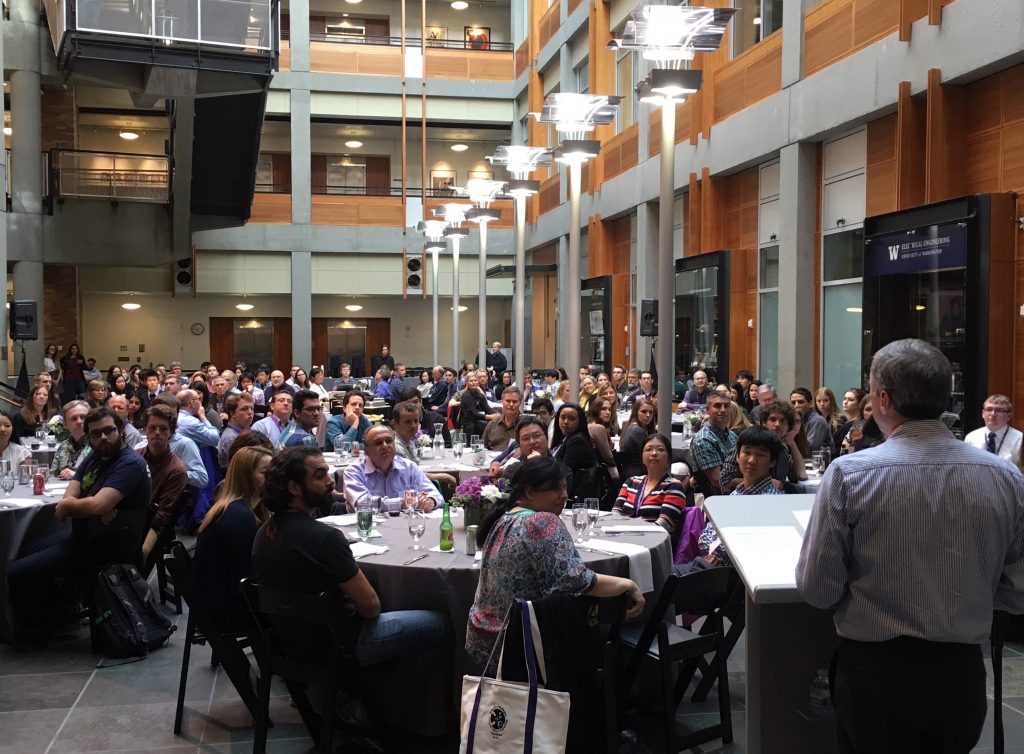
UW CSE’s celebration of “Inspirational Teachers”

CSE 2016 Inspirational Teacher DinnerEvery year, we in Computer Science & Engineering invite our new majors to identify their most inspirational high school or community college teacher – the teacher (each of us had one!) who changed their perception of what they should aspire to. We host these teachers, their partners, and the students who nominated them for dinner in the Allen Center (plus a bit of propaganda designed to encourage the teachers to send us more great students!).

From early learning through graduate school, all educators are in the same business. Parents entrust us with their most precious asset – their children. We do our best to help these kids achieve their potential. When they excel – which is almost always, given the amazing raw material with which we are entrusted – we take pleasure in the fact that we’ve played at least some small role in that success.

Congratulations and thanks to UW CSE’s 2015-16 Inspirational Teachers – nominated by our students for the difference you’ve made in their lives. Read more →

UW CSE ACM Student Chapter spring picnic

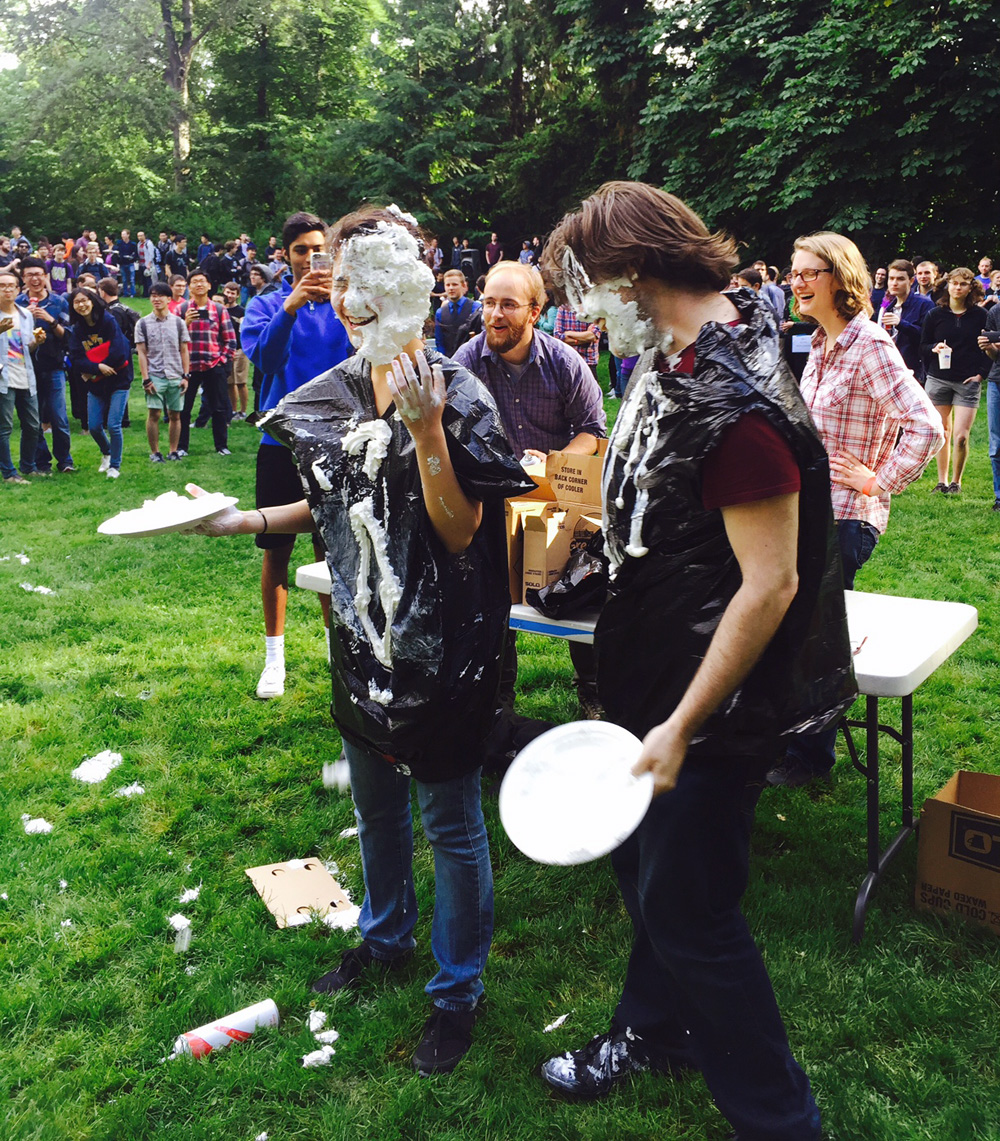
Perfect weather on Friday for the UW CSE ACM Student Chapter spring picnic! (As usual, faculty pie-throwing was the highlight …)

Luis

Zorah Fung and Adam Blank – looks like a draw!

Read more →

Workforce gaps in Washington State: It’s all Computer Science

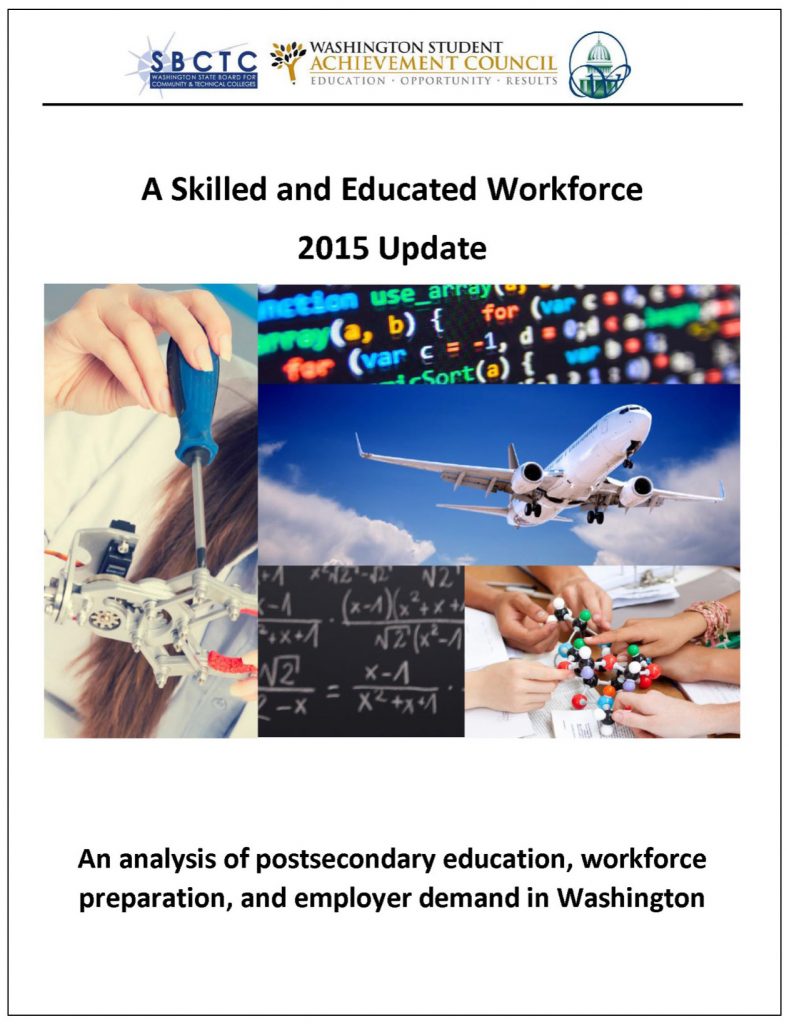
Cover with borderThe latest update of the authoritative Washington State workforce gap analysis was released in April by the Washington Student Achievement Council, the State Board for Community and Technical Colleges, and the Workforce Training and Education Coordinating Board.

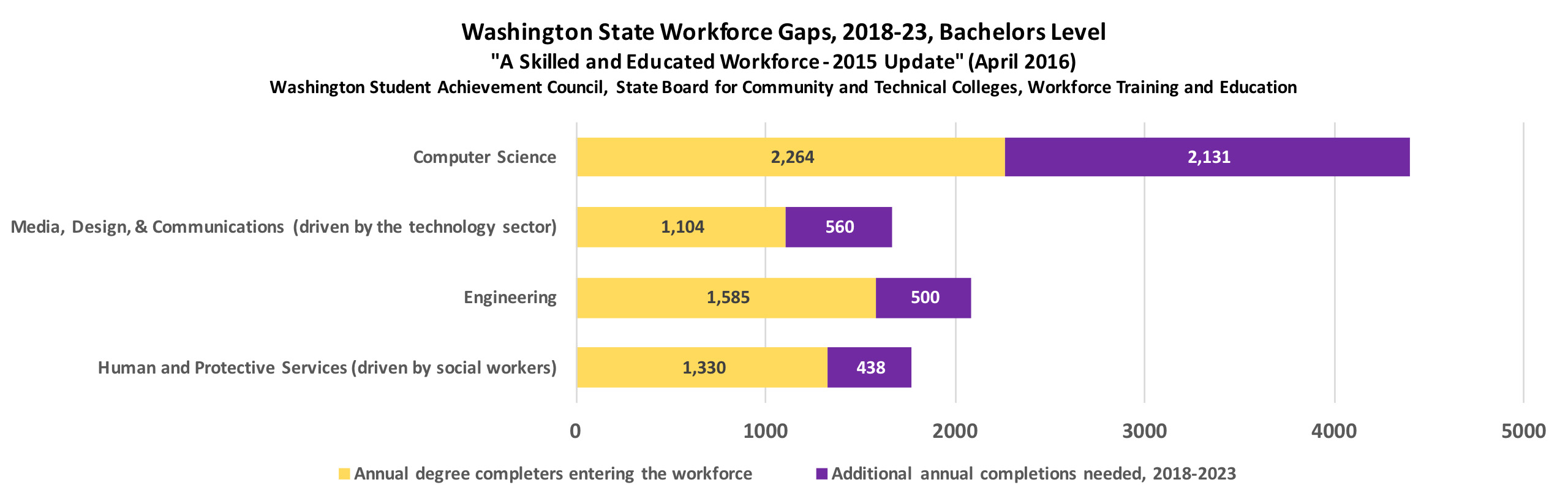
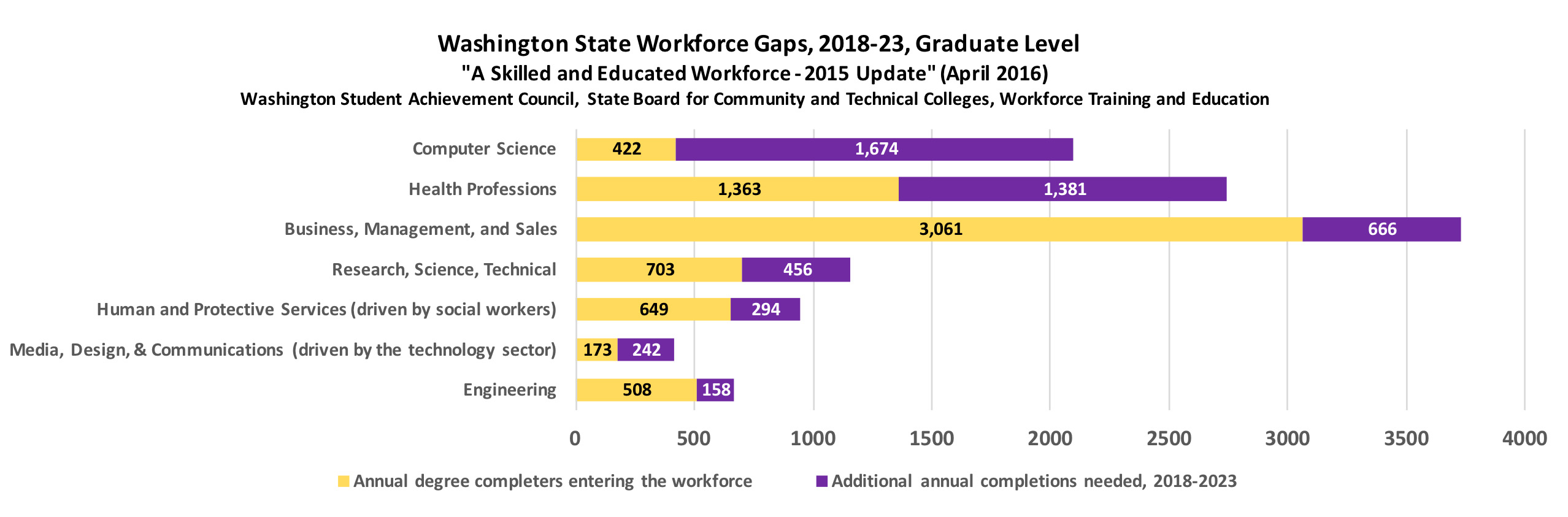
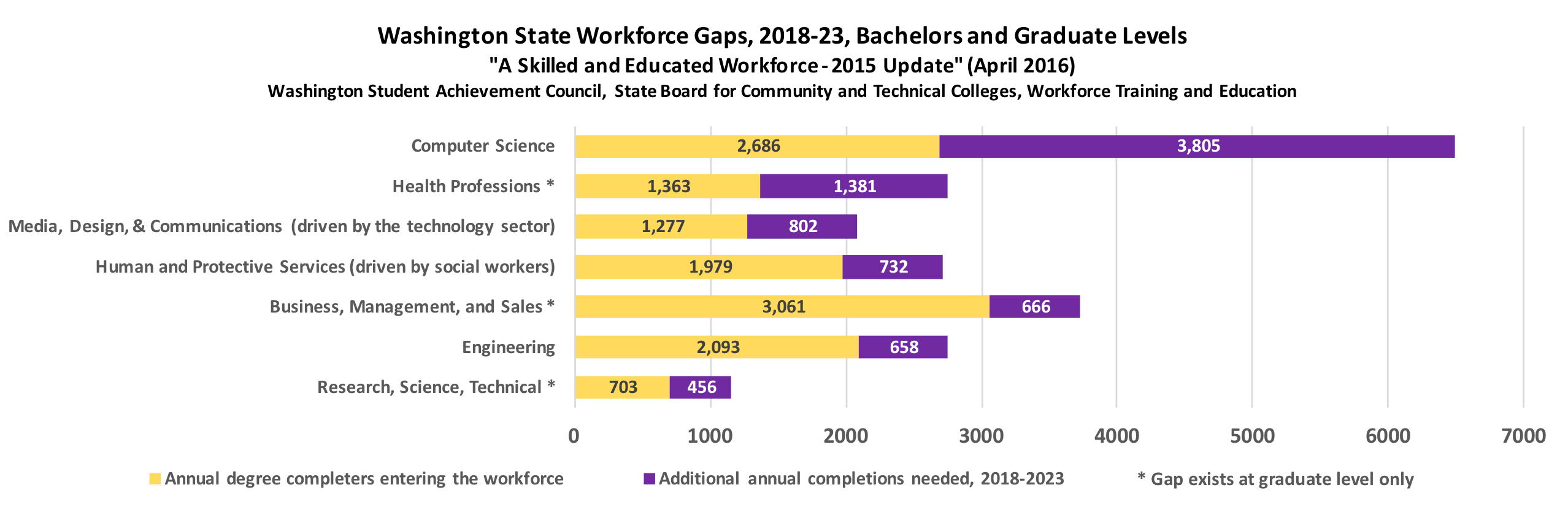
The report – A Skilled and Educated Workforce: 2015 Update – examines supply and demand in roughly 500 occupations divided into a dozen major categories.

At the Bachelors level, four fields are identified as having significant gaps between annual completors entering the workforce and total annual job openings. Computer Science leads the way, with a gap nearly four times as large as the gap in the next field.

When Bachelors and Graduate degree levels are combined, seven fields are identified as having significant gaps. Computer Science again leads the way, with a gap nearly three times as great as the gap in the next field.

bg

bgOf course, it’s not just Washington’s software industry that’s responsible for this. We recently reported on the dominance of computing professionals in our region’s aerospace industry.

And it’s not just a regional phenomenon. We recently reported on the latest U.S. Bureau of Labor Statistics decadal workforce projections. Read more →

« Newer PostsOlder Posts »