UW continues winning ways at NSDI with Best Paper Award for Passive Wi-Fi

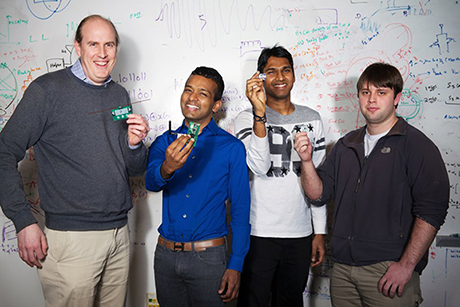
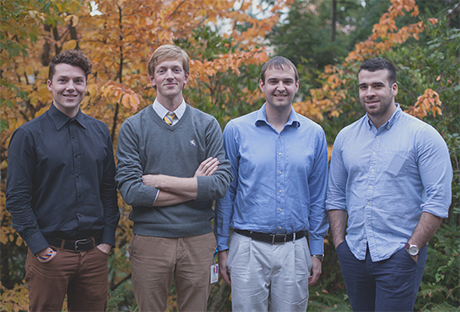
The Passive Wi-Fi team

Left to right: Josh Smith, Shyam Gollakota, Vamsi Talla and Bryce Kellogg. (Photo credit: Daniel Berman)

A team of UW CSE and EE researchers captured the Best Paper Award at the 13th USENIX Sympoxium on Networked Systems Design and Implementation (NSDI ’16) for Passive Wi-Fi: Bringing Low Power to Wi-Fi Transmissions. The Passive Wi-Fi project was developed in CSE’s Networks & Mobile Systems Lab by EE graduate students Bryce Kellogg and Vamsi Talla, CSE professor Shyam Gollakota, and CSE and EE professor Josh Smith.

Passive Wi-Fi is capable of generating Wi-Fi transmissions using 10,000 times less power than conventional methods. MIT Technology Review recently named Passive Wi-Fi among its 10 Breakthrough Technologies of 2016.

This is the second year in a row that UW CSE has taken home the big prize from NSDI, and our sixth NSDI Best Paper Award since 2007. UW ranks #1 among academic research institutions (and second only to Microsoft Research among all computing research organizations) in Best Paper Awards at major conferences in the field.

Read more about Passive Wi-Fi in our previous blog post here.

Congratulations Bryce, Vamsi, Shyam and Josh! Read more →

UW researchers cure fat-finger syndrome with sonar-based gesture tracking system

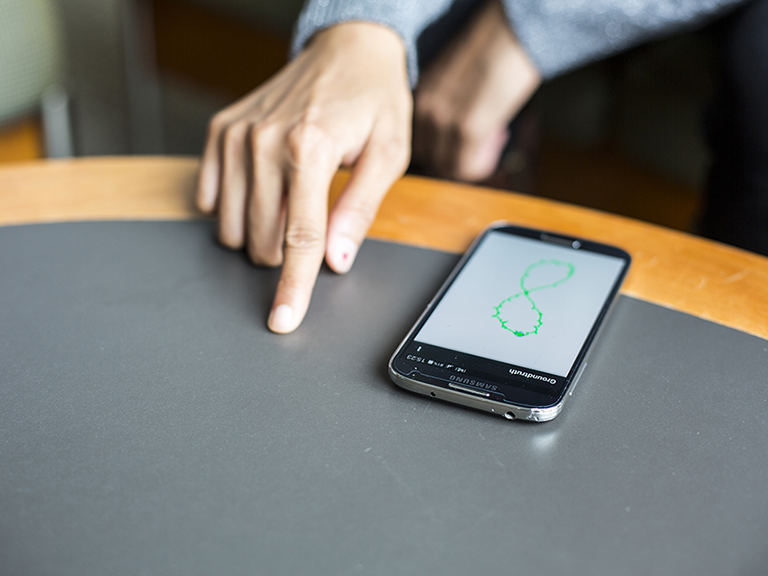
FingerIO demonstration on smartphoneA new technology developed by UW CSE and EE researchers could take the “touch” out of touchscreen and transform the way we interact with our mobile devices. FingerIO, which was developed in the Networks & Mobile Systems Lab led by CSE professor Shyam Gollakota, employs sonar to enable users to interact with their smartphones and smartwatches by gesturing or writing on any nearby surface.

From the UW news release:

“As mobile and wearable devices such as smartwatches grow smaller, it gets tougher for people to interact with screens the size of a matchbook.

“That could change with a new sonar technology developed by University of Washington computer scientists and electrical engineers that allows you to interact with mobile devices by writing or gesturing on any nearby surface—a tabletop, a sheet of paper, or even in mid-air….

“‘You can’t type very easily onto a smartwatch display, so we wanted to transform a desk or any area around a device into an input surface,’ said lead author Rajalakshmi Nandakumar, a UW doctoral student in Computer Science & Engineering. ‘I don’t need to instrument my fingers with any other sensors—I just use my finger to write something on a desk or any other surface and the device can track it with high resolution.'”
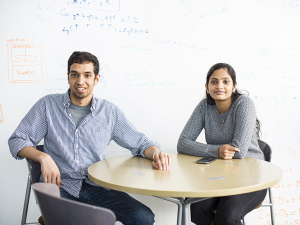
Vikram Iyer and Rajalaskhmi Nandakumar

Vikram Iyer (left) and Rajalakshmi Nandakumar

FingerIO uses the device’s own speaker, emitting an inaudible sound wave that bounces off the user’s finger and is then recorded using the device’s microphone. That signal is used to calculate the finger’s location in space. The researchers employed a common technique in wireless communication, Orthogonal Frequency Division Multiplexing, to achieve sub-centimeter tracking accuracy.

Sonar has significant advantages over other approaches. For example, unlike camera-based finger tracking, it does not require a direct line of sight—which means it can work through fabric, such as a pocket or a sleeve. And compared to radar, sonar does not require as much computing power or custom hardware to work.

“‘Acoustic signals are great—because sound waves travel much slower than the radio waves used in radar, you don’t need as much processing bandwidth so everything is simpler,’ said Gollakota…’And from a cost perspective, almost every device has a speaker and microphones so you can achieve this without any special hardware.'”

The team, which also includes EE Ph.D. student Vikram Iyer and CSE affiliate faculty member Desney Tan (Principal Researcher at Microsoft Research), will present its research paper on FingerIO at the upcoming CHI 2016 conference in San Jose, California, where it has been recognized with an honorable mention. Nandakumar previously was awarded Best Presentation for FingerIO at the Microsoft Research Student Summit on Mobility, Systems, and Networking.

Read the full news release here, and visit the FingerIO web page here. Watch a video demonstration here, and view the Discovery Channel Canada segment here. Also check out coverage by The Oregonian, GeekWireGizmagFastCompany and Motherboard. Read more →

Josue Rios’ journey from Venezuela to UW CSE

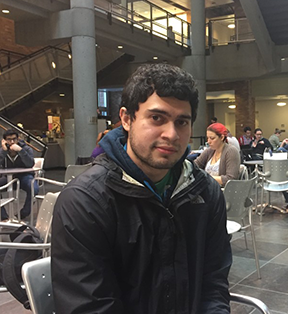
Josue RiosUW CSE senior Josue Rios was one of the first students to benefit from Washington State’s REAL Hope Act, an initiative that enables undocumented immigrants to access state financial aid for higher education. Nearly 20 years ago, Rios and his family left Venezuela in fear; these days, he is looking forward to graduating from UW CSE with a bachelor’s degree in computer engineering. An excellent article by UW journalism student Kayla Roberts that was published today in Seattle’s civic-focused online journal, Crosscut, highlights Rios’ journey and how the REAL Hope Act has lived up to its name:

“Josue Rios, a 21-year-old student at the University of Washington, escaped violence in Venezuela with his parents when he was two years old.

“The plan was to stay in Washington six months on a tourist visa. When his family home in Venezuela was invaded and sold on false documentation, this turned into 19 years.

“‘Because we had nothing to go back to, because everything was taken away from us, we decided to start over here,’ Rios said. This meant applying himself academically in high school and eventually pursuing a college education. He is set to graduate in the spring from the computer science and engineering department at UW.”

The author notes that because undocumented immigrants are ineligible for federal financial aid, the state program is the only government support available to enable students like Rios to pursue higher education. Read the full article here.

Rios has been an active contributor to the UW CSE community, serving as a teaching assistant in our Systems Programming and Introduction to Digital Design courses. He spent last summer as an intern at Amazon and has plans to work with Microsoft and a start-up company after graduation.

Thanks, Josue, for sharing your inspirational story. We look forward to celebrating your achievements with you in June! Read more →

UW CSE’s Tianqi Chen, Arvind Satyanarayan win 2016 Google Ph.D. Fellowships

Tianqi-ChenToday, Google announced that UW Ph.D. student Tianqi Chen has been chosen as a 2016 Google Ph.D. Fellow in machine learning. Chen works with professor Carlos Guestrin in the UW MODE Lab (Machine Learning, Optimization, Distributed Systems and Statistics) and is the creator of XGBoost, an open-source, end-to-end tree boosting system that is designed to be efficient, flexible and portable.

Tree boosting is a highly effective and widely used machine learning method. Researchers have embraced XGBoost because it is capable of running 10 times faster on a single machine and of scaling beyond billions of examples while using fewer resources compared to existing systems. More than half of the teams who won Kaggle machine learning challenges last year used it, as did every top-10 winning team at the 2015 KDDCup. Learn more about Chen’s work on the XGBoost project page here.

arvind-green-small-lessgreenArvind Satyanarayan, a Ph.D. student who works with UW CSE professor Jeff Heer in the Interactive Data Lab, also won a Google Ph.D. Fellowship – his in human-computer interaction. While technically a student at Stanford University (Heer moved from Stanford to UW several years ago), Satyanarayan spends the bulk of his time here in UW CSE; he is currently co-instructor with Jeff of the graduate course in User Interface Software & Technology in the Masters of Human-Computer Interaction & Design program. Learn more about Satyanarayan’s work here.

Read the Google announcement here.

Google Ph.D. Fellows are considered to be among the most promising young academic researchers across the globe. The competition has been particularly kind to UW CSE students, including past winners Aaron Parks and Kyle Rector (2015), Robert Gens and Vincent Liu (2014), Adrian Sampson (2013), Tom Bergan (2011), and Roxana Geambasu and Michael Piatek (2009).

Congratulations, Tianqi and Arvind, and thanks to Google for supporting UW CSE students and their work! Read more →

UW CSE students compete in the UW Health Innovation Challenge

The MultiModal Health team

Lars Crawford, Brian Mogen, Tyler Libey and Dimitrios Gklezakos

The finals of the inaugural Health Innovation Challenge, hosted by the UW Foster School of Business Buerk Center for Entrepreneurship, took place yesterday on campus. Three finalists with a UW CSE connection—FitTraction, HLTH, and MultiModal Health—were among the 18 interdisciplinary teams (out of a competitive field of 34) invited to pitch their ideas to improve health with technology to a roomful of judges drawn from the local community.

MultiModal Health, which captured third place, developed an interactive platform for physical rehabilitation. The company’s vHAB product line gamifies therapy exercises to improve patient engagement and outcomes and provide real-time data to providers. The MultiModal Health team includes UW CSE student Dimitrios Gklezakos, bioengineering students Tyler Libey and Brian Mogen, and neurobiology alum Lars Crawford.

FitTraction is a mobile and web app that could revolutionize the fitness industry by providing a way for gym members and their trainers to share and track workouts. The goal of FitTraction is to improve motivation and accountability—which will lead to improved health. The FitTraction team includes UW CSE students Ian Turner and Justin Lee, and entrepreneurship and information systems student Christian Taylor.

The HLTH app is designed to empower underserved and low-income populations to follow medically recommended preventative health schedules. HLTH was created by UW CSE student Travis Chen, medical student Daniel Dudley, HCDE student Anastacia Jaime, and international marketing student Yamato Abe.

Read more about the winning teams here, and check out the terrific GeekWire article on the competition.

Congratulations to Dimitrios and his teammates, and well-done to everyone from UW CSE and across the campus who participated! Read more →

Holy cow! UW CSE alum Joe Heitzeberg launches crowdsourced cattle-sharing venture

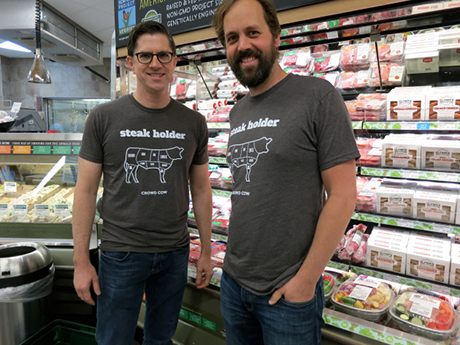
Joe Heitzeberg and Ethan Lowry

Joe Heitzeberg (left) and Ethan Lowry (Kurt Schlosser/GeekWire)

Crowd Cow, a new company launched by UW CSE alum Joe Heitzeberg (B.S., ’05) and fellow startup veteran Ethan Lowry, offers a different kind of meat market—one in which Northwest steak lovers become “steak holders” by crowdsourcing their evening meal.

Unlike typical cattle-sharing arrangements that require a significant investment in freezer space, Crowd Cow enables customers to purchase only the quantity and cuts that they want online, from sources that are committed to sustainable and humane practices. By tapping into the crowdsourcing trend and uniting quality with convenience, the company hopes to transform the way people shop for meat.

From a recent article on GeekWire:

“Crowd Cow removes the mystery by working directly with select Washington ranches that are producing the best possible meat from start to finish. It also brings a high-tech sensibility to the age-old practice of processing and buying meat, taking the crowdsourced funding techniques popular among tech products and non-profit initiatives and applying them to the pasture, instead….

“The first cow, or ‘event’ as they call it, was launched with an email to 100 friends. Six hundred people ended up coming to the site, and Lowry and Heitzeberg knew they were on to something.

“‘We knew the mechanics of crowdfunding as a way to engage an audience and essentially pre-sell something….We’re the only online retailer, that I can find, where you can buy meat and know exactly where it came from, from a variety of ranchers, of the exact cuts and quantity you want,’ Heitzeberg said.”

Read the full GeekWire article here, and check out the KOMO 4 News story here. Read more →

UW researchers shine at CSCW 2016

Our friends at Georgia Tech’s GVU Center prepared an interactive graphic showing the number of papers and authors by organization at the upcoming ACM Conference on Computer-Supported Cooperative Work and Social Computing (CSCW 2016). UW tops the list, with 15 papers at the conference representing contributions from 46 distinct authors—ahead of such heavyweights as Carnegie Mellon, Cornell, MIT and Georgia Tech itself. The variety of submissions involving UW authors illustrates the strength of our collaboration across multiple departments and with outside research organizations, and teams with UW authors earned a total of three Best Paper Awards and three Honorable Mentions.

CSCW

The award-winning paper Boundary Negotiating Artifacts in Personal Informatics: Patient-Provider Collaboration with Patient-Generated Data is  the product of a collaboration between UW CSE professor James Fogarty, HCDE professors and CSE adjuncts Julie Kientz and Sean Munson, HCDE Ph.D. students Chia-Fang Chung and Kristin Dew, Family Medicine professor Allison Cole and physician Jasmine Zia. The paper examines how patients and providers collaborate in the age of patient-generated data enabled by wearable sensors and smartphone apps, and makes recommendations for the future development of personal informatics systems and practices to address privacy concerns and remove barriers to more effective patient-provider collaboration.

Another Best Paper winner, You Get Who You Pay for: The Impact of Incentives on Participation Bias, was co-authored by HCDE professor (and CSE adjunct) Gary Hsieh and HCDE Ph.D. student Rafal Kocielnik. That paper examines how incentives influence who participates in crowdsourced tasks, and how participant self-selection results in different outcomes.

Other CSCW contributors with a UW CSE connection include UW CSE professors Oren Etzioni, Jeffrey Heer and Dan Weld; Ph.D. students Jonathan Bragg and Shih-Wen Huang; and HCDE professors and CSE adjuncts Cecilia Aragon, Daniela Rosner and Kate Starbird (whose papers earned Honorable Mentions) and iSchool professor and CSE adjunct Jacob Wobbrock.

Check out the GVU Center graphic here and explore the complete list of CSCW papers here.

Way to go, everyone! Read more →

Watch, listen and read: UW’s Shwetak Patel and “The Human Face of Big Data”

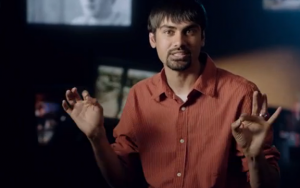
Shwetak Patel in The Human Face of Big DataLast night the new documentary The Human Face of Big Data premiered on PBS. UW CSE and EE professor Shwetak Patel contributed his expertise and insights to the film, which examines how the vast amounts of data collected in our increasingly connected world is changing the way we live and shaping our future. As big data’s big night approached, Patel and executive producer Rick Smolan joined Jeremy Hobson, host of NPR’s “Here & Now,” to talk about the anticipated benefits and potential pitfalls associated with the age of big data.

One of the benefits Patel highlighted was health care. In contrast to the traditional visit to a doctor’s office, where a patient’s vitals are taken and perhaps more tests are ordered to come up with a diagnosis, “Think about what you could do if you could collect physiological information throughout the day, and in non-invasive ways,” he suggested, “and then using artificial intelligence and machine learning to gain some interesting insights about what may happen in the future…to diagnose and predict disease before it’s too late.”

Another topic discussed by the trio was the need for transparency around what data is being collected and how it is being used. Patel agreed that it is a conversation we need to have, and that technology could help broker that. “One of the issues is that people really don’t know what’s possible with the data and what’s actually happening behind the scenes,” he said.

Although on the one hand, many people may react negatively to the concept of big data, Patel noted that they are “voting with their feet” by using the apps and services. “At the end of the day, it’s really the data analytics that’s enabled this whole technology revolution and this new paradigm,” he said.

Listen to the full interview on the NPR website, and watch clips from the documentary online courtesy of PBS. Also check out related coverage on GeekWire and the original book on which the film is based. Read more →

UW’s Passive Wi-Fi named one of the 10 breakthrough technologies of 2016

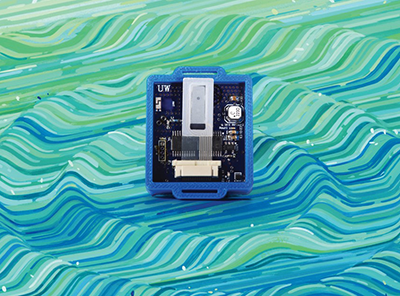
Passive Wi-FiPassive Wi-Fi, a new low-power Wi-Fi communications system developed by researchers at UW CSE and EE, has been named one of MIT Technology Review’s 10 Breakthrough Technologies of 2016. The system, which can generate Wi-Fi transmissions using 10,000 times less power than conventional methods, was developed in UW CSE professor Shyam Gollakota’s Networks & Mobile Systems Lab by a team that includes EE graduate students Bryce Kellogg and Vamsi Talla and joint UW CSE and EE professor Joshua Smith.

From the article:

“Even the smallest Internet-connected devices typically need a battery or power cord. Not for much longer. Technology that lets gadgets work and communicate using only energy harvested from nearby TV, radio, cell-phone, or Wi-Fi signals is headed toward commercialization. The University of Washington researchers who developed the technique have demonstrated Internet-connected temperature and motion sensors, and even a camera, powered that way….

“One version of the University of Washington technology, dubbed passive Wi-Fi, is being commercialized through a spin-off company, Jeeva Wireless. It lets battery-free gadgets connect with conventional devices such as computers and smartphones by backscattering Wi-Fi signals. In tests, prototype passive Wi-Fi devices have beamed data as far as 100 feet and made connections through walls.”

A UW News release explains how the team decoupled the digital and analog operations involved in transmitting the signals, assigning the power-intensive analog functions to a single device plugged into a wall. Passive sensors can then produce Wi-Fi packets using very little energy by reflecting and absorbing the signal using a digital switch—enabling communication with any Wi-Fi-enabled device straight out of the box.

“‘We wanted to see if we could achieve Wi-Fi transmissions using almost no power at all,’ said co-author Shyam Gollakota…’That’s basically what Passive Wi-Fi delivers. We can get Wi-Fi for 10,000 times less power than the best thing that’s out there….’

“Aside from saving battery life on today’s devices, wireless communication that uses almost no power will help enable an ‘Internet of Things’ reality where household devices and wearable sensors can communicate using Wi-Fi without worrying about power.”

The team will present its research paper on Passive Wi-Fi at the NSDI 2016 conference next month.

Read the MIT Technology Review article here. Read the UW news release here, and watch our video demonstrating Passive Wi-Fi here. Also check out some of the great coverage of this story by the Seattle Times, Wired, Ars TechnicaPC World, GizmodoGeekWire and local ABC affiliate KOMO 4 News.

Image: MIT Technology Review Read more →

UW CSE’s Emina Torlak, Mike Cafarella, Roxana Geambasu win Sloan Research Fellowships

Emina Torlak

Emina Torlak

UW CSE professor Emina Torlak and Ph.D. alums Mike Cafarella and Roxana Geambasu were recognized by the Alfred P. Sloan Foundation today with Sloan Research Fellowships. Recipients of these prestigious awards are nominated by their peers and selected by the foundation based on their early-career research accomplishments and for showing outstanding promise of making fundamental contributions to their fields.

From the Sloan Foundation news release:

“‘Getting early-career support can be a make-or-break moment for a young scholar,’ said Paul L. Joskow, President of the Alfred P. Sloan Foundation. ‘In an increasingly competitive academic environment, it can be difficult to stand out, even when your work is first rate. The Sloan Research Fellowships have become an unmistakable marker of quality among researchers. Fellows represent the best-of-the-best among young scientists.'”

Mike Cafarella

Mike Cafarella

Torlak is a member of our Programming Languages & Software Engineering (PLSE) group and develops tools and programming models for computer-aided design, verification and synthesis of software. She was recently named the winner of the 2016 junior AITO Dahl-Nygaard Prize, an award that recognizes an early-career researcher who demonstrates exceptional potential in the area of programming and simulation. Torlak becomes one of 20 current UW CSE faculty members who have held one of these prestigious fellowships.

Cafarella is on the faculty of University of Michigan. His research focuses on databases, information extraction, data mining and data integration. He completed his UW CSE Ph.D. in 2009 working with professors Dan Suciu and Oren Etzioni.

Geambasu is a professor at Columbia University. Her research spans distributed systems, operating systems, databases, security and privacy. She completed her UW CSE Ph.D. in 2011 working with professors Hank Levy and Yoshi Kohno.

Roxana Geambasu

Roxana Geambasu

The Sloan Foundation awards a total of 126 fellowships each year to early-career researchers across the United States and Canada, based on nominations from their fellow scientists, spread across eight fields: chemistry, computer science, economics, mathematics, computational and evolutionary molecular biology, neuroscience, ocean sciences and physics. 16 were awarded this year in computer science.

Read the complete list of 2016 fellowship recipients here, the Sloan Foundation press release here and the UW News release here.

Congratulations, Emina, Mike and Roxana! Read more →

« Newer PostsOlder Posts »