
When it comes to cybersecurity, UW student team is full of tricks

Ghost in the machineAs National Cyber Security Awareness Month draws to a close, we thought we would treat you to some news on Batman’s Kitchen, UW’s frightfully good team of undergraduate hacking heroes who are preparing once again to battle the virtual bad guys. The team — CSE’s Alex Kirchhoff and Bo Wang, Dan Arens of Atmospheric Sciences, and Stanley Hsieh of Physics — will compete in the finals of the Capture the Flag competition hosted by New York University next month.

CTF is the flagship event of the Cyber Security Awareness Week conference (CSAW ’16), the largest student-run cybersecurity event in the nation. Batman’s Kitchen joins 14 other university teams at the U.S. finals, where they will compete onsite November 10-12 simultaneously with students from around the world gathered at NYU Abu Dhabi and the Indian Institute of Technology Kanpur. The members of Batman’s Kitchen and their fellow finalists bested a pool of more than 2,000 teams from 109 countries for a chance to compete for the big prize—not to mention some serious cybersecurity bragging rights.

This is the second year in a row that the UW team, which is advised by CSE staffer Melody Kadenko and is currently ranked among the top one percent of CTF teams in the world, has progressed to the finals of CSAW. Based on their achievements to date, it is clear that the members of Batman’s Kitchen have a few tricks up their sleeves.

Good luck at the finals, Alex, Bo, Dan and Stanley! Read more →

UW CSE and AI2 in the New York Times: “Artificial intelligence at your fingertips”

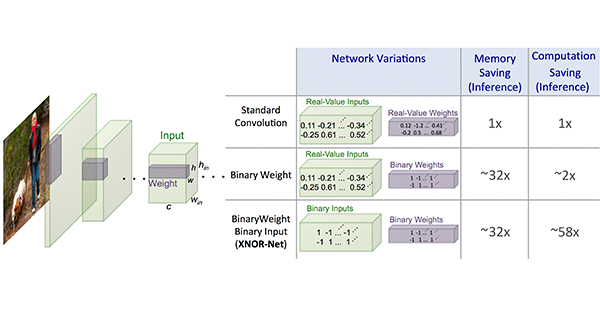
XNOR diagramThe New York Times published an article over the weekend exploring recent advances in approximate computing in response to a slowdown in Moore’s Law. In the article, UW CSE professor Ali Farhadi, who splits his time between campus and Allen Institute for Artificial Intelligence, shared the results of work with CSE Ph.D. student Joe Redmon and his AI2 colleagues, Mohammad Rastegari and Vicente Ordóñez, to develop efficient variations of convolutional neural networks for object recognition and detection.

From the article:

“Ali Farhadi holds a puny $5 computer, called a Raspberry Pi, comfortably in his palm and exults that his team of researchers has managed to squeeze into it a powerful program that can recognize thousands of objects.

“Dr. Farhadi…calls his advance ‘artificial intelligence at your fingertips.’ The experimental program could drastically lower the cost of artificial intelligence and improve privacy because you wouldn’t need to share information over the internet.

“But the A.I. system is emblematic of something even more significant for the microelectronics industry as it inches closer to the physical limits of semiconductors made with silicon: It uses 1/32 of the memory and operates 58 times as fast as rival programs.”

The UW CSE-AI2 team’s approximations, Binary-Weight Networks and XNOR-Networks, demand significantly less memory and computational power than standard CNN-based systems but were shown to be highly accurate in natural image classification. Because of this mix of efficiency and accuracy, they could be used to build state-of-the-art recognition systems into portable and wearable devices — which would be a boon for developers of new virtual reality and augmented reality applications. The team revealed its work at the European Conference on Computer Vision (ECCV 2016) in Amsterdam earlier this month.

Read the full article here, and the team’s research paper here. Also see our previous blog coverage of the collaboration between UW CSE and AI2 featuring ImSitu here and GeoS here. Read more →

UW CSE’s Will Strimling combines a passion for data and politics at FiveThirtyEight

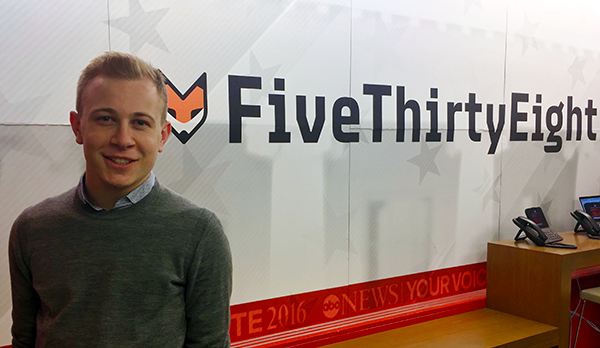
Will Strimling at FiveThirtyEightWill Strimling is a UW CSE undergraduate with a passion for data visualization and politics. This quarter, he has taken a break from hitting the books for an opportunity to work as a Visual Journalism Intern with Nate Silver’s FiveThirtyEight, one of the most influential sites for analysis of the 2016 election. If you are following the race for the Oval Office — and like the proverbial car wreck, who could look away? — you have probably seen some of Will’s charts and interactives.

Kicking off a new feature of the blog in which we interview students with interesting stories to share, we bring you the CSE Undergrad Spotlight, election edition.

CSE: Why did you choose to study computer science?

WS: I believe the invention and application of new technologies is the largest instigator of socio-political change — and because I’m interested in creating things that might have a meaningful impact on society, learning to create technology made sense. Computer science teaches methods for constructing tools through programming, but more importantly provides new lenses and paradigms through which one can reason about the world and solve problems. I think of computer science as the perfect bridge between quantitative methods, engineering, and philosophy — which is a good fit for my interests.

CSE: Why did you decide to intern at FiveThirtyEight?

WS: It allows me the unique opportunity to contribute to important, widely read journalism work during the precarious 2016 presidential election, to learn from some of the best in data visualization, and of course to apply some of what I’ve learned in class and while working on tools in CSE’s Interactive Data Lab.

CSE: What are your responsibilities as an intern?

WS: I help build the larger interactives found on the site for predicting the upcoming election, sports, etc. I also work on static charts for use in everyday articles, and the tools used internally to generate them.

CSE: What is your favorite project you have worked on so far?

WS: One of the charts I created appeared on the Daily Show, which I thought was pretty cool. I really like seeing my work enjoyed, especially when it brings about meaningful discussions.

CSE: How has UW CSE inspired you and helped prepare you for your role at FiveThirtyEight?

The work and achievements of the Interactive Data Lab, where I have helped out a bit over the last year, has definitely had the greatest impact on me and is part of the reason I came to the UW! Professor Jeff Heer‘s Data Visualization class and working in the lab with Ph.D. students Dominik Moritz and Kanit Wongsuphasawat turned me on to new ways of thinking that have continued to have an impact on my studies and my work. This experience inspired me to work on data visualization projects and tools both this summer at Harvard and this fall at FiveThirtyEight — I can’t get enough. I greatly look forward to pursuing this interest further and deepening my involvement with the lab. They have been great teachers and role-models.


Check out some of Will’s work on the FiveThirtyEight blog here, and don’t forget to vote! Read more →

UW CSE’s Annie Ross excels in ACM Student Research Competition

Annie Ross onstage at the Grace Hopper CelebrationUW CSE Ph.D. student Annie Ross earned second place in the graduate student category of the ACM Student Research Competition at the Grace Hopper Celebration of Women in Computing last week. In her poster titled “Enhancing the Accessibility of Mobile Apps,” Ross presented research aimed at enabling third parties to repair and enhance accessibility of mobile applications.

While Ross’ work focuses primarily on mobile apps for people who are blind or low-vision, it involves techniques that can be applied more broadly to improve accessibility for a variety of users. Ross undertook the project in collaboration with fellow Ph.D. student Xiaoyi ZhangAnat Caspi of UW CSE’s Taskar Center for Accessible Technology, CSE professor James Fogarty, and iSchool professor Jacob Wobbrock.

Ross was recognized for her achievement in front of thousands of GHC participants assembled at the Toyota Center arena in Houston, Texas. An estimated 15,000 people attended this year’s conference, which is the largest gathering of women in computing in the world. The ACM Student Research Competition provides an opportunity for students to present original research at ACM-sponsored conferences.

Way to go, Annie! Read more →

Engineers want to turn your living room into a wireless charging station

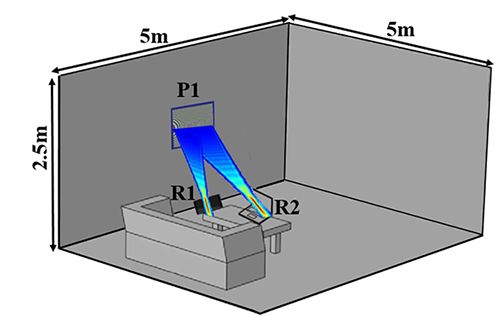
Wireless power transfer schematicA team of engineers from the UW, Duke University, and Intellectual Ventures’ Invention Science Fund has moved a step closer to liberating us from those pesky power cords and bulky battery chargers. In a paper posted on arXiv, the researchers explain how flat-screen technology could be used to build a wireless power transfer system right into a wall or ceiling that is capable of efficiently charging a variety of devices in a room.

According to UW CSE and Electrical Engineering professor Matt Reynolds, “There is an enormous demand for alternatives to today’s clunky charging pads and cumbersome cables, which restrict the mobility of a smart phone or a tablet. Our proposed approach takes advantage of widely used LCD technology to seamlessly deliver wireless power to all kinds of smart devices.”

Reynolds and his colleagues propose a flat, reconfigurable antenna made of metamaterial that would gather and focus electromagnetic energy to recharge devices within its line of sight. Unlike existing, magnetic near-field systems, this new approach would not require close proximity to a charging station in order to achieve efficient power transfer.

“The ability to safely direct focused beams of microwave energy to charge specific devices, while avoiding unwanted exposure to people, pets and other objects, is a game-changer for wireless power,” Reynolds said. “And we’re looking into alternatives to liquid crystals that could allow energy transfer at much higher power levels over greater distances.”

In addition to Reynolds, the research team includes David Smith, Vinay Gowda, Okan Yurduseven, Stéphane Larouche and Yaroslav Urzhumov of Duke University’s Center for Metamaterials and Integrated Plasmonics, and Guy Lipworth of Intellectual Ventures.

Read the UW news release here and the research paper here. Read more →

UW CSE’s Thomas Rothvoss profiled in UW Today

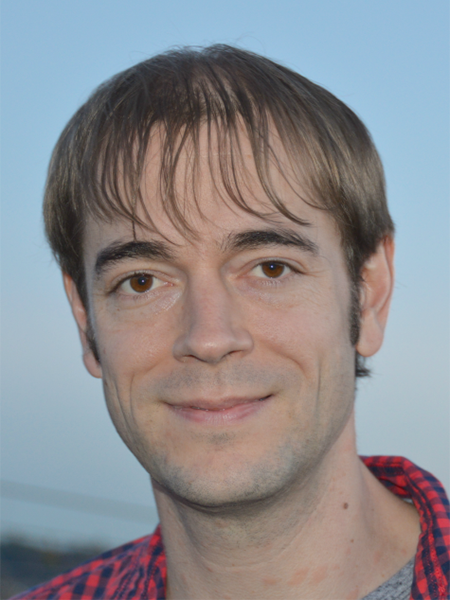
Thomas RothvossUW Today has published a great article on newly-minted Packard Fellow Thomas Rothvoss, a professor in UW CSE’s Theory group and the UW Department of Mathematics. In it, Rothvoss explains how his research at the intersection of computer science and mathematics aids in the design of more efficient algorithms for analyzing complex datasets — and how the fellowship will aid him in advancing this research working alongside his students.

From the article:

“‘This is really a problem of optimization,’ said Rothvoss. ‘Let’s say you have a lot of objects of different weights and sizes — and boxes to pack them in. You want to optimize the packing process, grouping the objects into the smallest number of boxes as possible as quickly as possible.’

“It could be possible to write an algorithm to perform this calculation and produce a plan for packing the objects in boxes, Rothvoss said. But, the scenario is so complex that the algorithm would be sluggish and inefficient.

“‘A better approach is to recognize these limitations and come up with algorithms that approximate an ideal answer,’ said Rothvoss. ‘Find an efficient algorithm that gets you close to that optimum. That’s my specialty.'”

The Packard Fellowship is designed to enable early-career researchers like Rothvoss to focus on his research and to take risks. From the sounds of it, he plans to take full advantage of the freedom that comes with the award.

“‘Basically, this means for the next five years that I can spend less time writing grants and more time doing research with my students,’ said Rothvoss. ‘And that is wonderful news.'”

Read the full story here, and read our previous blog coverage here.

Congratulations again to Thomas on this fantastic achievement! Read more →

Seattle Times: Job recruiters work to woo UW computer science students

Zillow recruiters talk to students at UW CSE“Daphna Khen happily described her normal workday to a prospective Zillow job candidate Thursday at the University of Washington …

“Yes, there are many opportunities to learn different skills. Senior engineers offer ‘office hours,’ and everyone Khen asks is happy to help out troubleshooting any issue.

“Job seekers at the Computer Science and Engineering (CSE) recruiting fair generally don’t ask Khen about salary or vacation days or health benefits. They’re more interested in how she likes her job and the projects she works on.

“Many know their degrees all but guarantee them a job with high pay and good perks, but they really want to know if they’ll like it.

“Hundreds of UW computer science students attended the packed recruiting fair Thursday, one of two this week where companies set up colorful booths to market their job openings.”

Read the full article here.

Photo credit: Johnny Andrews/The Seattle Times Read more →

It’s UW CSE’s autumn recruiting day for established companies!

recruitingThank goodness the fire marshal is otherwise occupied!

Many thanks to the companies recruiting today, and on Tuesday. And thanks to our Industry Affiliates and local alums for the great turnout at our Open House on Wednesday evening. (See our previous post about the Madrona Prize and People’s Choice Award.) Read more →

Madrona and UW CSE recognize student innovation

Matt McIlwain, Mehrdad Hessar, Hank Levy, Ed Lazowska

Mehrdad Hessar accepts the 2016 Madrona Prize

Each year as part of our Industry Affiliates meeting, UW CSE welcomes alumni and friends to a celebration of student research and its potential for impact. Our annual open house, which was held last night, features good food, great company, and terrific posters and demos that showcase an impressive variety of projects from the CSE labs.

The event also features the Madrona Prize, an award from our friends at Madrona Venture Group that recognizes student research with commercialization potential, and the People’s Choice Award, which is, as the name suggests, a chance for our guests to select their favorite projects.

Matt McIlwain of Madrona awarded the 11th annual Madrona Prize to “The Next Big Leap in Backscatter Communication,” presented by CSE postdoc Vamsi Talla. This project builds on previous backscatter research in the Networks & Mobile Systems Lab that enables battery-free devices to communicate by pulling power out of the air.  The team, which also includes EE Ph.D. students Mehrdad Hessar and Bryce Kellogg, CSE professor Shyam Gollakota, and CSE and EE professor Josh Smith, demonstrates with its latest project that backscatter can work over distances of up to 1 kilometer, with potential applications in agriculture, home sensing, and smart medical devices.

Below is a complete run-down of the award winners and runners up who were recognized during last evening’s festivities.

2016 Madrona Prize

Winner: The Next Big Leap in Backscatter Communication (Electrical Engineering Ph.D. students Mehrdad Hessar and Bryce Kellogg; CSE postdoc Vamsi Talla; CSE professor Shyam Gollakota; CSE and EE professor Josh Smith)

Runner up: PipeGen: Data Pipe Generator for Hybrid Analytics (CSE Ph.D. student Brandon Haynes; CSE professors Alvin Cheung and Magda Balazinska)

Runner up: Just Say NO to Paxos Overhead: Replacing Consensus with Network Ordering (CSE Ph.D. students Jialin Li, Ellis Michael, Naveen Kr. Sharma, and Adriana Szekeres; CSE professor Dan R. K. Ports)

Runner up: Programming by Examples for Industrial Data Wrangling (CSE Ph.D. student Alex Polozov; Sumit Gulwani and the PROSE team at Microsoft)

Yasaman S. Sefidgar

Yasaman S. Sefidgar explains her research at the open house

2016 People’s Choice Award

Winner: Situated Tangible Robot Programming (CSE researcher Yasaman S. Sefidgar; EE undergraduate Prerna Agarwal; CSE professor Maya Cakmak)

Runner up: When the White Coats Leave: Unsupervised Decoding of Long-term, Naturalistic Human Neural Recordings with Automated Video and Audio Annotations (CSE Ph.D. student Nancy Xin Ru Wang; Jeff Ojemann of Seattle Children’s Hospital; UW CSE professors Ali Farhadi and Rajesh Rao; UW biology professor Bing Brunton)

Runner up: TummyTrials: Using Self-Experimentation to Detect Individualized Food Triggers (CSE Ph.D. students Ravi Karkar, Jessica Schroeder, and Daniel Epstein; CSE postdoc Laura Pina; CSE staff member Jeffrey Scofield; CSE professor James Fogarty; HCDE professors Julie Kientz and Sean Munson; Duke University professor Roger Vilardarga; Jasmine Zia of UW Medicine)

Read Madrona’s press release here, and check out the complete list of posters and demos here. Congratulations to all of our winners, and huge thanks to our friends at Madrona and to all of our alumni and friends who came out to support student research! Read more →

Popular Science selects DNA data storage as “Best of What’s New” in 2016

DNA imageResearchers in the Molecular Information Systems Lab, a partnership between the UW and Microsoft Research, have been recognized for their efforts to develop a DNA-based data storage system with a “Best of What’s New” Award from Popular Science. The annual awards highlight the game-changing technologies that will shape the future. The MISL team — led by UW CSE professor Luis Ceze, CSE and EE professor Georg Seelig, and Microsoft researchers Karin Strauss and Doug Carmean — won in the software category for having set a new world record for the amount of digital data successfully stored and retrieved using strands of DNA.

This is not the first time a UW CSE project has been recognized: last year, UW CSE and EE researchers earned a Best of What’s New Award for Power Over Wi-Fi (PoWiFi) in the engineering category.

Read about the latest award winners in Popular Science here and the UW Today story here. Learn more about the DNA data storage project by visiting the MISL website here.

Congratulations to the entire MISL team! Read more →

« Newer PostsOlder Posts »