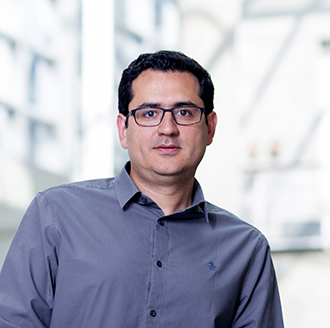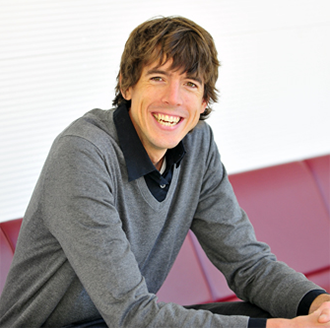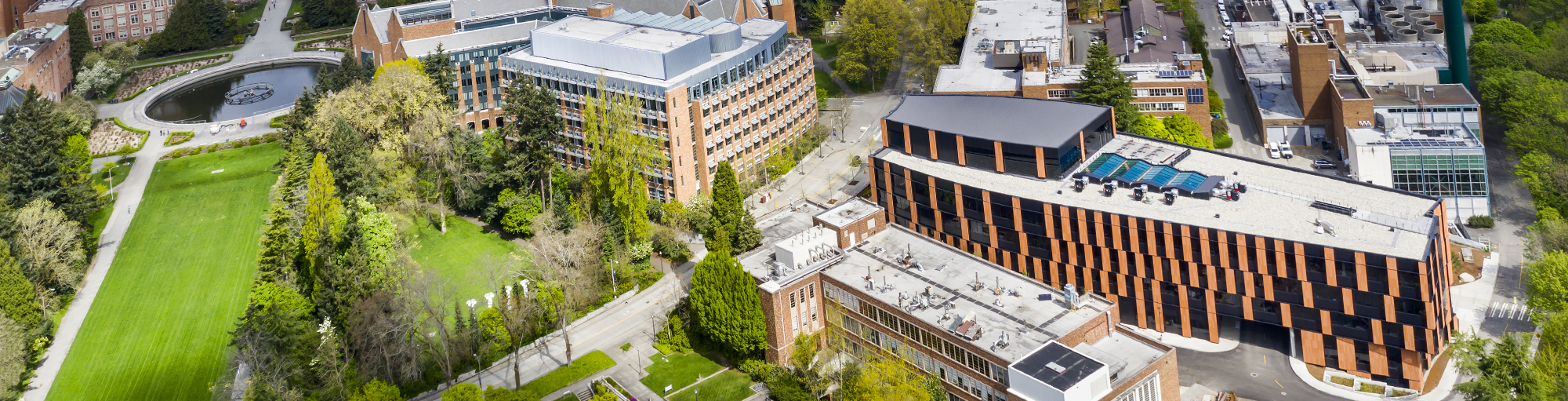
Six Allen School faculty members win NSF CAREER Awards

National Science Foundation logoThe Paul G. Allen School at the University of Washington is celebrating an unprecedented total of six NSF CAREER Awards earned by faculty members in 2017. The National Science Foundation Faculty Early Career Development Program is the agency’s most prestigious category of awards and is designed to recognize and support junior faculty who exemplify the role of teacher-scholars and successfully integrate education and research. The six recipients are engaged in research that will advance core and emerging areas, with projects focused on theory, data management, programming languages, security and privacy, computer vision, and human-computer interaction. But the impact of their work will extend far beyond the field of computing. Through the development of new principles, tools and processes, they are laying the foundation for future advances in health care, transportation, education, and more.


Alvin Cheung: Improving database management for real-world applications

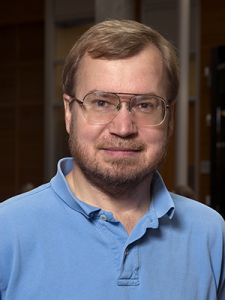
Alvin CheungProfessor Alvin Cheung works with the Database and Programming Languages & Software Engineering (PLSE) groups on research into program analysis, program synthesis, and building large-scale data management systems. He earned a CAREER Award for his proposal “Generating Application-Specific Database Management Systems” to automate the process of domain specialization in database management systems (DBMSs). Cheung will leverage recent advances in programming systems and data management to build tools that automatically understand database application semantics — streamlining what is currently a complex and error-prone process to improve a variety of applications that rely on DBMSs, from banking, to social media, to scientific discovery.

Cheung will make the tools he develops and the data he gathers on the performance of real-world database applications publicly available for the benefit of other researchers and practitioners in the field, and some of his preliminary results will appear in upcoming data management and programming systems conferences this year.


Ali Farhadi: Enhancing computers’ understanding of the visual world
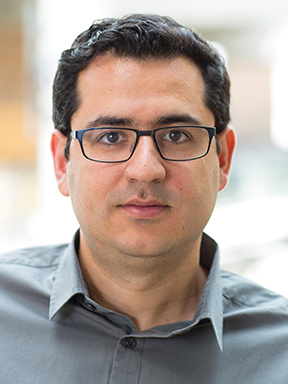
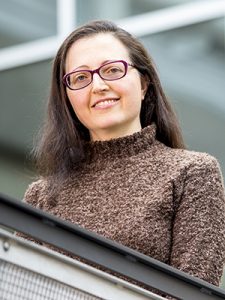
Ali FarhadiAli Farhadi is a professor in the Allen School’s Graphics & Imaging Laboratory (GRAIL), where his research spans computer vision and machine learning, and a senior research manager at the Allen Institute for Artificial Intelligence in charge of Project Plato. Farhadi received a CAREER Award for “Active and Action-Centric Visual Understanding,” a project that will enable computers to develop a more human-like understanding of actions and their consequences in order to improve their ability to plan and perform tasks. Farhadi aims to create a framework that supports active visual understanding accompanied by new data sets and algorithms that address several fundamental challenges at the intersection of computer vision and artificial intelligence.

Farhadi’s work will open up new research directions in computer vision, robotics, and AI while enabling real-world applications in areas such as health care, elder care, education, and entertainment.


Katharina Reinecke: Creating culturally-aware user interfaces, driven by data
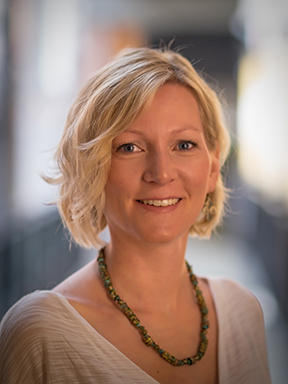
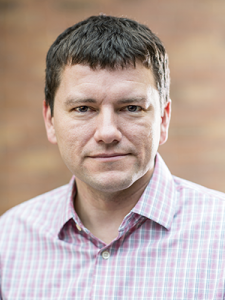
Katharina ReineckeProfessor Katharina Reinecke is a researcher in human-computer interaction and co-founder of LabintheWild, a virtual lab for conducting large-scale behavioral studies online to understand how people’s interactions with technology are influenced by cultural background, demographics, and geography. She won a CAREER Award for her proposal “Data-Driven User Interface Designs for Culturally Diverse Groups,” in which she will use data collected through LabintheWild to develop new guidelines and tools for the development of culturally-specific web interfaces. Reinecke will analyze data comparing human perception among users in at least 30 countries in order to produce a set of best practices for user interface designers and create predictive models and other tools that will support the automated adaptation of web interfaces for different groups of users.

Through this work, Reinecke will increase access to technology and user satisfaction among people of varied backgrounds while contributing vital new knowledge in the realms of visual perception, cultural psychology, adaptive interfaces, and human-computer interaction.


Franziska Roesner: Promoting safety and security for users of augmented reality
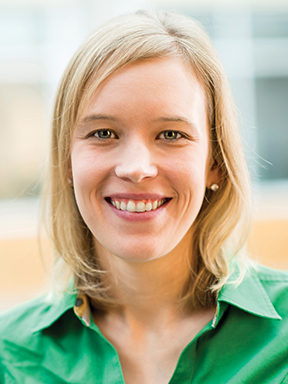
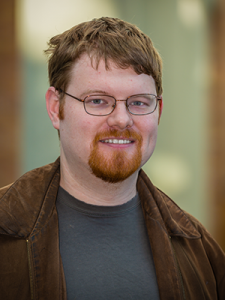
Franziska RoesnerProfessor Franzi Roesner is co-director of the Allen School’s Security and Privacy Research Lab. She has devoted her early career to analyzing and developing solutions for security and privacy risks associated with existing and emerging technologies, considering both system design and human factors. With her CAREER Award “Towards Secure Augmented Reality Platforms,” Roesner is setting out to explore a new frontier in security, privacy, and safety for end users. Augmented reality (AR) is on the verge of widespread commercial viability for a range of applications, from entertainment to transportation, but the overlay of digitally generated audio, visual, and haptic feedback on users’ perception of the physical world could make these technologies vulnerable to malfunctioning or malicious outputs.

Roesner’s research will identify potential risks associated with AR technologies and offer a strong technical foundation to guide the industry in developing AR platforms that combine rich functionality with strong safeguards for users — ensuring that people are able to enjoy the benefits of AR while mitigating risks to their privacy and security.


Thomas Rothvoss: Designing new algorithms for intractable problems
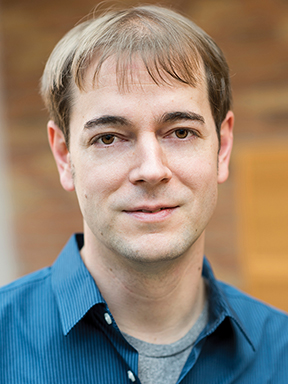
Thomas RothvossThomas Rothvoss is a professor in the Allen School’s Theory group with a joint appointment in the UW Department of Mathematics. He received a CAREER Award for his proposal “Approximation Algorithms via SDP Hierarchies,” which aims to design new and better approximation algorithms to address several well-known, outstanding problems in combinatorial optimization, including the Directed Steiner Tree, Graph Coloring, Unique Games, and Unrelated Machine Scheduling problems. The new algorithms will be based on the Lasserre semidefinite programming hierarchy — a hierarchy that remains poorly understood outside of theoretical computer science circles. The implications of Rothvoss’ research and teaching will extend far beyond his own field.

In tackling these fundamental problems of computation, Rothvoss is also tackling the problem of how to efficiently process and extract value from vast quantities of data — one of the most pressing issues facing the scientific community and a host of other industries.


Emina Torlak: Simplifying verification and synthesis to build better software

Emina TorlakProfessor Emina Torlak focuses on the development of new programming languages and tools for software verification, synthesis, and computer-aided design as a member of the Allen School’s PLSE group. She received a CAREER Award for her project “The Next 700 Solver-Aided Languages,” which proposes a novel approach to programming that involves automating domain-specific languages (DSLs) with solver-aided tools for verification and synthesis. Such tools help developers build better software more easily, by finding critical bugs in existing code and creating new code that is bug-free and performant by construction. Typically, tools for verification and synthesis must be hand-crafted and hand-tuned by computer scientists — a laborious process requiring expertise in many fields. Torlak aims to simplify this process and enable experts and non-experts alike to quickly build, profile, and optimize solver-aided tools.

Torlak’s research will extend the benefits of solver-aided programming to facilitate the creation of new software applications in a variety of domains, from scientific research, to health care, to education.


This latest round of CAREER Awards brings the Allen School’s total to nine awards in just two years, following wins by Maya Cakmak (robotics), Su-In Lee (computational biology), and Shayan Oveis Gharan (theory) in 2016. A total of 38 current Allen School faculty have been recognized with a CAREER Award or its predecessor, the Presidential/NSF Young Investigator Award. Our performance in this competition and in the Presidential Early Career Awards (PECASE) program — in which professors Emily Fox, Shwetak Patel and Luke Zettlemoyer were recent honorees — demonstrates the strength of our rising young faculty in setting the future direction of computer science education and research.

Congratulations to Alvin, Ali, Katharina, Franzi, Thomas and Emina! Read more →

Allen School’s Tom Anderson elected to the American Academy of Arts & Sciences

Tom AndersonAllen School professor and Ph.D. alum Tom Anderson has been elected a member of the American Academy of Arts & Sciences, one of the nation’s oldest and most esteemed learned societies focused on advancing knowledge, scholarship, and civic discourse. Anderson, who holds the Warren Francis and Wilma Kolm Bradley Chair in Computer Science & Engineering at UW, is one of only seven computer scientists elected this year out of 228 new members drawn from the biological and physical sciences, mathematics, social sciences, business, government, humanities, and the arts.

The Academy seeks out the most accomplished scholars, artists and contributors to civic life for membership. Anderson has made numerous, fundamental contributions to the field of computing in a research career that spans more than 25 years and has yielded more than 20 award papers. Anderson’s work has advanced a variety of important areas, including operating systems, distributed systems, computer networks, multiprocessors, and security. Recently, he has turned his attention to improving the performance of communication-intensive data center applications.

Anderson and his fellow 2017 inductees, including UW Chemistry professor Karen Goldberg, will be officially welcomed to the Academy at a ceremony in Cambridge, Massachusetts in October. They are set to join such rarefied company as Thomas Jefferson, Alexander Graham Bell, Ralph Waldo Emerson, and Georgia O’Keefe — and Allen School colleagues Susan Eggers, Anna Karlin, and Ed Lazowska — as members.

This latest honor follows Anderson’s induction last year into the National Academy of Engineering — one of the highest professional honors bestowed upon an engineer — as well as an impressive string of previous awards and recognition that includes the IEEE Koji Kobayashi Computers & Communication Award, the USENIX Lifetime Achievement Award, and election as a Fellow of the Association for Computing Machinery.

Read the Academy press release here, and view the complete list of 2017 inductees here. Read the UW News release here.

Congratulations, Tom! Read more →

Allen School undergraduates recognized in the Husky 100

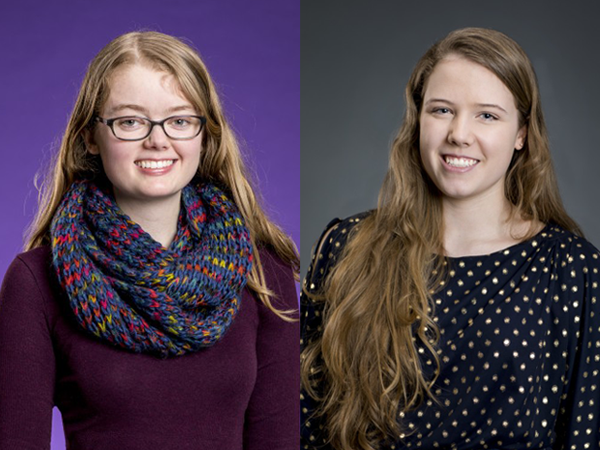
Kelsie Haakenson and Camille Birch

Kelsie Haakenson (left) and Camille Birch

Allen School undergraduates Camille Birch and Kelsie Haakenson have been selected as members of the 2017 class of the Husky 100. The Husky 100 program recognizes students from across the three UW campuses who are making the most of their Husky experience while making a difference on campus and in their communities through discovery, leadership, and a commitment to inclusivity.

Camille Birch is a senior from Woodinville, WA pursuing degrees in bioengineering and computer science. After developing an interest in neuroscience as a freshman, she joined UW Physiology & Biophysics professor Eberhard Fetz’s lab as an undergraduate researcher focused on brain-computer interfaces and functional connectivity. Birch has earned a number of awards for her work, including a Washington Research Foundation Innovation Fellowship from the UW Institute for Neuroengineering. She also was named a Levinson Emerging Scholar for her research in cross-cortical connectivity and prefrontal cortex control of brain-computer interfaces using the NeuroChip-3.

In addition to her passion for research, Birch is committed to fostering inclusivity in her chosen fields, guided by the belief that “the scientific community should be as diverse as the communities for which we do research.” After completing her bachelor’s, Birch plans to enroll in an M.D./Ph.D. program in neural engineering in the hopes of using her research to advance rehabilitative medicine.

Kelsie Haakenson, also from Woodinville, is a senior double-majoring in history and computer science with a minor in French. Computer science didn’t factor into her plans when she first arrived at UW. But after working as an intern on the Newbook Digital Texts project and teaching herself the Python programming language, Haakenson decided to combine her love of the humanities and newfound interest in computer science. Since then, she applied and was accepted into the Allen School, spent a semester polishing her language skills at the Université de Nantes in France, and completed software engineering internships at Adobe and Socrata.

“Throughout my education, I have connected the dots between my studies and experiences, be it my research in history, projects in computer science, or language studies in French,” Haakenson said. After graduation, she hopes to pursue a career in digital history and make primary sources — like those she worked with as part of the Newbook Digital Texts project — accessible to more people through online publishing.

Read more about the Husky 100 Class of 2017 here. And check out our students in the inaugural Husky 100 Class of 2016 here.

Congratulations, Camille and Kelsie! Read more →

Allen School’s Shyam Gollakota wins 2017 SIGMOBILE RockStar Award

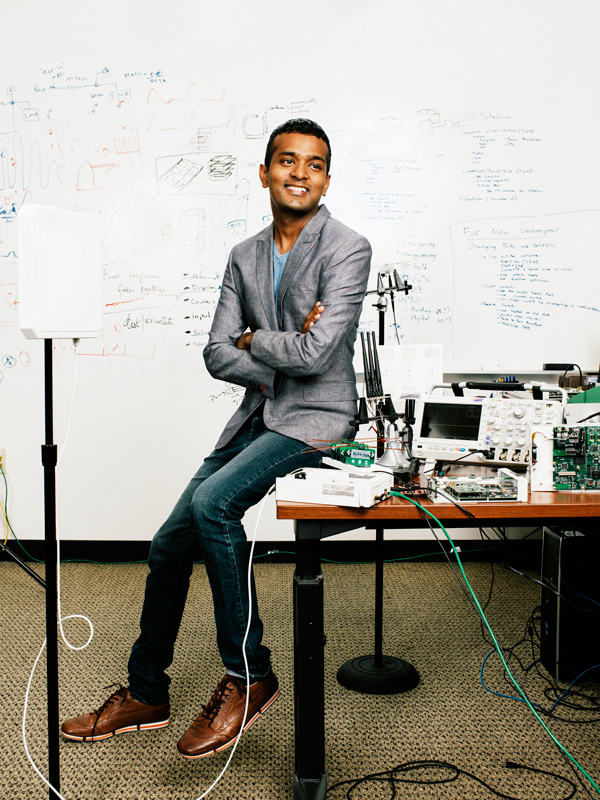
Shyam GollakotaProfessor Shyam Gollakota, who is widely known for his pioneering work on ambient backscatter as leader of the Allen School’s Networks & Mobile Systems Lab, has been named the winner of the 2017 SIGMOBILE RockStar Award. The award, which was voted on by a committee of his peers and senior researchers in the mobile computing community, acknowledges Gollakota’s outstanding early-career contributions and the depth, novelty and impact of his research.

Since he joined the Allen School faculty in 2013, Gollakota has earned international recognition for his groundbreaking work on backscatter technology that allows battery-free devices to draw power and communicate using wireless signals already present in the air. He and his collaborators have used backscatter to enable a variety of novel applications, from connected contact lenses to smart fabrics. Along the way, Gollakota and his team have earned multiple Best Paper awards from leading conferences such as SIGCOMM and NSDI, and their Passive Wi-Fi project was named one of the 10 breakthrough technologies of 2016 by MIT Technology Review. They have since established a startup company, Jeeva Wireless, to commercialize their research.

Gollakota will be recognized by SIGMOBILE at the MobiCom 2017 conference in Snowbird, Utah in October.

We have always regarded Shyam as a rock star — now it’s official! Congratulations, Shyam! Read more →

Allen School students excel in NSF Graduate Research Fellowship competition

Photos of Allen School students recognized by NSFEvery year, the National Science Foundation highlights outstanding graduate student research in science, technology, engineering and mathematics through its Graduate Research Fellowship Program — and every year, our students’ performance in this competition confirms the Allen School as one of the nation’s top destinations for promising young researchers in the computing fields. In the latest round, nine Allen School students were recognized by NSF, including seven graduate students and two undergraduates.

The competition for these fellowships is intense: More than 13,000 students from 449 baccalaureate-granting institutions applied for a total of 2,000 awards. Five Allen School students were among the recipients in the “Comp/IS/Eng” category:

Ellis Michael, a Ph.D. student working in the Computer Systems Lab with professors Tom Anderson and Dan Ports, received an award for computer systems and embedded systems research.

Leah Perlmutter, a Ph.D. student advised by professor Maya Cakmak in the Human-Centered Robotics Lab, received an award in human-robot interaction.

Anne Spencer Ross, a Ph.D. student working with professor James Fogarty on making mobile applications accessible to people with disabilities, received an award in human computer interaction.

John Thickstun, a Ph.D. student co-advised by Allen School professor Sham Kakade and Statistics professor Zaid Harchaoui, received an award for machine learning research.

Darby Losey, who worked with Allen School professor Raj Rao in the Neural Systems Lab while earning his bachelor’s in computer science and neurobiology, received an award for research in brain-computer interfaces. He is currently a researcher at the UW’s Institute for Learning & Brain Sciences (I-Labs).

In addition to the fellows, four more Allen School students were recognized by NSF with honorable mentions: Ph.D. students Martin Kellogg, Rahul Nadkarni and Isaac Tian, and undergraduate Nate Yazdani. Kellogg is a member of the Programming Languages & Software Engineering (PLSE) group, working with professor Michael Ernst; Nadkarni works with professor Emily Fox on machine learning research; and Tian works with professor Brian Curless in the Graphics & Imaging Laboratory (GRAIL). Yazdani, who is double-majoring in computer science and mathematics, works with Allen School professor Ras Bodik of PLSE.

NSF has been very good to Allen School students through the Graduate Research Fellowship Program. Over the past three years alone, the agency has recognized 33 of our most promising student researchers with awards or honorable mentions — an impressive achievement and one of which we are extremely proud.

Read the 2017 announcement here, and learn more about the program here.

Congratulations to all! Read more →

University of Washington establishes the Paul G. Allen School of Computer Science & Engineering

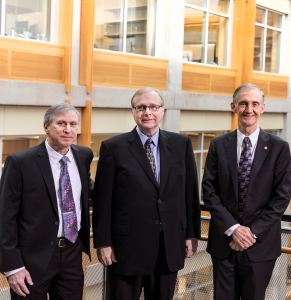
Hank Levy, Paul Allen, and Ed Lazowska

Hank Levy, Paul Allen, and Ed Lazowska

Dear Friends of CSE,

A few minutes ago – in an extraordinary launch to our 50th Anniversary year – the University of Washington Board of Regents approved the establishment of the Paul G. Allen School of Computer Science & Engineering. The elevation of UW CSE’s status from a department to a school signifies our increasing prominence on the campus, in the region, and around the world. Becoming a school also positions us to have even greater impact through our leadership in computer science education and research, supported by a new $50 million endowment established by Paul Allen in support of our school (including a contribution from Microsoft in his honor).

The establishment of the Allen School recognizes Paul Allen’s many contributions to science and society, and honors his lifelong friendship and generosity to CSE and the University. It also honors our shared vision of the role of scientific discovery and innovation in the quest for solutions to humankind’s greatest challenges. This is the second time Paul has made a gift that promises to change the trajectory of our program. Since he opened the doors to the Paul G. Allen Center for Computer Science & Engineering, CSE has emerged as one of the pre-eminent computer science programs in the nation and generated game-changing innovations in mobile health, sustainability, global development, neural engineering, synthetic biology, machine learning, and more.

As the Paul G. Allen School, we will enjoy more autonomy and flexibility, as well as a higher profile within the computing community. We will also be more nimble when it comes to setting new directions in our research, generating new approaches to education and outreach, and recruiting the very best faculty and students. But even more importantly, becoming the Paul G. Allen School of Computer Science & Engineering associates us, in perpetuity, with an internationally revered innovator and visionary who has left an indelible mark on science, on technology, on the Pacific Northwest, and on the world. The aspirational value of this gift is incalculable, and it will inspire us to reach higher every day.

Warm regards,

Hank Levy
Director and Wissner-Slivka Chair
Paul G. Allen School of Computer Science & Engineering
University of Washington Read more →

Wilma Bradley Matching Challenge will amplify UW CSE alumni giving

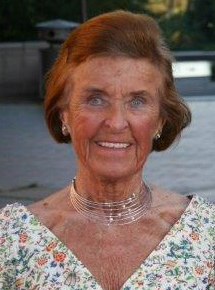
Wilma BradleyWilma Bradley, a longtime friend and generous supporter of UW CSE, has established a $1 million matching fund aimed at promoting alumni giving toward construction of a second computer science building on the UW campus. The new fund will match, dollar for dollar, multi-year pledges by recent alumni that total between $5,000 and $50,000 — enabling young alumni to double (or more, if a corporate match is applied) the impact of their personal gifts to CSE2.

For more than 20 years, Bradley has been passionate about expanding educational opportunities to more students at UW CSE. In that time, she has maintained close ties to the program and created an endowed fellowship and an endowed chair. Now, she is keen to support CSE2 while demonstrating the power of philanthropy by encouraging a new generation to become active partners in their alma mater’s future growth.

The Wilma Bradley Matching Challenge is open to UW CSE alums who received their bachelor’s degrees between 2006 and 2016. The match will be applied to pledges received by June 30, 2017 or until the fund is depleted, whichever comes first. To date, nearly $130,000 in donations from CSE alums have been matched through Bradley’s generosity. Learn more about this exciting new opportunity to support CSE’s expansion here.

Thank you, Wilma, for your generous support of our program and our students. You are an inspiration! Read more →

UW CSE’s Tom Anderson, James Fogarty and Dan Ports win Google Faculty Research Awards

Tom Anderson

Tom Anderson

UW CSE professors Tom Anderson, James Fogarty, and Dan R. K. Ports have been selected to receive Google Faculty Research Awards, a competition designed to support world-class faculty conducting cutting-edge research that advances core and emerging areas of computer science.

Anderson, who earned an award in the networking category, focuses on the construction of robust, secure, and efficient computer systems. His recent work concerns the development of next-generation peer-to-peer systems and approaches to dramatically improve internet availability and denial-of-service resilience.

Fogarty received an award in the human-computer interaction category. His research focuses on developing, deploying, and evaluating new approaches to address human obstacles hindering widespread adoption of ubiquitous sensing and intelligent computing technologies. Anat Caspi, director of UW CSE’s Taskar Center for Accessible Technology, is a co-principal investigator on the award.

Anat Caspi

Anat Caspi

James Fogarty

James Fogarty

Ports, who received an award in the systems category, focuses on building distributed systems for modern data-center-scale applications that are faster, more reliable, easier to program, and more secure.

Six members of the extended UW CSE family also earned awards: Ph.D. alums Jon Froehlich (University of Maryland College Park, physical interfaces and immersive experiences), Martha Kim (Columbia University, systems), Karen Liu (Georgia Institute of Technology, other), Adrian Sampson (Cornell University, other), and Michael Swift (University of Wisconsin – Madison, systems), and former postdoc David Choffnes (Northeastern University, networking).

Dan R. K. Ports

Dan R. K. Ports

Google received 876 submissions from researchers at more than 300 universities in 44 countries in response to its call for proposals. The company selected 143 projects to receive funding.

Learn more about the awards here, and read the full list of recipients here.

Way to go, team CSE — and thanks to Google for supporting outstanding faculty research! Read more →

UW CSE professor Ali Farhadi and Ph.D. alum Jon Froehlich win Sloan Research Fellowships

Ali Farhadi

Ali Farhadi

UW CSE professor Ali Farhadi and Ph.D. alum Jon Froehlich have been recognized with 2017 Sloan Research Fellowships. The fellowships are granted by the Alfred P. Sloan Foundation to support outstanding early-career researchers who represent the next generation of scientific leaders. Fellows are nominated by their peers and selected to receive one of these prestigious awards by an independent panel of senior scholars based on their demonstrated potential to make significant contributions in their respective fields.

“The Sloan Research Fellows are the rising stars of the academic community,” said foundation president Paul L. Joskow in a press release. “Through their achievements and ambition, these young scholars are transforming their fields and opening up entirely new research horizons. We are proud to support them at this crucial stage of their careers.”

Farhadi and Froehlich are among only 16 researchers recognized in the computer science category — and only 126 recipients in all, representing 60 colleges and universities and eight different fields: chemistry, computer science, computational and evolutionary molecular biology, economics, mathematics, neuroscience, ocean sciences, and physics.

Farhadi’s research focuses on artificial intelligence, computer vision, machine learning, and natural language processing. He is particularly interested in enabling computers to perform visual tasks that humans can do seamlessly, such as intuiting why an “abnormal” image looks strange or understanding the actions and behaviors in a scene. In addition to his role on the UW CSE faculty, Farhadi is the senior research manager for the Computer Vision Group at the Allen Institute for Artificial Intelligence. There, he leads Project Plato, which aims to advance visual knowledge extraction and reasoning and go beyond standard image classification and object recognition to achieve visual “common sense.”

Jon Froehlich

Jon Froehlich

Froehlich is on the faculty of University of Maryland-College Park. His research focuses on human-computer interaction with an emphasis on interactive technologies that address social issues such as accessibility, environmental sustainability, and personalized health and wellness. He completed his Ph.D. in 2011 working with UW CSE professor James Landay and CSE and Electrical Engineering professor Shwetak Patel. His dissertation, “Sensing and Feedback of Everyday Activities to Promote Environmentally Sustainable Behaviors,” earned him CSE’s William Chan Memorial Dissertation Award as well as the UW Graduate School Distinguished Dissertation Award.

Farhadi is the 22nd current UW CSE faculty member to have earned a Sloan Fellowship, joining recent winners Emina Torlak (2016) and Emily Fox, Shyam Gollakota, and Thomas Rothvoss (2015). In addition to Farhadi, two other members of the UW faculty — Emily Levesque in astronomy and John Tuthill of physiology and biophysics — were named fellows in 2017.

Read the Sloan Foundation press release here and the UW News release here. Check out the full list of 2017 fellows here.

Congratulations, Ali and Jon! Read more →

UW CSE establishes the Guestrin Endowed Professorship in Artificial Intelligence and Machine Learning

Carlos Guestrin in the Allen CenterUW CSE announced today the creation of the Guestrin Endowed Professorship in Artificial Intelligence and Machine Learning to support efforts to recruit and retain outstanding faculty in these leading-edge areas of the field. The $1 million endowment, which is named after CSE professor and machine learning expert Carlos Guestrin, was made possible by Apple’s acquisition of CSE spin-out Turi last year.

Guestrin has been a member of the UW CSE since 2012, when he was named the Amazon Professor of Machine Learning. He later founded Turi to commercialize large-scale machine learning tools he developed as part of his open-source research project, GraphLab. When Apple acquired Turi in 2016, it appointed Guestrin as its new director of machine learning. In this role, he will help the Cupertino, California-based company to establish a new hub for its artificial intelligence and machine learning research in Seattle and strengthen its ties with UW.

“Seattle and UW are near and dear to my heart, and it was incredibly important to me and our team that we continue supporting this world-class institution and the amazing talent coming out of the CSE program,” Guestrin told UW News. “We look forward to strong collaboration between Apple, CSE and the broader AI and machine learning community for many years to come.”

Read the UW News release here, and coverage by Geekwire, The Seattle TimesCNBC, and The Verge. Also be sure to check out today’s GeekWire exclusive on Apple’s plans to expand its operations in Seattle.

This is terrific news for UW CSE, and terrific news for our region! Read more →

« Newer PostsOlder Posts »