UW CSE’s Melissa Galloway blazes her own trail, honoring the spirit of Grace Hopper

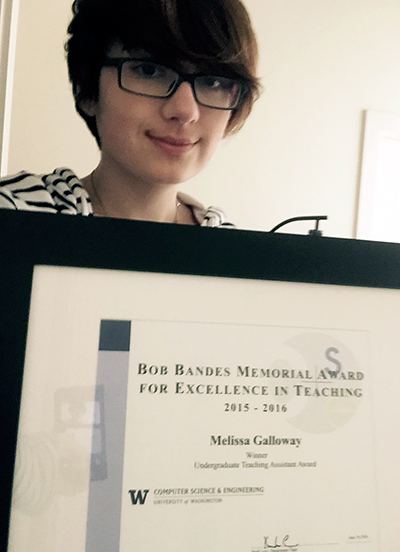
Melissa Galloway holding her teaching assistant awardThis fall, we launched a new feature, the CSE Undergrad Spotlight, to shine a light on the diverse ways in which our students are contributing to our campus and our community. For our second installment, CSE talked to Melissa Galloway, a senior from Vancouver, Washington who is pursuing a double degree in Computer Science and Human Centered Design & Engineering. Galloway has been involved in undergraduate research, working with professor Zach Tatlock in CSE’s Programming Languages & Software Engineering (PLSE) group, and was selected as a 2016-2017 Washington Research Foundation Fellow.

Galloway also dedicates her time to mentoring students as a Teaching Assistant for CSE’s popular introductory programming courses — a commitment which last spring earned her the Bob Bandes Memorial Award for Excellence in Teaching in recognition of her outstanding performance as a TA. This quarter, Galloway serves as the head TA for CSE 143 and as a TA for CSE’s Women in Computing Seminar. CSE caught up with Galloway just in time to mark the occasion of Grace Hopper’s birthday — a fitting tribute to someone who blazed a trail for women in computing, by one who is setting an example for a new generation.

CSE: How did you discover your passion for CSE?

MG: Similar to a surprising number of students in the department, I discovered computer science after arriving at UW. Entering college, I planned to pursue medical school, drawn to working in a fast-paced and challenging environment that presented new problems to solve every day. My particular interests were in diagnostics and genetic research. After taking my first CSE course, I realized that my interests in biology and medical school were much more strongly aligned with what an education in computer science could offer. As I have progressed through my CSE studies, I have found many connections to my earlier interests in biology, including the study of data structures and algorithms, compilers, parallel computing, and program optimization. I look forward to pursuing future research in computer science where I can combine CS with genomics and proteomics research, and potentially even integrate my interests in educational technology on a tool like FoldIt, which was developed here at UW.

CSE: What is your favorite thing about being a CSE student?

MG: It’s difficult to pick a “favorite,” but perhaps top of the list would be the variety of opportunities I have access to as a CSE student. Prior to joining the major, I participated in the CSE 14X program as a Teaching Assistant for CSE 143. Since becoming part of this community, I have discovered an unexpected passion for teaching and mentorship. I have found a number of opportunities to TA for different CSE courses and recently contribute more through head TA roles. This experience has introduced me to a community of similar-minded individuals who thrive on solving challenging problems and who also share a passion for introducing students to the field of computer science.

I have additionally found research in the department a unique experience that helps reinforce my understanding of what I learn in classes through real-world applications. It also allows me to expand my knowledge base in new topics in the field. I have had the chance to work on research in different sub-fields, including programming languages and computer science education, and I have found research to be a very fulfilling way to learn while contributing to real-world applications. The experience has led me to my present goal of continuing my CS education through a Masters and/or Ph.D. program, and to ultimately find a combined role in teaching and research at a similarly research-focused university.

CS: What made you decide to become a TA, and how has that helped you shape your long-term goals?

MG: I decided to pursue this opportunity because my transition from pre-med to computer science was inspired by the instructors and TA’s I had in CSE 14X and 154, and I wanted to similarly inspire others to study computer science or related fields. As a TA, I have the opportunity to help students discover how exciting and fulfilling CS can be as a course of study — and help them to realize the potential CS has in real-world applications. I strive to provide students the tools and knowledge to succeed in their coursework as well as start their own programming projects on the side to reinforce their understanding of the material in a way that is most interesting to them. I also hope to serve as a role model for fellow TA’s and students who are thinking of pursuing teaching roles in CSE.

Teaching gives me the opportunity to foster interest in the field among students regardless of their background or experience level. I find the “puzzle” of helping students understand material in different ways very rewarding. Since starting as a CSE 143 TA, I have continued TA-ing each quarter in different courses. This experience has influenced my current goal of pursuing computer science education. I have thoroughly enjoyed the many responsibilities I have had as a TA, including teaching a section, writing exam and section material, developing resources, providing individualized feedback on assignments, and inspiring other students to pursue CSE or related fields. Each quarter I teach I have found ways to contribute more to the course, and in my role as a head TA these past two quarters I have enjoyed learning more about the course curriculum and organization. Following my undergraduate education I plan to pursue a lecturer or professor role, which would enable me to have an even greater impact.

CSE: You attended the Grace Hopper Conference for women in computing as part of a delegation from CSE. What was that experience like?

MG: The Grace Hopper conference was an amazing opportunity — it showed me just how many women are involved in the tech field. While I had heard from past attendees that it would be an eye-opening experience to see so many female engineers at once, I was not prepared for the impact that it actually would have. At the conference, I discovered many opportunities for women to get more involved in diversity efforts as well as find roles at different tech companies. As a student pursuing research and academia, I found it very rewarding to see representation in these areas among the popular tech companies.

I have realized that there are relatively few women pursuing teaching or research in CS, and meeting female leaders in these roles helped reinforce my goals of pursuing graduate school. Reflecting back on the experience, I believe that the Grace Hopper Conference will be one of the most valuable experiences I will have as a CSE student. I highly recommend other female CSE students to apply for the conference next year!


Thanks to Melissa for being a great ambassador for CSE — and happy birthday, Grace Hopper! Read more →
Shwetak Patel named a Fellow of the Association for Computing Machinery

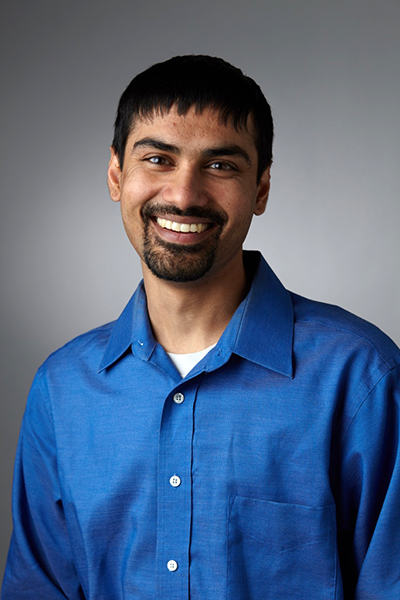
Shwetak PatelShwetak Patel, the Washington Research Foundation Entrepreneurship Endowed Professor in Computer Science & Engineering and Electrical Engineering at the University of Washington, today was named a Fellow of the Association for Computing Machinery, the world’s largest educational and scientific computing society. Patel is among 53 computer scientists from a dozen countries selected for recognition as a 2016 Fellow based on their outstanding contributions to the arts, sciences and practices of computing and impact on the broader community.

Selection as an ACM Fellow is one of the highest honors accorded to a computer scientist or computer engineer. Fellows are chosen by their peers and represent the top one percent of the ACM’s nearly 100,000-strong membership. Patel’s peers have chosen to recognize him at a relatively early point in his career for his “contributions to sustainability sensing, low-power wireless sensing and mobile health.”

“I’m humbled by this great honor,” said Patel. “Many of my mentors that I’ve looked up to throughout my career have been honored as ACM Fellows in the past, and it’s unreal for me to believe that I have been elected to that great group.”

Patel has directed UW CSE’s UbiComp Lab since he joined the University’s faculty in 2008. He first garnered attention in engineering and entrepreneurial circles for his work on low-power sensor systems for monitoring home energy and water usage at the appliance level, a line of research he initiated while a Ph.D. student at Georgia Tech. Patel started a company, Zensi, to commercialize this research after his arrival at the UW. When Belkin acquired Zensi in 2010, he became Belkin’s Chief Scientist — a role he still occupies today — and helped the company to establish its WeMo Labs in Seattle four years later. In 2012, Patel co-founded SNUPI, a UW spin-out focused on the development of a low-power, whole-home wireless sensing platform whose product, Wally Home, was later acquired by Sears.

As mobile phones increased in popularity — with sensing capabilities that were becoming increasingly sophisticated — Patel recognized an opportunity to repurpose a technology used for communication and entertainment into a life-saving medical tool. He and his students set about developing applications that make use of a phone’s built-in microphone, camera, and other features — features that enabled Patel’s team to turn a typical smartphone into a powerful yet portable medical device that could transform health care delivery in low-resource settings.

To date, Patel and his collaborators in the UbiComp Lab, UW Medicine and other partner organizations have introduced apps to detect newborn jaundice in vulnerable infants, measure lung function in patients living with chronic respiratory illness, screen for blood diseases such as anemia, monitor blood pressure, and more.

“I’ve had a long interest in the applications of computing to areas like health — in fact, I’m just flying back from a Computing Community Consortium workshop on smart health,” Patel said. “It’s great to see my students get excited about the possibility of having real world impact with their work.”

Patel is the 20th UW CSE faculty member to be named a Fellow of the ACM, but he is not the only newly-minted Fellow with a UW CSE connection: affiliate professors Tony Hey, Senior Data Science Fellow at the UW eScience Institute, and Radia Perlman, Dell EMC Fellow, are also among the Class of 2016. Hey was honored for his leadership in high-performance computing and data science, while Perlman was recognized for her many contributions to the theory and practice of internet routing and bridging protocols. Former UW CSE professor James Landay, now a member of the computer science faculty at Stanford University, also was selected, for his contributions in human-computer interaction, with a focus on user-interface design and ubiquitous computing.

Patel’s ACM Fellowship caps off a banner year in which he also collected the prestigious Presidential Early Career Award (PECASE) from U.S. President Barack Obama, received an Outstanding Collaborator Award from Microsoft Research, and earned international attention for his groundbreaking mobile health work. His courses in embedded systems, ubiquitous computing, and hardware often feature among the top-rated classes in the College of Engineering, based on student feedback. He is a past recipient of the NSF CAREER Award, TR-35 Award, Sloan Research Fellowship, and MacArthur “Genius” Award, and has graced the cover of Wired and Seattle Business magazines.

Shwetak is an exemplary teacher, researcher, and member of the CSE family. He continually wows us with his many achievements and contributions to CSE, to the University, and to communities around the globe.

Congratulations to Shwetak and to all of the newly-elected ACM Fellows!

Learn more about the ACM Fellows program here, and read the ACM press release here. Read more →

Enter The Matrix: UW researchers enable virtual reality interaction through direct brain stimulation

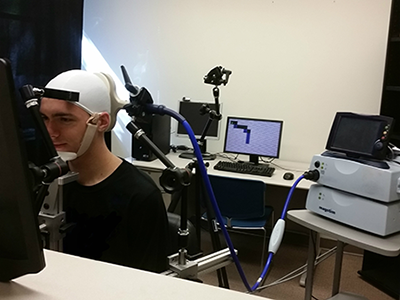
Research subject navigating a maze through direct brain stimulationWhen it comes to opening new frontiers in the world of virtual reality, it’s “game on” thanks to a team of researchers led by UW CSE professor Rajesh Rao, who also directs the National Science Foundation’s Center for Sensorimotor Neural Engineering. In a paper published in the online journal Frontiers in Robotics and AI, Rao and his colleagues describe their first-ever demonstration of a human playing a computer game using input from direct brain stimulation. Targeting specific areas of the brain to create a virtual reality may sound like a science fiction story straight out of Hollywood, but Rao and his team provided a real-world demonstration using a non-invasive method called transcranial magnetic stimulation.

In the computer game experiment, five subjects were asked to navigate a variety of computer mazes by responding to visual cues transmitted through a magnetic coil placed near their skulls. Players correctly interpreted the cues to make the correction directional move 92 percent of the time with direct brain stimulation, compared to 15 percent without it.

In a UW News release Rao explained, “The way virtual reality is done these days is through displays, headsets and goggles, but ultimately your brain is what creates your reality.”

“The fundamental question we wanted to answer was: Can the brain make use of artificial information that it’s never seen before that is delivered directly to the brain to navigate a virtual world or do useful tasks without other sensory input?” he said. “And the answer is yes.”

UW CSE and Neurobiology alum Darby Losey (B.S., ’16), now a staff researcher in the UW’s Institute for Learning & Brain Sciences (I-LABS), is lead author of the paper. “We’re essentially trying to give humans a sixth sense,” he said. “So much effort in this field of neural engineering has focused on decoding information from the brain. We’re interested in how you can encode information into the brain.”

UW Psychology professor and I-LABS research scientist Andrea Stocco and I-LABS research assistant Justin Abernethy worked with Rao and Losey on the project.

While the maze experiment involved navigating a two-dimensional world, using binary information delivered by technology that can’t leave the lab, researchers are looking ahead to the day that the bulky brain hardware gives way to a more portable solution. By placing a variety of sensors on a person’s body, more information about a person’s surroundings could be collected and transmitted to a person’s brain to help guide his/her actions — with applications that go beyond entertainment. Members of the team have started a company, Neubay, to help turn their ideas into reality.

“Over the long term, this could have profound implications for assisting people with sensory deficits while also paving the way for more realistic virtual reality experiences,” Rao said.

We think that’s pretty a-maze-ing.

Read the UW News release here and the journal article here. Also check out coverage in New Atlas, CNET, Futurism, and Digital Trends. Read more →

UW CSE student researchers shine at FSE 2016

PLSE logoUW CSE undergraduate and graduate students captured four of the six awards given out during the ACM Student Research Competition at the ACM SIGSOFT International Symposium on the Foundations of Software Engineering (FSE 2016) in Seattle last month. The students, all of whom who work with CSE professor Michael Ernst in our Programming Languages & Software Engineering (PLSE) group, captured first and third place in both the graduate and undergraduate student research categories.

Top honors in the undergraduate competition went to first-year CSE Ph.D. student Martin Kellogg for “Combining Bug Detection and Test Case Generation.” The paper, which is based on work Kellogg began while he was an undergraduate at University of Virginia, presents N-prog, a new tool for detecting software bugs. Automated bug-finding tools or test generators can waste developers’ time by producing false positives or using incorrect oracles. N-prog minimized this problem by combining the two approaches to find interesting, untested behavior while reducing wasted effort.

CSE undergraduate Christopher Mackie earned third place for “Preventing Signedness Errors in Numerical Computations in Java.” The paper presents a new verification tool, the Signedness Checker, which is built on a type system that segregates signed from unsigned integers. The system enables developers to detect errors regarding unsigned integers at compile time, thus avoiding such errors at run time.

In the graduate competition, CSE Ph.D. student Calvin Loncaric captured first place with “Cozy: Synthesizing Collection Data Structures.” Cozy is a novel tool for implementing new data structures using counter-example guided inductive synthesis as an alternative to the tedious and error-prone process of handwritten implementation. Loncaric and his colleagues evaluated Cozy’s synthesized implementations across four real-world programs to show that its performance can match that of handwritten implementations while avoiding human error.

Last but not least, CSE Ph.D. student Spencer Pearson placed third in the graduate competition for “Evaluation of Fault Localization Techniques.” The paper presents the results of a study evaluating the effectiveness of artificial faults for identifying the best real-world fault localization tools. Pearson demonstrated that a commonly-held assumption — that the best tools for localizing artificial faults will be best for localizing real-world faults — is false, thus turning the prevailing wisdom on its head. Based on these results, he and his colleagues developed a set of new fault localization techniques, several of which are shown to outperform existing techniques.

Read more about the winning projects in Ernst’s blog post here. Congratulations to all! Read more →

UW CSE joins the White House, Code.org in celebrating CS Education Week and promoting #CSforAll

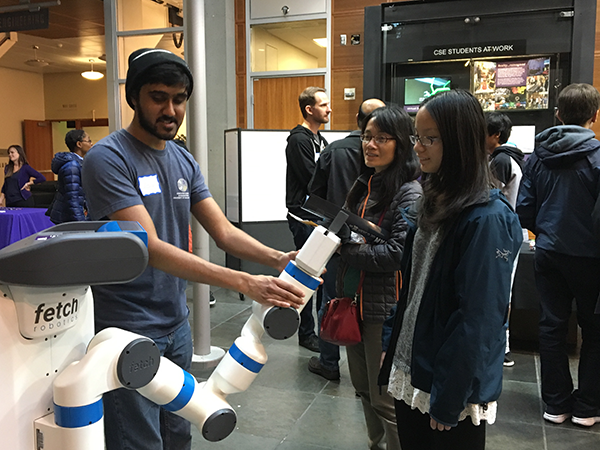
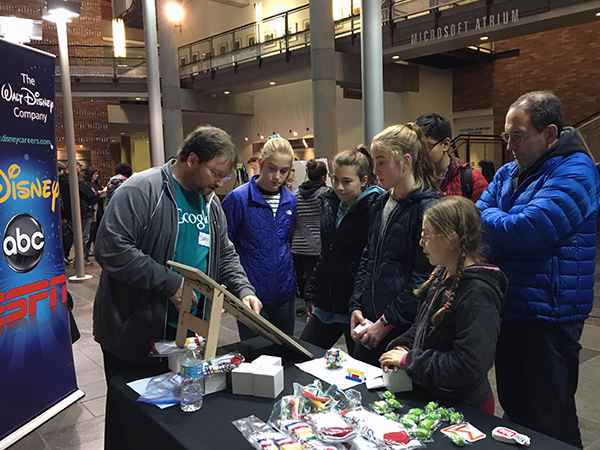
Students and robot at the 2016 Computing Open HouseIt’s the most wonderful time of the year: Computer Science Education Week, when we bring the joy of computing to people of all ages through community outreach, events and hands-on activities. Last year, we featured an Hour of Code with UW President Ana Mari Cauce; this year, we are joining the White House and organizations across the country in pursuing a variety of strategies to make computer science education available to all.

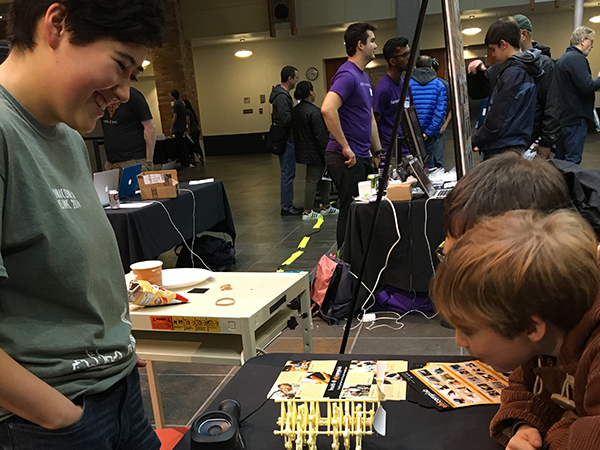
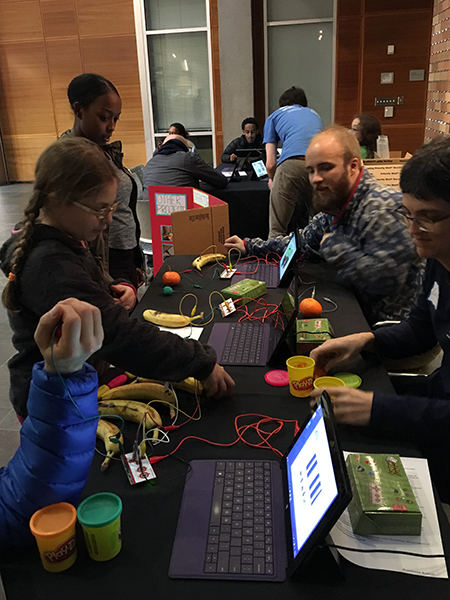
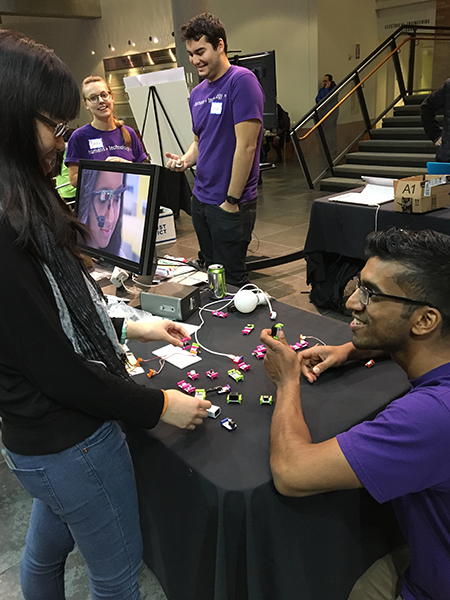
We kicked off the festivities with our annual Computing Open House on Saturday. More than 400 middle and high school students, parents and teachers descended upon the Paul G. Allen Center to explore computer science and computer engineering through interactive demos and lab tours arranged through our K-12 outreach program, DawgBytes. Participants also had the opportunity to learn about computing careers by talking with industry representatives about what they do and why they love doing it.

We are following that up today with several sessions of the Hour of Code organized by Code.org. First, the students in Principal Lecturer Stuart Reges’ introductory CS courses — and there are more than 1,000 students enrolled this quarter — invited friends and family who have never tried programming before to join them in Kane Hall to do the Hour of Code. Later, CSE student ambassadors will join representatives of Google at the Girls in Science Hour of Code event hosted by the UW’s Burke Museum to talk with the students about what it’s like to study and work in computer science.

These activities are part of a wider effort by UW CSE to amplify our outreach — particularly to diverse communities — to encourage participation in computer science and increase access for underrepresented students. For example, the aforementioned CSE Ambassadors program is an expansion of our old tour guide program. The new ambassadors, all current CSE majors, will play a more active role in our outreach efforts by designing and leading workshops and other activities on the UW campus and in K-12 classrooms around the state to encourage students of all backgrounds to pursue computer science.

We are also partnering with the Washington State Academic RedShirt (STARS) program through the UW College of Engineering to prepare more high-achieving students from low-income backgrounds to succeed in CSE. As part of that effort, we are developing a series of courses to complement our introductory programming classes, which will help STARS students hit the ground running as they begin to explore CSE. We are also working with the Washington State Opportunity Scholarship program to encourage more students of low- and middle-income backgrounds to apply to CSE through application workshops and other strategies.

Calling 2016 “a year of action in support of computer science,” the White House is highlighting our efforts — and many other initiatives around the nation — as part of its CS Education Week celebration.

Learn more about the great work being done to expand CS for all in the White House fact sheet here. Learn about the UW’s Girls in Science event here, and try the Hour of Code for yourself here. Check out photos from our Computing Open House below and on the DawgBytes Facebook page here.

Happy Computer Science Education Week to all!

Students try an interactive demo at the 2016 Computing Open HouseStudents try an interactive demo at the 2016 Computing Open House


A student tries an interactive demo at the 2016 Computing Open House

Industry representatives talked to students about computer science careers at the 2016 Computing Open House


  Read more →

UW researchers hit the right note with new machine learning tool for music

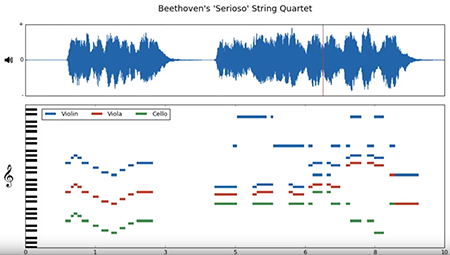
MusicNet demoA team of UW CSE and UW Statistics researchers have released MusicNet, a collection of 330 classical music recordings accompanied by more than one million annotated labels indicating the precise timing, instrument and position of every note. As the first large-scale public dataset of its kind, MusicNet could be music to the ears of machine learning researchers and composers alike.

From the UW News release:

“The composer Johann Sebastian Bach left behind an incomplete fugue upon his death, either as an unfinished work or perhaps as a puzzle for future composers to solve.

“A classical music dataset released Wednesday by University of Washington researchers — which enables machine learning algorithms to learn the features of classical music from scratch — raises the likelihood that a computer could expertly finish the job.

“MusicNet is…designed to allow machine learning researchers and algorithms to tackle a wide range of open challenges — from note prediction to automated music transcription to offering listening recommendations based on the structure of a song a person likes, instead of relying on generic tags or what other customers have purchased.”

The researchers who orchestrated this novel tool — CSE Ph.D. student Jonathan Thickstun, CSE and Statistics professor Sham Kakade, and Statistics professor Zaid Harchaoui — hope that MusicNet will do for music-related machine learning what ImageNet did for computer vision.

“An enormous amount of the excitement around artificial intelligence in the last five years has been driven by supervised learning with really big datasets, but it hasn’t been obvious how to label music,” Thickstun said.

To create MusicNet, the researchers had to be able to track what instruments were playing what notes down to the millisecond. They employed a technique called dynamic time warping, which enabled them to synch real performances to synthesized files containing musical notations and digital scoring of the same pieces of music. They then mapped the digital scoring onto the original performances — turning 34 hours of chamber music into a tool for supervising and evaluating machine learning methods.

“At a high level, we’re interested in what makes music appealing to the ears, how we can better understand composition, or the essence of what makes Bach sound like Bach,” said Kakade. “No one’s really been able to extract the properties of music in this way…We hope MusicNet can spur creativity and practical advances in the fields of machine learning and music composition in many ways.”

Read the full news release here, and visit the MusicNet project page to learn more.

Read more →

Cybercrime-fighters of Batman’s Kitchen cook up a 3rd place finish at CSAW ’16

CSAW '16 Capture the Flag badgeLast week, a team of UW undergraduates known as Batman’s Kitchen became cybersecurity superheroes when they earned third place at the U.S. finals of Capture the Flag at Cyber Security Awareness Week (CSAW ’16). The CSAW CTF competition, which was hosted by New York University’s Tanton School of Engineering, featured 15 teams battling it out in response to a series of computer security challenges inspired by real-world scenarios that tested their cybercrime-fighting mettle. The New York competition was one of three held simultaneously around the world in what is billed as the largest student-run cybersecurity contest.

The competition, which spanned 36 hours, began Thursday night and ran uninterrupted until late afternoon on Saturday. The grueling schedule meant team members had to take turns sleeping in shifts.

Was it worth it? UW CSE student Alex Kirchhoff, who traveled to Brooklyn to compete as a member of Batman’s Kitchen, says yes.

“CSAW gives us the opportunity to practice computer security skills, meet students from other universities with similar interests, and connect with companies in the field,” he said.

That sentiment was echoed by Kirchhoff’s team mates, including fellow CSE major Bo Wang, Physics major Stanley Hsieh, and Atmospheric Sciences major Dan Arens.

“Competing with the best undergraduate teams around the U.S. and Canada is really fun and rewarding,” said Hsieh. Arens was similarly enthusiastic, complimenting the “great teams, challenges, and sponsors” involved in the competition.

After an action-packed weekend of battling cyber-villains, the students are back in classes this week. Three members of the team that went to New York barely have time to reflect on their success before gearing up for their next competition in just a few short days — this time, traveling to Japan.

“I was surprised by how well we did,” said Wang. “Now, I’m hoping for the best for Trend Micro finals this week.”

Wang, Kirchhoff and Hsieh will be joined by pre-engineering student Grayson Sinclair at the Trend Micro CTF competition in Tokyo. The talented members of Batman’s Kitchen are making a habit out of not only representing the UW, but the entire country in these elite cybersecurity competitions.

“This year, Batman’s Kitchen is going global,” said Melody Kadenko, CSE research program director and adviser to Batman’s Kitchen. “We were the only team from a U.S. university to compete at the VolgaCTF finals in Russia earlier this fall, and we will be the only U.S.-based team competing in Japan.”

Batman’s Kitchen is growing in size as well as international visibility. Around 700 current and former students, drawn from the three UW campuses, are involved in meetings and activities. Kadenko selects members to represent Batman’s Kitchen in various competitions from a pool of core CTF enthusiasts who have developed skills in cryptography, forensics, web security and reverse engineering. Going into CSAW, the team ranked 34th out of nearly 11,000 CTF teams worldwide.

Read more about the results of the CSAW CTF here.

Way to go, team — and good luck in Japan! Read more →

UW CSE earns yet another Best Paper Award at OSDI

osdi-16-logoUW CSE continued our winning ways this week with a Best Paper Award at the 12th USENIX Symposium on Operating Systems Design and Implementation (OSDI ’16). The winning paper, Push-Button Verification of File Systems via Crash Refinement, was co-authored by a team of researchers from UW CSE’s Computer Systems Lab and Programming Languages & Software Engineering (PLSE) group that includes Ph.D. students Helgi Sigurbjarnarson and James Bornholt, and professors Emina Torlak and Xi Wang.

The paper presents Yggdrasil, an efficient and practical new toolkit that will enable programmers to build reliable storage applications using push-button verification. The toolkit requires no manual annotations or proofs about the implementation code. To define file system correctness, Yggdrasil uses crash refinement, which is amenable to fully automated reasoning with satisfiability modulo theories (SMT) solvers. Yggdrasil offers several techniques to scale up automated verification, including a stack of abstractions and separation of data representations, so that developers can implement file systems in a modular way for verification. Yggdrasil also generates a concrete test case (a counterexample) in instances where it finds a bug in the file system implementation or its consistency invariants.

The team’s Best Paper Award is one of three given out at this year’s conference, which is taking place this week in Savannah, Georgia. It is not the only one with a UW CSE connection: former postdoc Simon Peter, now on the faculty of the University of Texas at Austin, co-authored one of the other winning papers, Ryoan: A Distributed Sandbox for Untrusted Computation on Secret Data.

With this latest win, UW CSE has completed the trifecta of top systems and networking conferences this year, having also earned Best Paper accolades at NSDI and SIGCOMM.

Go team! Read more →

Seattle Business explores the region’s – and UW CSE’s – emergence as a high-tech magnet

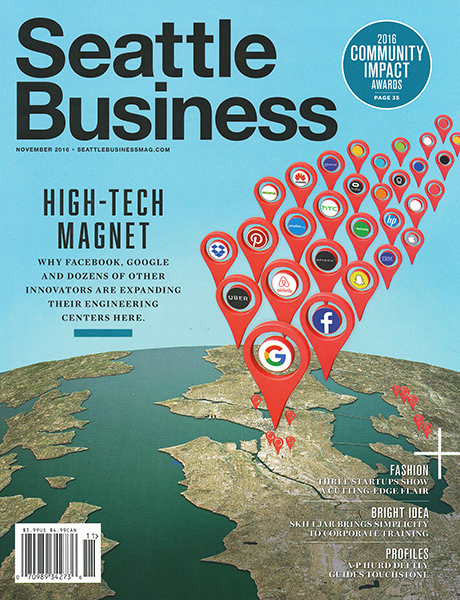
November 2016 cover of Seattle Business magazineFor its November cover article, Seattle Business magazine examines the factors that contribute to our region’s growing attractiveness to tech companies looking to expand or open new engineering operations outside of their hometowns. The list of firms who have put down roots in and around the Emerald City is a who’s who of fast-growing firms, multi-national powerhouses, and household names, including Airbnb, Alibaba, Facebook, Google, Magic Leap, Pinterest, Snapchat, and Uber. In some cases, the newcomers’ local workforce has grown to hundreds or even thousands of employees — with space for even more.

From the article:

“Eighty satellite offices may not seem like many, given that there are some 12,000 tech firms in Washington state. But the number of branches has grown dramatically in recent years, and they tend to include the world’s most successful companies with astonishingly rapid growth trajectories. More than half of the engineering centers have been established since 2014, according to GeekWire…While they typically start small, many have grown quickly and now play strategic roles for such global giants as Google and Facebook.

“The Seattle tech community, once described as Snow White and the Seven Dwarfs because of the overwhelming presence of Microsoft, has gradually become more diversified with the emergence of Amazon and numerous midsize companies like Tableau Software and F5 Networks. The new engineering centers add yet another important source of growth and variety.”

How to explain this astonishing growth? The magazine surveyed economic development, research and industry leaders on what makes our region so enticing. Quality of life (particularly if you like the great outdoors), inexpensive office space, a lower cost of living than the Bay Area — all of these may factor into a company’s decision to open an outpost here.

But the key ingredient in Seattle’s secret sauce, which comes up again and again, is talent — lots of it, according to the article:

“‘We have more software engineers than any city per capita in the nation,’ says Suzanne Dale Estey, CEO of the Economic Development Council of Seattle & King County.

“And even though Silicon Valley is by far the leader in venture capital funding, WTIA CEO Michael Schutzler says, ‘For actual engineering talent, for software development, this is the center of the universe.’

“Yet it’s not just about quantity. University of Washington Computer Science & Engineering Professor Ed Lazowska points out that Seattle area engineers are in the vanguard in a broad range of sectors, from cloud computing and e-commerce to online gaming and virtual reality.

“‘We are, honestly, in a different league,’ says Lazowska. ‘It’s Silicon Valley and Seattle. New York has an extremely vibrant startup culture, but it is much less of a magnet for engineering offices.'”

The article notes that UW CSE has played its part in drawing companies from outside of the region. For example, the magazine recalls the story of then-UW CSE professor Brian Bershad opening Google’s first Seattle office. It also cites the influence of CSE and Electrical Engineering professor Shwetak Patel, whose work on low-power sensing for water and energy monitoring led Belkin International to establish WeMo Labs.

Read the full article here. Read more →

UW CSE’s Ed Lazowska named to Seattle magazine’s 50th anniversary Hall of Fame

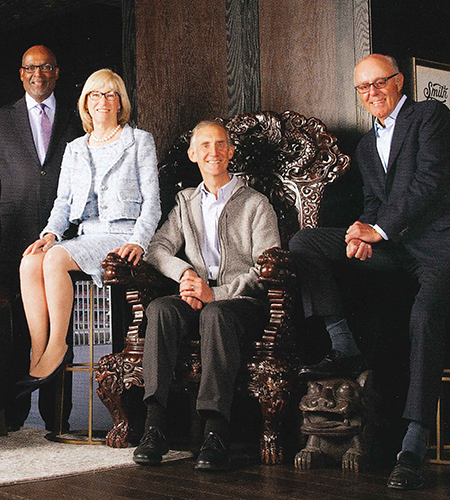
Norm Rice, Patricia Kuhl, Ed Lazowska, Jeff Brotman

UW CSE’s Ed Lazowska (center) with fellow hall of famers (left to right) former Seattle mayor Norm Rice, UW I-LABS co-director Patricia Kuhl, and Costco founder Jeff Brotman. Credit: Hayley Young

“Every city possesses its own, unique spirit — its zeitgeist. It’s what makes a metropolis move, defines its identity and propels it forward. We owe much of ours to our city’s shapers — those leaders, trendsetters and trailblazers who, over the past 50 years, have transformed the town in extraordinary ways…

“The people on these pages — living legends who have made a major contribution during the past five decades — are influential in their own right, but are also just a representative cross section of the many talented visionaries, big thinkers and risk-takers who have shaped our city into the remarkable place it is.”

With that, Seattle magazine introduced its list of the most influential Seattleites of the past 50 years in art, philanthropy, social justice, technology, and more. On that list of movers and shakers who have helped to define our city, which the magazine compiled to mark its 5oth anniversary, is UW CSE’s very own Ed Lazowska. He earns his place in the magazine’s Hall of Fame in the Technology and Business category based on his many contributions as an educator, researcher, volunteer, and advocate.

“His research and teaching of high-performance computing and communications systems, and his service on countless advisory councils and boards helped shape Seattle’s high-tech economy and influence the future of information technology,” noted the magazine.

Lazowska joins Paul Allen, Jeff Bezos, the Gates Family, Madrona Venture Group’s Tom Alberg, personalized medicine pioneer Lee Hood, and others credited with helping to transform Seattle into the vibrant center of innovation and economic dynamism that it is today. The magazine is planning a celebration of these luminaries and the city’s past, present and future on November 17 — find event information here.

Lazowska’s inclusion in Seattle magazine’s Hall of Fame is only the latest accolade inspired by his tireless commitment to our department, our university and our region. Last month, Seattle Business magazine named him its 2016 Tech Impact Champion for his achievements and advocacy on behalf of the local tech community.

Congratulations, Ed! Read more →

« Newer PostsOlder Posts »