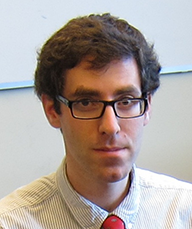
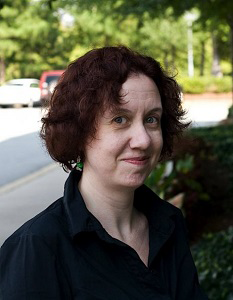
Nova Barlow of UW CSE’s Center for Game Science delivers straight talk on community management at GDC

Nova Barlow

Photo credit: J. Hayter

Next week, tens of thousands of interactive game industry professionals will converge on San Francisco for the annual Game Developers Conference® (GDC) – the world’s largest and longest-running event of its kind – for five days of lectures, roundtable discussions, tutorials, and celebrations of all things game-related. Among them will be Nova Barlow, community manager at UW CSE’s Center for Game Science, who is leading a panel of industry veterans in some straight talk about community management.

Noting that “community management is no longer a quiet job behind the scenes,” the organizers are staging the first-ever Community Management Summit and devoting an entire day to this aspect of the game industry. Nova’s panel will discuss the history and challenges of community management and identify ways to transition this increasingly popular role from stepping-stone job to viable career path.

“I was encouraged by my co-workers at the Center for Game Science to submit the idea for the panel – a topic I’ve been kicking about in my own head for a while – to the GDC organizers,” said Nova. “I’m looking forward to contributing to the conference and being able to draw upon the experience of my fellow panelists.”

The Game Developers Conference® is March 2-6.

Learn more about Nova’s GDC session here.

Check out the latest news from the Center for Game Science here. Read more →
UW CSE: Reaching more students than ever and expanding opportunities for women in computer science

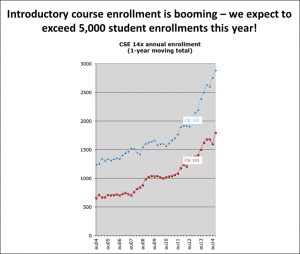
14x growth in introductory course enrollment at UW CSEHere at UW CSE, we are experiencing record interest in our undergraduate major and record enrollments in our introductory courses. This explosion of interest is happening across the country, but UW is doing particularly well among a key demographic underrepresented in the field: women.

When principal lecturer Stuart Reges attended a recent meeting organized by the National Center for Women & Information Technology, he talked about the tremendous growth of student interest in computer science. He shared UW CSE’s enrollment data to illustrate his point: around 2,800 students per year enroll in our first intro course – representing nearly half of the freshman class – and around 1,800 students per year in our second course. These two courses alone account for about 1.6 percent of all undergraduate student units taught on UW’s Seattle campus.

Building on what is already a good-news story, UW CSE is also seeing record percentages of women taking our introductory courses and pursuing our undergraduate major. The 2013-14 Taulbee Survey found that, nationally, less than 15 percent of undergraduate computer science degrees were granted to women.  At the UW, 30% of bachelors degrees in the most recent year were granted to women. And we expect this trend to continue: In our first intro course (CSE142), the class is currently 35% women.

A key element of our success has been our undergraduate TA program. CSE has 83 undergraduate TAs helping us to teach the 1,800 students currently enrolled currently in CSE142. Thirty-nine of those TAs are women; at 47 percent, this is the highest concentration of women we have seen in the last 10 years. Seeing young women a year ahead thriving in the field provides the best possible encouragement!

There is more work to be done, but we are proud of the way our commitment to diversity in computer science is helping us to lead the nation in engaging more women in the field!

View our video about the explosive growth in student participation in CSE’s intro courses here.

Learn more about the steps UW CSE is taking to broaden participation in the field here. Read more →

UW CSE alum Ben Hindman offers advice on career and life as part of Leadership Seminar Series

Ben Hindman at the UW CSE Leadership Seminar SeriesToday, UW CSE alum Ben Hindman (B.S. ’07), co-founder of data center operating system startup Mesosphere, offered current CSE undergrads advice on what to do when your path diverges from your plan, as part of our Leadership Seminar Series.

Among Ben’s top tips for students approaching life after CSE: “always be learning” (great advice regardless of what one does after graduation), and “love your co-workers” (emphasizing the importance of picking one’s partners, employees and investors carefully).

Ben’s first stop after earning his undergraduate degree at UW CSE was a brief stint at Google, followed by graduate school at UC Berkeley, where he co-created the Mesos data center kernel as an open source project. Twitter was among the companies that adopted Mesos to better manage resources in running their data center applications, enticing Ben away from academia in the process. Upon leaving Twitter three years later, instead of resuming his studies, Ben decided to go the entrepreneurial route by starting Mesosphere – a venture-backed company that recently surpassed 50 employees.

Ben was generous with his advice and candid about what daily life is like as a start-up executive. When asked about fundraising, Ben urged budding entrepreneurs to make sure they can articulate a compelling story about where the company came from and where it is going, calling it “the most important part of the pitch deck.” He also noted that team can trump technology, and both culture and communication are critical for building a successful company.

Ben closed by noting that in both life and business, there is only a handful of truly important decisions that one has to make along the way. “Figure out those questions,” he said, “and you will know what to focus on.”

Read our previous post on Ben here. Read more →

New poll reveals Washington citizens’ overwhelming support for greater investment in computer science education

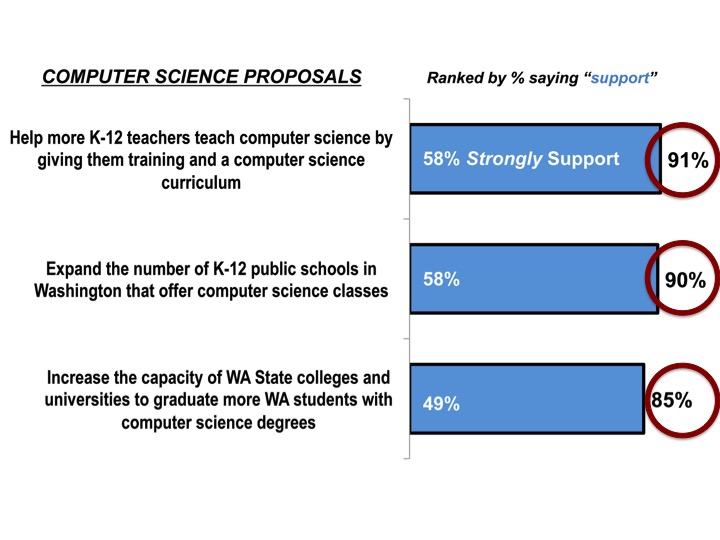
Slide1Washington STEM, an organization that supports improved STEM education for our state’s students “from cradle to career,” recently announced the results of a poll showing overwhelming support among Washington’s citizens for improved access to computer science education at the K-12 and post-secondary levels.

Among the highlights:

  • 85 percent support increasing computer science degree capacity at Washington’s public higher education institutions.
  • 90 percent support expanding the number of public K-12 schools in Washington that offer computer science classes.
  • 91 percent support training more of our state’s K-12 teachers in computer science.

The poll, which surveyed 647 registered Washington voters, was conducted by Strategies 360, and covered all aspects of STEM education. In this context, the overwhelming support for investment in computer science education was particularly gratifying!

Learn more about the poll results and Washington STEM’s support for computer science education here. Check out a slideshow on the full results of the survey here.

Read previous blog posts on the effort to improve computer science education at the K-12 level – H.B. 1813, sponsored by State Representatives Drew Hansen and Chad Magendanz – here and here.

Learn more about employer and student demand for computer science degrees, from CSE department chair Hank Levy’s testimony before the Washington State Legislature earlier this year, here. Read more →

Live outside of your comfort zone: UW CSE alum Mohamed El-Zohairy shares lessons learned as a student, an entrepreneur and an activist

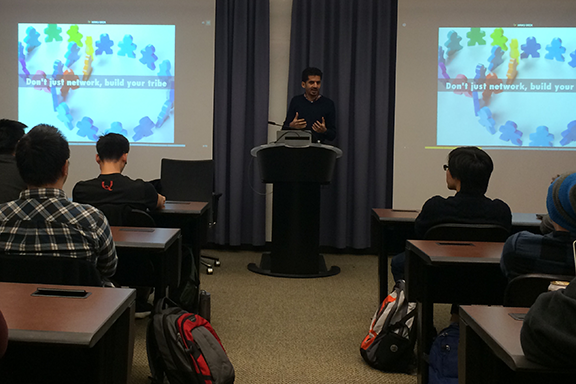
Mohamed El-Zohairy at UW CSEUW CSE alumni may be revolutionary in technology terms, but Mohamed El-Zohairy (BS, ’07) took it to a new level when he joined the political revolution in his home nation of Egypt. Yesterday, Mohamed returned to the Allen Center to share his experiences with a group of undergraduates as part of CSE’s Leadership Seminar Series.

Mohamed opened his talk by urging students to “live outside of your comfort zone” – words he certainly lived by during his unconventional journey from high school student in Egypt captivated by UW CSE’s robotic soccer dogs, to UW CSE graduate, startup founder, and director of product engineering at News Corp.

Mohamed was in graduate school at the University of British Columbia when the protests against the government of President Hosni Mubarak began in early 2011. He took a leave of absence from his studies to join his compatriots in Tahrir Square – but not before reaching out to TechCrunch to alert the Western media about the Internet blackout instigated by Egypt’s government in response to the protests.

After the revolution, Mohamed remained in Egypt, where he was joined by fellow UW CSE alums Allen Chen and Bobby Mathews in building the content creation platform CloudPress. One year later, News Corp. acquired CloudPress – and with it, the team. Mohamed then departed Egypt for New York to join News Corp. to help build the company’s mobile publishing platform.

Even with all he has experienced after CSE, Mohamed made sure to share practical advice to help students make the most of their time in the department. Among his pearls of wisdom: “If you procrastinate, do it right!” and, “Know your most productive time of day.” And, drawing from his entrepreneurial heritage, he urged them to not be afraid of failing, because “failing doesn’t make you a failure.”

Read the TechCrunch article on the Egyptian revolution and Mohamed’s role in bringing the government’s Internet shutdown to the attention of the media here.

Read about News Corp.’s acquisition of CloudPress on TechCrunch here and on GeekWire here.

See Mohamed’s presentation slides – great advice for students – here. Read more →

Making math addictive: UW CSE’s Zoran Popovic featured in Crosscut

Zoran PopovicZoran Popovic, director of UW CSE’s Center for Game Science, is featured in a recent Crosscut article about Enlearn, software developed by the non-profit of the same name that is designed to provide a more personalized, adaptive learning experience to students.

Zoran is founder and chief scientist at Enlearn, where he put his experience developing the Center for Game Science’s wildly popular protein folding game, FoldIt, to good use in tackling another massive challenge: improving K-12 math education.

From the article:

” ‘Enlearn very much evolved out of Foldit. That’s where I realized there could be completely alternative pathways to learning,’ says Popovic. Enlearn is designed to capture the entire gamut by being responsive to each student, and hitting the sweet spot of addictive entertainment normally reserved for triple-A Xbox titles.”

Zoran and his team have set a goal to “achieve mastery by 95 percent of the kids in any classroom, with any teacher, in any school.”

Read the Crosscut article here.

Learn more about Enlearn here.

  Read more →

Transforming Washington’s Industries Through Big Data: A day-long event co-presented by the Technology Alliance and UW CSE

Ed LazowskaUW CSE’s Ed Lazowska and Carlos Guestrin will be featured speakers at an event next month that will examine the impact of big data in Washington State. “Insight to Impact: Transforming Washington’s Industries Through Big Data” will provide a comprehensive look at ground-breaking developments in big data and explore how this rapidly growing field will shape Washington’s industries and economy.

Ed, the Bill & Melinda Gates Chair in Computer Science & Engineering at UW CSE, will provide the audience with a comprehensive overview of the big data opportunity for Washington – examining our current assets and a looking ahead to what big data might enable in the future.

Carlos GuestrinCarlos, the Amazon Professor of Machine Learning at UW CSE and co-founder and CEO of big data startup Dato (formerly known as GraphLab), will participate in a panel discussion alongside Bloomberg News correspondent Dina Bass; Joseph Sirosh, Corporate Vice President of Machine Learning at Microsoft; and Madrona Venture Group’s Matt McIlwain.

In addition, the event will feature a keynote address by Inrix CEO Bryan Mistele and a showcase of big data-driven innovations and companies that are helping to transform health care, government, retail and other industries.

Big-Data-Event“Insight to Impact,” which is co-presented by the Technology Alliance, will take place on Tuesday, March 3rd, 7:30 am to 6:00 pm at the Renaissance Seattle Hotel. An early-bird registration rate is available until February 20th. Find more information and register to attend here. Read more →

Watch UW CSE and DARPA hack a car driven by 60 Minutes’ Lesley Stahl

Car hacking demonstration on 60 MinutesLook, Ma! No brakes!

Last night, 60 Minutes broadcast a segment called “DARPA Dan” in which Dan Kaufman, head of the agency’s Information Innovation Office, described the various ways DARPA is supporting research on cybersecurity and the Internet of Things. In one of the more dramatic demonstrations during the broadcast, Dan and UW CSE alum Karl Koscher hack into a car driven by 60 Minutes correspondent Lesley Stahl (with DARPA PM Kathleen Fisher riding shotgun). View the segment here – the car hacking demo begins at minute 6:40, and Yoshi and his team appear at 9:37.

The broadcast foreshadowed today’s release of a report by Senator Edward Markey (D-Mass.) on car hacking. Some of the media coverage refers to the 60 Minutes demonstration, which took place on the UW campus and was based on the work of UW CSE’s Yoshi Kohno and his students, in collaboration with colleagues at the University of California, San Diego.

Read more about today’s coverage here, here, and here, and delve into the history of UW and UCSD’s car hacking research, courtesy of The New York Timeshere and here.

Read our previous blog post on this topic here.

Photo: CBS News Read more →

Catch 60 Minutes this Sunday to see UW CSE cybersecurity research in action!

60 Minutes UW car hacking demoGet a sneak peek at this Sunday’s 60 Minutes episode in which UW CSE researchers hack into a car driven by Leslie Stahl, part of a segment examining cybersecurity threats and the Internet of Things. (See photos of the set-up taken by UW CSE’s Yoshi Kohno at right.)

During the segment featured in the CBS preview, the head of DARPA’s Information Innovation Office, Dan Kaufman, DARPA Program Manager Kathleen Fisher, and UW Ph.D. alum Karl Koscher demonstrate how hackers can control various functions of a motor vehicle. The demo is based on research conducted by a team from UW CSE (Yoshi KohnoAlexei Czeskis, Karl Koscher and Franzi Roesner) and colleagues at the University of California, San Diego.

60 Minutes UW car hacking demo set-upGet a sneak peek at the 60 Minutes episode in the CBS preview here – the preview is all UW CSE, all the time!

Read more about the automotive security collaboration between UW CSE and UCSD here.

Tune into your local CBS affiliate Sunday, February 8th at 7:00 pm to catch the full segment! Read more →

Join UW CSE’s Center for Game Science at Meet an Engineer Night

Aaron BauerAaron BauerCenter for Game Science, a PhD student at UW CSE’s Center for Game Science, will participate in Meet an Engineer Night on February 26th. The event is part of a month-long program of activities organized by the Seattle Public Library and Pacific Science Center as an extended celebration of National Engineers Week.

Meet an Engineer Night aims to introduce teens to engineering as a career. While the target audience is age 12 and above, everyone is welcome to attend and learn about the exciting field of engineering at Seattle Public Library’s northeast branch from 6:30 to 7:30 pm.

Learn more about this and other events organized as part of Engineer Month, which begins this Saturday, here. Read more →

« Newer PostsOlder Posts »